
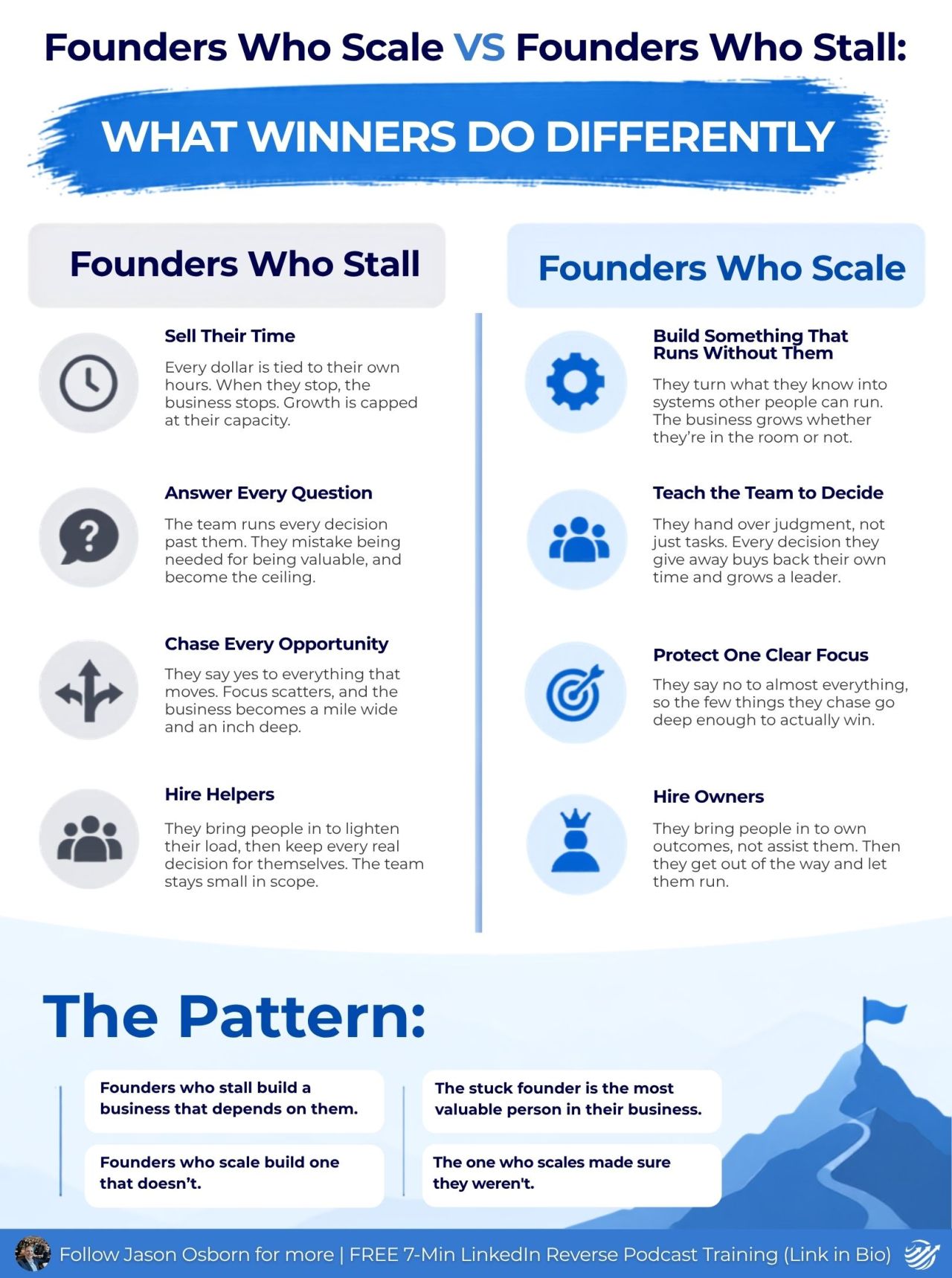
In a recent LinkedIn post, Jason Osborn delves into the critical differences between founders who successfully scale their businesses and those who find themselves stalled. Osborn argues that the core distinction lies not in talent or market conditions, but in the fundamental structure the founder builds.
He begins by identifying a common pitfall: the founder who becomes indispensable to every facet of the business. This, Osborn contends, creates a “ceiling” rather than fostering growth.
“Most founders build a business that needs them everywhere. Every decision. Every sale. Every problem that needs solving. It feels like leadership. It’s actually a ceiling.”
The “Stuck Founder” Creates a Job, Not a Business
Osborn characterizes founders who stall as those who essentially sell their time. In this model, the business’s revenue is directly tied to the founder’s hours worked; when the founder stops, the business stops. He elaborates on the behaviors characteristic of these founders:
- Answering Every Question: The team consistently defers to the founder, mistaking being needed for being truly valuable.
- Chasing Every Opportunity: A tendency to say “yes” to too many prospects, leading to a business that is “a mile wide and an inch deep.”
- Hiring Helpers, Not Owners: Bringing in staff to assist but retaining all significant decision-making power, which limits the team’s scope and the business’s scalability.
According to Osborn, this approach results in the founder creating a job for themselves rather than a sustainable business entity.
What Founders Who Scale Do Differently
In contrast, Osborn highlights that founders who achieve significant scale focus on building a business that can operate independently of their constant involvement. He outlines their distinct strategies:
Building Systems for Autonomy
Osborn emphasizes that scaling founders transform their knowledge into systems that others can execute. “They turn what they know into systems other people can run,” he writes. This allows the business to grow irrespective of the founder’s physical presence.
Empowering the Team Through Decision-Making
A key differentiator is the willingness to delegate decision-making authority. Osborn states, “They hand over judgment, not just tasks.” This not only frees up the founder’s time but also cultivates leadership within the team.
“Every decision they give away buys back their time and grows a leader at the same time.”
Maintaining a Focused Vision
Scaling founders are adept at strategic prioritization. Osborn notes, “They say no to almost everything so the few things they chase go deep enough to actually win.” This focused approach ensures resources are concentrated on high-impact initiatives.
Hiring for Ownership
Instead of hiring assistants, Osborn points out that successful scaling founders recruit individuals who are empowered to “own outcomes, not assist with them.” They then provide the autonomy for these individuals to execute effectively.
“The difference isn’t talent or timing or market. It’s whether the founder built something that depends on them or something that doesn’t.”
Osborn concludes by posing a direct question to founders, urging them to assess whether they are building a business that relies on them or one that can thrive independently. He frames this as the fundamental choice between creating a job and creating a business.
📝 About This Content
This article is based on insights shared by Jason Osborn on LinkedIn.
📅 Originally posted on September 14, 2026 | View original post on LinkedIn →