
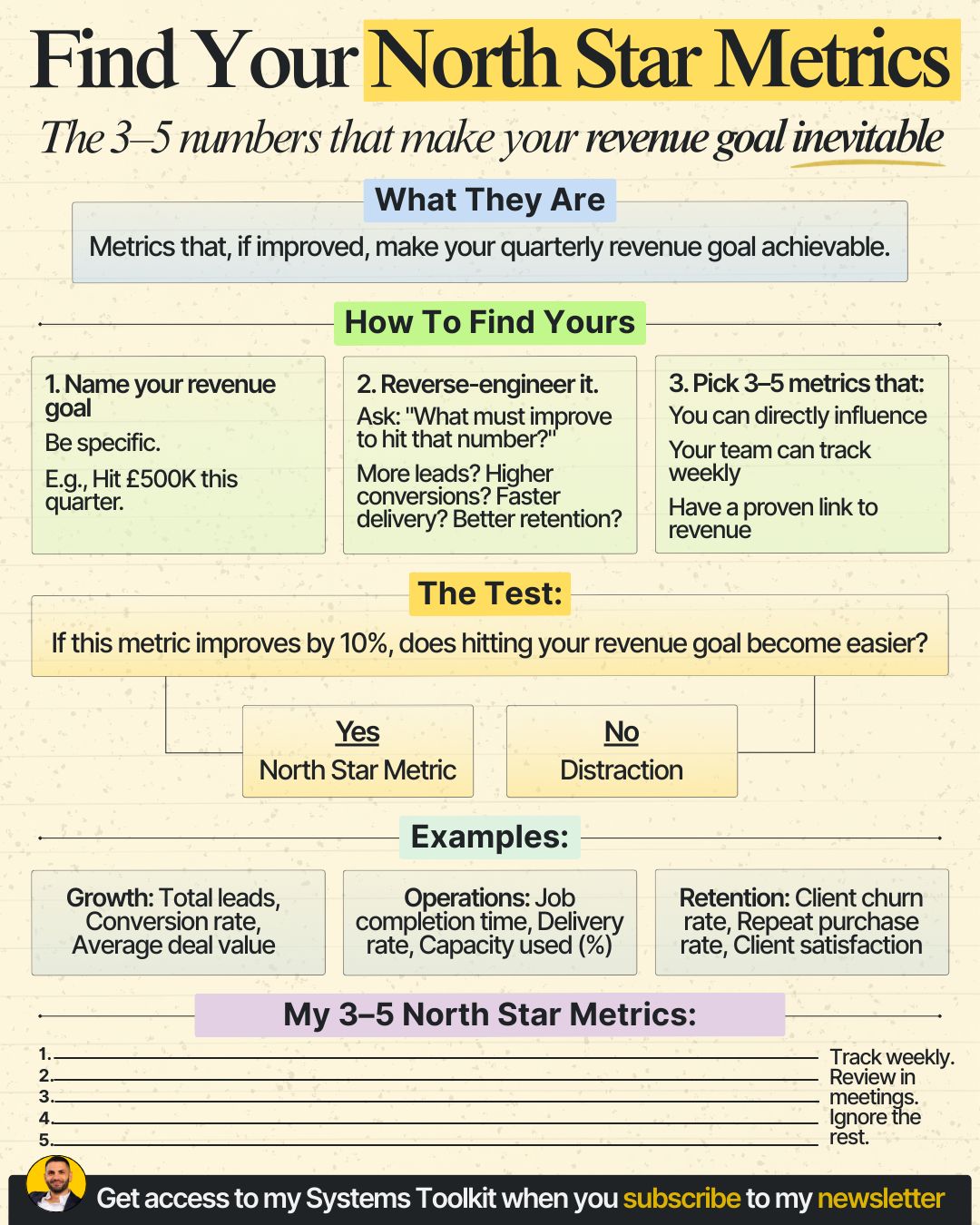
In a recent LinkedIn post, John Castro discusses the pitfalls of overloaded dashboards and advocates for a focused approach to key performance indicators (KPIs) to drive predictable revenue growth. Castro, a business consultant, argues that many business owners fall into the trap of tracking too many metrics, leading to a lack of clarity and hindering actual progress.
Castro emphasizes that the sheer volume of data presented on typical business dashboards can be counterproductive. He states:
“Busy dashboards are a revenue killer. Pick 3–5 metrics that convert.”
He elaborates on this by pointing out a common pattern he observes:
“They’ve got a dashboard full of numbers, but no idea which 3–5 would make the quarter a win.”
The Distinction Between Activity and Progress
According to John Castro, the core issue lies in conflating activity with progress. He introduces the concept of ‘North Star Metrics’ as the crucial 3-5 numbers that, when improved, directly contribute to achieving revenue goals. These are not superficial ‘vanity metrics’ but the fundamental drivers of a business’s financial success.
Castro outlines a clear, three-step process for identifying these vital metrics:
- Name Your Revenue Goal: This step requires specificity. Instead of a vague objective like “Increase revenue,” Castro advises setting a concrete target, such as “Hit £500K this quarter.”
- Reverse Engineer It: Once a specific goal is set, the next step is to break it down. Business owners should ask themselves what actions and drivers are necessary to achieve that target.
- Pick 3–5 Metrics: Based on the reverse-engineering process, the final step is to select the 3-5 metrics that have the most direct influence on the revenue goal.
Testing and Validating North Star Metrics
John Castro provides a simple yet effective test to determine if a metric qualifies as a North Star Metric: if improving it moves the business closer to its revenue goal, it is a true driver. If not, it’s considered a distraction.
He illustrates this with examples categorized by business focus:
- Growth-focused: New leads per week, Sales conversion rate, Average deal size.
- Ops-focused: Job completion time, Customer retention, Gross profit margin.
- Retention-focused: Churn rate, Customer lifetime value, Client satisfaction.
Case Study: From Overwhelmed to Optimized
To underscore the impact of this focused approach, Castro shares a client success story. This client was initially tracking dozens of metrics, leading to feelings of being overwhelmed and stressed, with long working hours. By identifying his North Star Metrics – specifically, Lead to survey conversion rate, Sales conversion rate, and Meta ad ROAS – the client experienced significant improvements within 90 days.
Castro details the client’s results:
- Lead to survey conversion rate jumped from 26% to 48%.
- Sales conversion rate increased from 29% to 36%.
- Achieved a 10.6x Return on Ad Spend (ROAS) on Meta ads.
This optimization led to the client having “empty calendar space. Guilt-free,” as Castro puts it, signifying a healthier work-life balance achieved through strategic measurement.
The Danger of Measuring Everything
John Castro reiterates the importance of measurement but warns against the opposite extreme: measuring too much. “You can’t optimise what you don’t measure. But measuring everything is just as dangerous as measuring nothing,” he argues.
In Castro’s view, North Star Metrics provide essential clarity, team focus, decision confidence, and ultimately, predictable revenue growth. He concludes by inviting readers to subscribe to his email list for more insights on systems for scaling businesses with less stress.
📝 About This Content
This article is based on insights shared by John Castro on LinkedIn.
📅 Originally posted on February 24, 2026 | View original post on LinkedIn →