
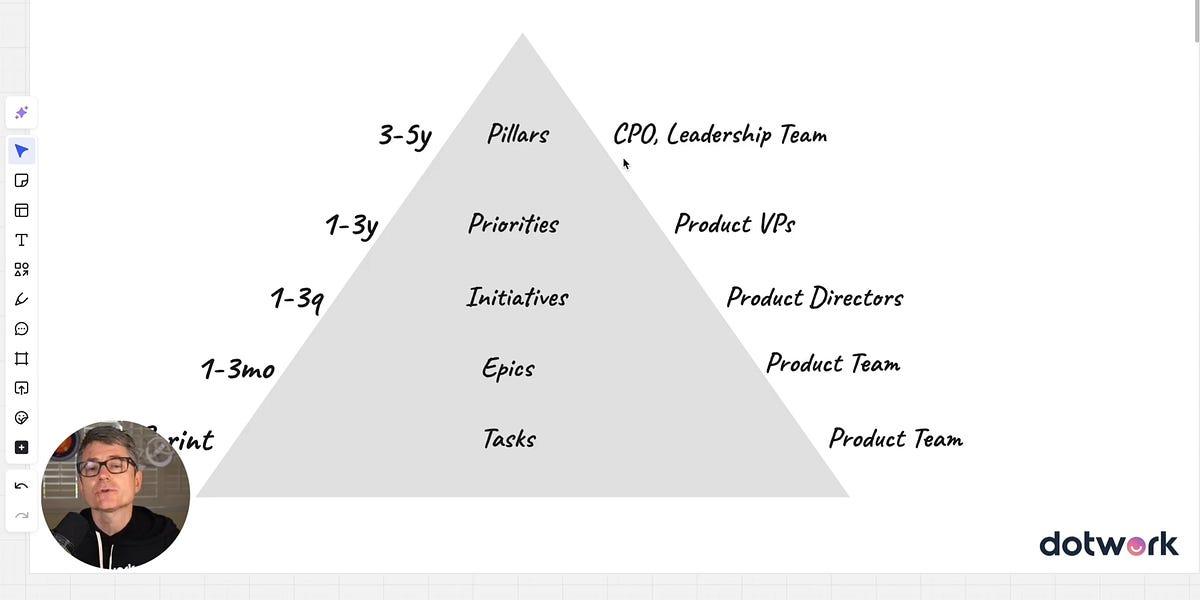
In a recent LinkedIn post, John Cutler discusses the limitations of the traditional strategy pyramid as a tool for designing effective operating models. While acknowledging its utility for storytelling and executive alignment, Cutler argues that it oversimplifies the complexities inherent in real-world business systems.
Beyond the Pyramid: A More Nuanced View of Strategy
Cutler’s central thesis is that the strategy pyramid, often depicted as a top-down cascade from strategy to execution, fails to capture the dynamic and interconnected nature of modern organizations. He suggests that a more sophisticated approach is required, one that embraces multiple perspectives and acknowledges the intricate relationships between various business functions.
“The strategy pyramid is a helpful storytelling tool, especially for presentations or executive alignment. But it is insufficient for designing actual operating models.”
According to Cutler, a key failing of the pyramid model is its inherent simplicity. He points out that effective operating models must recognize:
- Multiple lenses, rather than a single, overarching perspective.
- The temporal and definitional complexities that evolve over time.
- The necessity of dynamic linkages, contrasting them with static, nested structures.
Embracing Complexity for Effective Systems
Cutler elaborates on the need for a more holistic view, emphasizing the interplay between different organizational facets. He argues that strategy cannot be viewed in isolation but must be understood in conjunction with execution, finance, structure, and learning processes.
“The interplay of strategy, execution, finance, structure, and learning.”
In Cutler’s view, building a truly effective operating system requires moving beyond simplistic, linear models. He advocates for an approach that actively supports and reflects the inherent complexity of the business environment.
“Building an effective system means embracing this complexity and supporting it with the right artifacts and rhythms—not oversimplifying it into a cascade.”
He suggests that relying solely on a cascaded, pyramid-like structure can lead to an incomplete or even flawed operating model. Instead, organizations should focus on creating systems that are adaptable and responsive to the multifaceted nature of their operations. As Cutler concludes, the goal is not to simplify to the point of inaccuracy, but to build systems that manage and leverage complexity effectively.
📝 About This Content
This article is based on insights shared by John Cutler on LinkedIn.
📅 Originally posted on November 7, 2025 | View original post on LinkedIn →