
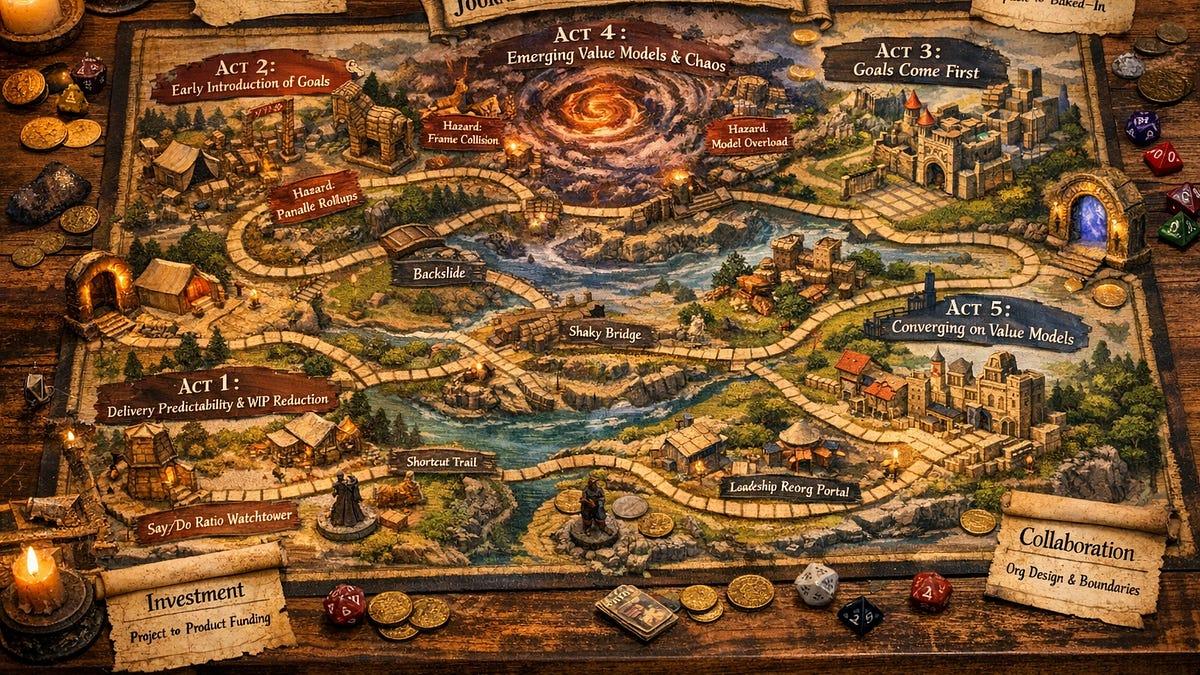
In a recent LinkedIn post, John Cutler explores the evolving mental models and priorities within companies as they mature. Cutler frames this journey not as a rigid, linear maturity model, but as a narrative device to understand shifting perceptions and the introduction of goals and value propositions.
He outlines a multi-act journey that companies undertake, emphasizing how what is considered important changes significantly over time. Cutler presents his framework as a way to understand these transitions, stating:
“Below, I take a journey across companies at different stages of evolution. I explore the competing mental models, what is important, and how perceptions shift. It is not an attempt at a linear model or a maturity model, but rather a narrative device.”
The Stages of Business Evolution
Cutler details five distinct acts in this evolutionary narrative, each marked by a shift in focus and operational priorities. The journey begins with a strong emphasis on predictable delivery and managing work-in-progress (WIP) at scale.
Act 1: Delivery Predictability and WIP Reduction at Scale
According to Cutler, companies in this initial stage are primarily concerned with establishing reliable processes and optimizing throughput. The focus is on making sure work gets done efficiently and predictably, often through lean or agile principles aimed at reducing bottlenecks.
Act 2 & 3: The Introduction and Primacy of Goals
As companies progress, Cutler observes the introduction of goals into their operational framework. Initially, goals are an addition to existing processes (Act 2). However, in the subsequent stage (Act 3), goals become the driving force, dictating priorities and shaping how work is undertaken. “Goals Come First” signifies a strategic shift where objectives directly inform execution.
Act 4: Embracing Value Models Amidst Chaos
The post highlights a more complex phase where emerging value models are introduced, often leading to a period Cutler describes as “Chaos.” This suggests a transition where the organization grapples with defining and measuring value, potentially leading to experimentation and a less predictable, but ultimately more adaptive, environment. He notes this phase as:
“Emerging Value Models And Chaos”
Act 5: Converging On Value Models
The final act in Cutler’s narrative sees companies converging on established value models. This stage implies a greater clarity and alignment around how the business creates and captures value, likely integrating the lessons learned from the preceding chaotic phase into a more coherent and sustainable strategy. As Cutler puts it:
“Converging On Value Models”
Throughout his post, John Cutler stresses that this is not a prescriptive maturity model but a “prototypical, yet nuance-filled journey.” His aim is to provide a framework for understanding how different organizational priorities and mental models emerge and interact as a business evolves, ultimately guiding leaders in navigating their own company’s developmental path.
📝 About This Content
This article is based on insights shared by John Cutler on LinkedIn.
📅 Originally posted on January 28, 2026 | View original post on LinkedIn →