
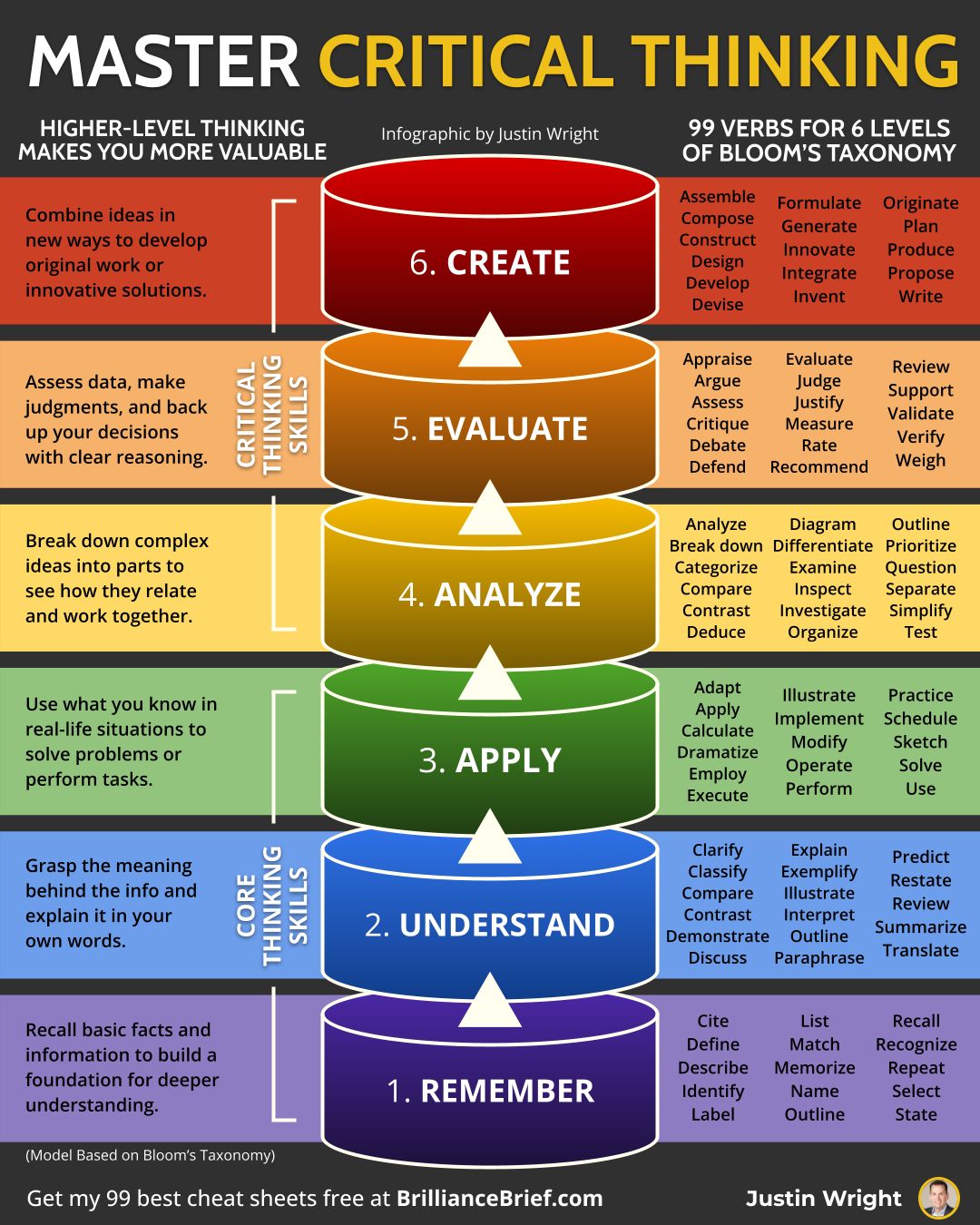
In a recent LinkedIn post, Justin Wright discusses a framework for cognitive development, drawing parallels between the human brain’s capabilities and the levels of Bloom’s Taxonomy. Wright frames the learning process as a series of “gears” that individuals can engage to enhance their thinking and problem-solving skills.
According to Wright, most individuals tend to operate within the first two gears, suggesting a widespread untapped potential for higher-level cognition. He introduces the concept by stating:
“The human brain has 6 gears. Most people never shift past 2nd.”
Wright then systematically breaks down each of the six levels of Bloom’s Taxonomy, offering a clear explanation for how each stage contributes to intellectual growth and professional value.
Understanding the Six Gears of Cognitive Function
Wright outlines the six gears as follows, emphasizing that each level builds upon the previous one:
1. Remember (1st Gear)
This foundational level, as described by Wright, involves the basic memorization of facts. While essential, he notes that it is merely the starting point of cognitive engagement.
2. Understand (2nd Gear)
The second gear is characterized by the ability to explain concepts clearly. Wright observes that many people become comfortable at this stage, potentially limiting their further development.
3. Apply (3rd Gear)
This is where, according to Wright, knowledge transitions into practical action, marking the beginning of significant growth. He highlights this as a crucial step in moving beyond theoretical knowledge.
4. Analyze (4th Gear)
Wright explains that at this level, individuals learn to deconstruct complex problems into smaller, manageable parts. This stage is critical for identifying patterns that might otherwise be overlooked and for forming strategic insights.
“Breaking big problems into smaller pieces. Seeing patterns others miss. This is where strategic insights form.”
5. Evaluate (5th Gear)
The fifth gear, as presented by Wright, involves making informed decisions supported by clear reasoning. He suggests that leaders particularly thrive in this phase, as it requires critical judgment and the selection of optimal paths forward.
6. Create (Top Gear)
Described as the highest level, this gear is where innovation flourishes. Wright posits that this is the stage where novel ideas are generated and solutions to persistent problems are conceived.
“Where new ideas come to life. Where solutions to old problems are born. The space for innovation.”
The Sequential Nature of Cognitive Advancement
A key point emphasized by Justin Wright is the inherent progression within these cognitive gears. He argues that each level serves as a building block for the next, enhancing an individual’s overall capability and value.
Wright suggests that the reason many individuals do not advance beyond the lower gears is not a lack of potential, but often a lack of awareness or instruction on how to “shift gears.” He concludes with an encouraging message about the brain’s vast capabilities:
“Most haven’t been shown how to shift gears. But it’s possible for anyone. Your brain is incredible. It can do so much more than you think.”
By sharing this breakdown, Wright aims to empower his audience to recognize and cultivate their higher-order thinking skills, thereby unlocking greater personal and professional potential.
📝 About This Content
This article is based on insights shared by Justin Wright on LinkedIn.
📅 Originally posted on March 4, 2026 | View original post on LinkedIn →