
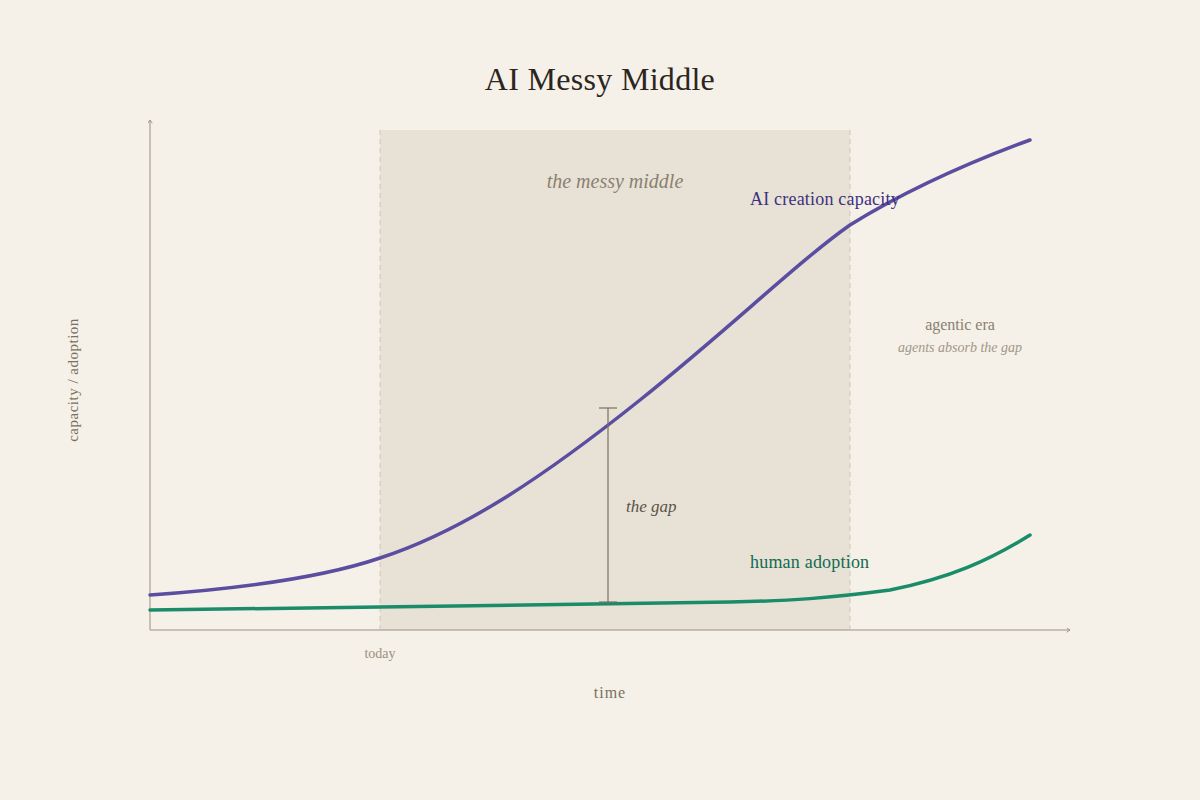
In a recent LinkedIn post, Kieran Flanagan discusses the current phase of Artificial Intelligence adoption within companies, which he terms the ‘messy middle.’ Flanagan argues that while the challenge is no longer with the AI models themselves, businesses are struggling to translate AI’s potential into tangible productivity gains.
Flanagan highlights that the existing AI models are highly capable, able to handle a significant portion of everyday tasks and empower knowledge workers. He states:
“The current set of models can do a large percentage of everyday tasks. They allow knowledge workers to produce more. Solve problems with custom software, new skills, new agents, more and more.”
Despite this technological advancement, Flanagan observes a disconnect between AI’s potential and its actual impact in many organizations. He attributes this gap to the unchanged human capacity for adopting new workflows, which may even be strained by the increased ‘noise’ generated by AI.
The Widening Gulf in AI Adoption
According to Flanagan, companies are facing a growing disparity between the infinite possibilities AI presents and the finite time employees have to adapt. This creates a scenario where AI might inadvertently lead to decreased productivity rather than enhancement.
Flanagan points out the core issue:
“But, we see stats time and again that show companies are struggling to adopt AI and show impact. It’s because the amount of time a person has to adopt AI and change their workflows hasn’t changed. It’s likely gotten worse as AI creates more noise.”
He elaborates on this ‘messy middle’ phase, suggesting that the rapid proliferation of new AI-driven work methods, combined with limited time for behavioral change, is a significant hurdle. This forces a situation where teams are overwhelmed, leading to a potential dip in overall productivity.
The Path Forward: Agents and Workflow Automation
Kieran Flanagan proposes that the true unlock for effective AI integration lies in humans changing their work methodologies. However, he emphasizes that human capacity for such change is limited.
Automating Full Workflows
The key, Flanagan argues, is to delegate entire workflows and tasks to AI agents. These agents can operate in the background, enhancing human productivity without demanding a complete overhaul of individual work habits.
“The reality is, humans will need to change how they work to adopt AI into their workflows. But the capacity to do that is finite. The true unlock will be handing off full workflows and tasks to agents, who work around the person to make them more productive.”
As an example, Flanagan cites the sales sector, where automating pre-sales tasks and post-call activities can free up sellers to focus on more contextual client interactions. This strategic application of AI aims to optimize the go-to-market process.
Balancing Automation and Human Enablement
In conclusion, Flanagan advises businesses to find the right equilibrium between full task automation and empowering their human workforce. This balance is crucial for successfully integrating AI into go-to-market strategies and achieving genuine productivity improvements.
📝 About This Content
This article is based on insights shared by Kieran Flanagan on LinkedIn.
📅 Originally posted on March 31, 2026 | View original post on LinkedIn →