
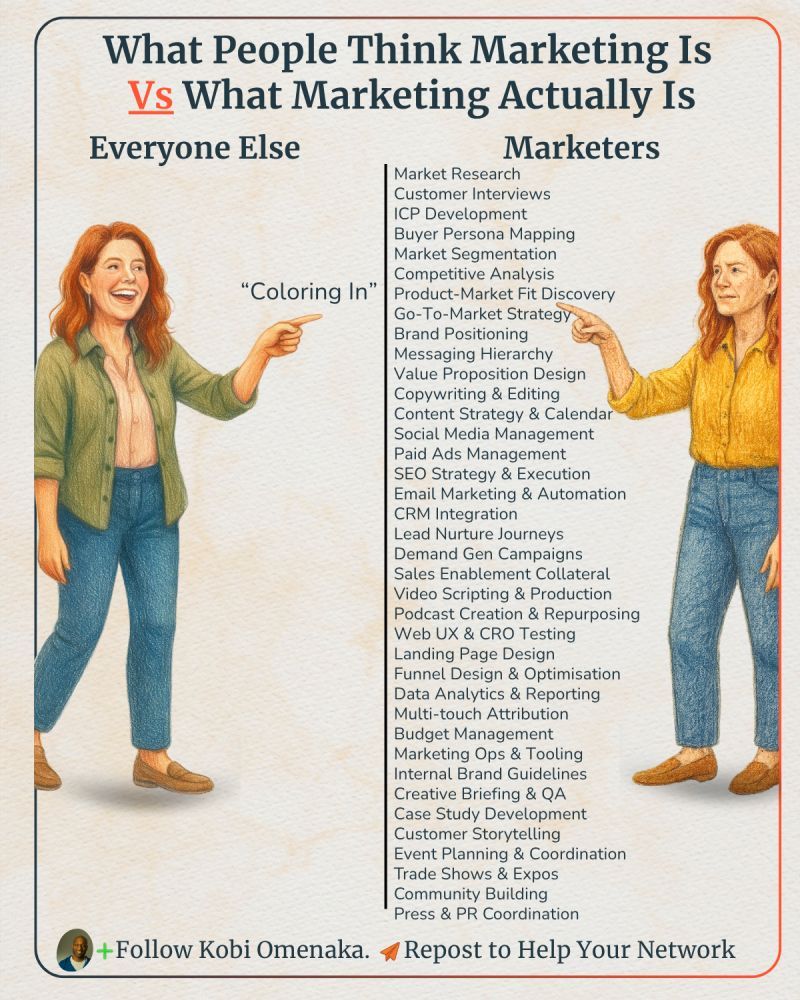
In a recent LinkedIn post, Kobi Omenaka challenges the common misconception that marketing is a superficial or secondary function within a business, arguing instead that it is a critical, results-driven engine.
Omenaka begins by directly addressing a frequent sentiment from founders: “We just need someone to do the socials.” He contrasts this with the reality of how skilled marketers operate, emphasizing that their focus is on tangible outcomes rather than superficial engagement metrics.
“But the marketers I work with… They’re not chasing likes, they’re chasing results.”
The Core Functions of Strategic Marketing
Kobi Omenaka breaks down the multifaceted nature of effective marketing into four key stages, illustrating that it requires a strategic and analytical approach far removed from simple content creation.
1. Finding the Opportunity
The foundational step, according to Omenaka, involves rigorous market research, defining Ideal Customer Profiles (ICPs), and segmentation. While perhaps not as glamorous as other aspects, Omenaka stresses its indispensability.
2. Making People Care
This stage focuses on the art of connecting with the audience through compelling messaging, positioning, and storytelling. Omenaka highlights that this is what captures attention in a crowded digital space.
3. Turning Interest into Action
Here, Omenaka points to the crucial conversion elements like landing pages, email nurturing sequences, and retargeting campaigns. He states unequivocally:
“Without this, content is just theatre.”
4. Feeding the Fire
The final stage involves the analytical and operational aspects of marketing, including attribution, reporting, Conversion Rate Optimization (CRO), and the selection of appropriate tooling. This data-driven approach is essential for understanding what works and for enabling scalable growth.
Marketing as the ‘Engine Room’
Omenaka uses a powerful analogy to underscore his point: marketing is the “engine room” of a business, not merely decorative elements. He criticizes the practice of underfunding this crucial area, leading to a predictable outcome:
“And when a founder underfunds this? Then complain they’re ‘not getting results’? It’s like cutting the power, then asking why the lights aren’t on!”
The implication is clear: neglecting the marketing engine inevitably leads to a lack of business results, yet the blame is often misdirected.
A Call for Respect
Ultimately, Kobi Omenaka argues that the issue is not a lack of ambition from marketers, but a fundamental lack of respect for the discipline and its strategic importance. He suggests that many marketers are not asking for larger budgets, but for the recognition and value their work deserves.
The post concludes with a direct question to the audience, prompting reflection on whether marketing is indeed undervalued in most organizations, and a call to action to share the post to help shift perceptions.
📝 About This Content
This article is based on insights shared by Kobi Omenaka on LinkedIn.
📅 Originally posted on January 31, 2026 | View original post on LinkedIn →