
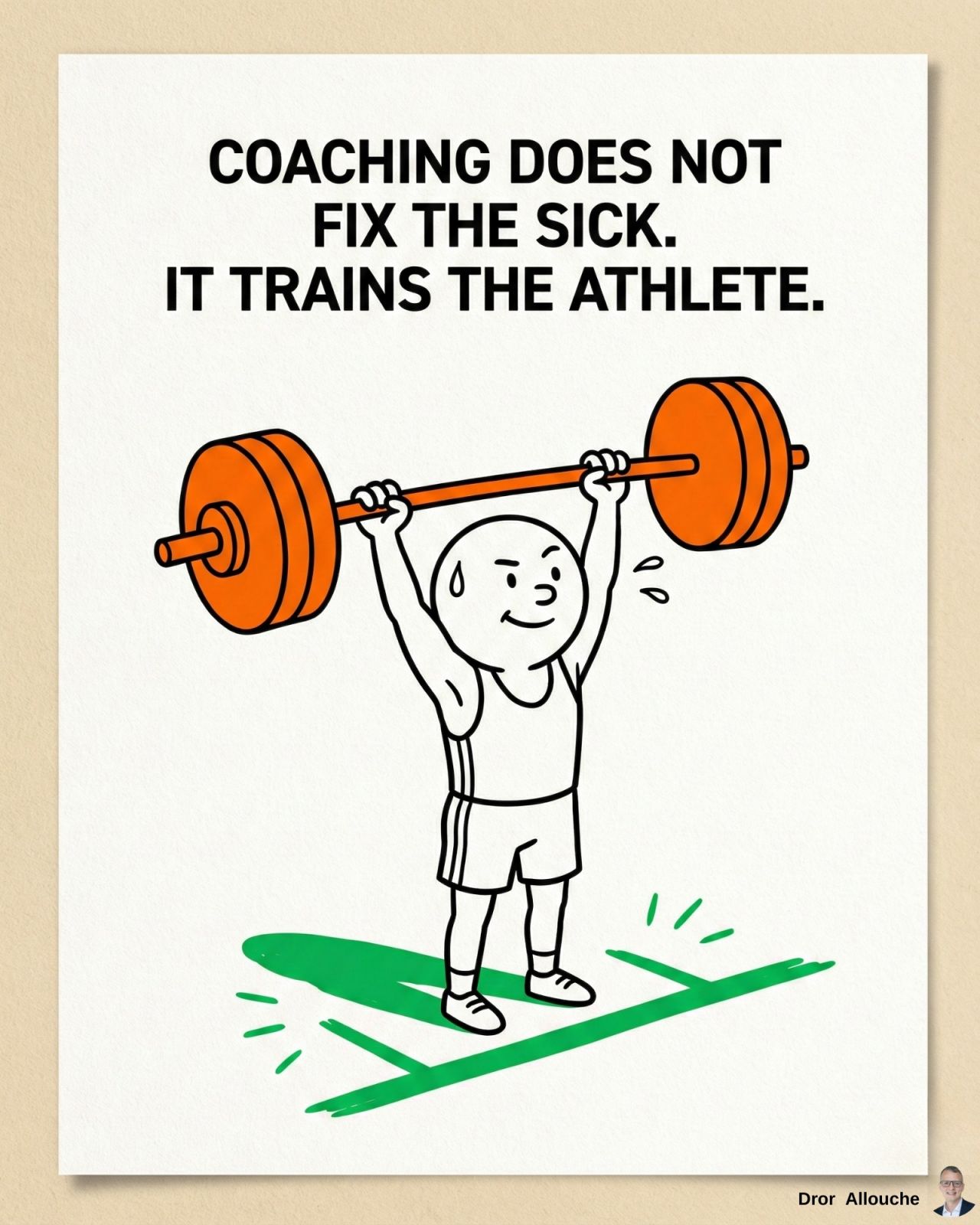
In a recent LinkedIn post, Dror Allouche challenges the conventional approach to leadership development, asserting that it is fundamentally a practice, akin to athletic training, rather than a purely theoretical pursuit. Allouche contrasts the proactive, consistent practice of athletes with the common corporate tendency to only address leadership issues when they become critical failures.
Allouche highlights a significant disconnect he observes in the professional world:
“I see thousands of professionals who never practice leadership. Even worse: When coaching is offered to them, they get defensive. They think they are ‘sick.’ They only want to practice when something is broken.”
The post critiques the superficial engagement with feedback mechanisms, such as digital 360° assessments, suggesting that merely reading reports is insufficient for genuine improvement. Allouche draws a parallel to sports, stating that athletes do not improve simply by reviewing statistics but by actively training and executing a plan.
The Practice-Oriented Approach to Leadership
Dror Allouche argues that effective leadership development requires consistent effort and practical application. He emphasizes that true behavioral change doesn’t stem from theoretical knowledge alone but from dedicated practice and iterative improvement. This perspective shifts the focus from remedial interventions to continuous skill-building.
Shifting from ‘Sick’ to ‘Athlete’ Mentality
A core theme in Allouche’s post is the need for professionals to adopt an ‘athlete’s mindset’ towards leadership. This involves embracing coaching and feedback not as indicators of deficiency but as essential tools for growth. According to Allouche, the reluctance to practice leadership skills until a crisis emerges is a major impediment to developing robust leadership capabilities.
“No athlete improves their game just by reading their statistics. They build a plan and put in the work.”
This analogy underscores Allouche’s central argument: leadership, like any high-performance skill, demands consistent, deliberate practice.
Allouche’s 5-Step Framework for Behavioral Change
To facilitate this practical approach, Dror Allouche outlines a structured 5-step process that his clients utilize to foster tangible changes in leadership behavior. This framework is designed to move professionals from passive observation to active implementation.
- The Objective: Identify a single, significant leadership behavior that requires improvement. Focusing on one area at a time is key to making progress manageable.
- The Stakeholders: Select a group of 6 to 12 individuals who regularly interact with the leader in their current role. Their perspectives are crucial for understanding real-world impact.
- The Follow-up: Commit to requesting ‘Feedforward’ – practical, future-oriented suggestions – from these stakeholders on a monthly basis. This differs from traditional feedback by focusing on actionable steps.
- The Plan: Based on the monthly feedforward, develop and adapt a concrete action plan. This iterative process ensures that efforts are directly informed by stakeholder input and evolving needs.
- The Measurement: Gauge progress through two mini-surveys administered to stakeholders. This provides a quantifiable way to track behavioral shifts and the effectiveness of the action plan.
Allouche stresses the difficulty of changing ingrained behaviors but points to a high success rate with his clients who adhere to this process for a full year.
“Changing a behavior is difficult. By following this process for 12 months, I’ve achieved a 100% success rate with my clients.”
He concludes by posing a direct challenge to readers, urging them to transition from merely consuming information about leadership to actively practicing it. Allouche even offers a compelling guarantee, suggesting clients only pay if they achieve their desired results, demonstrating his confidence in the efficacy of his practical, practice-based methodology.
📝 About This Content
This article is based on insights shared by Dror Allouche on LinkedIn.
📅 Originally posted on February 18, 2026 | View original post on LinkedIn →