
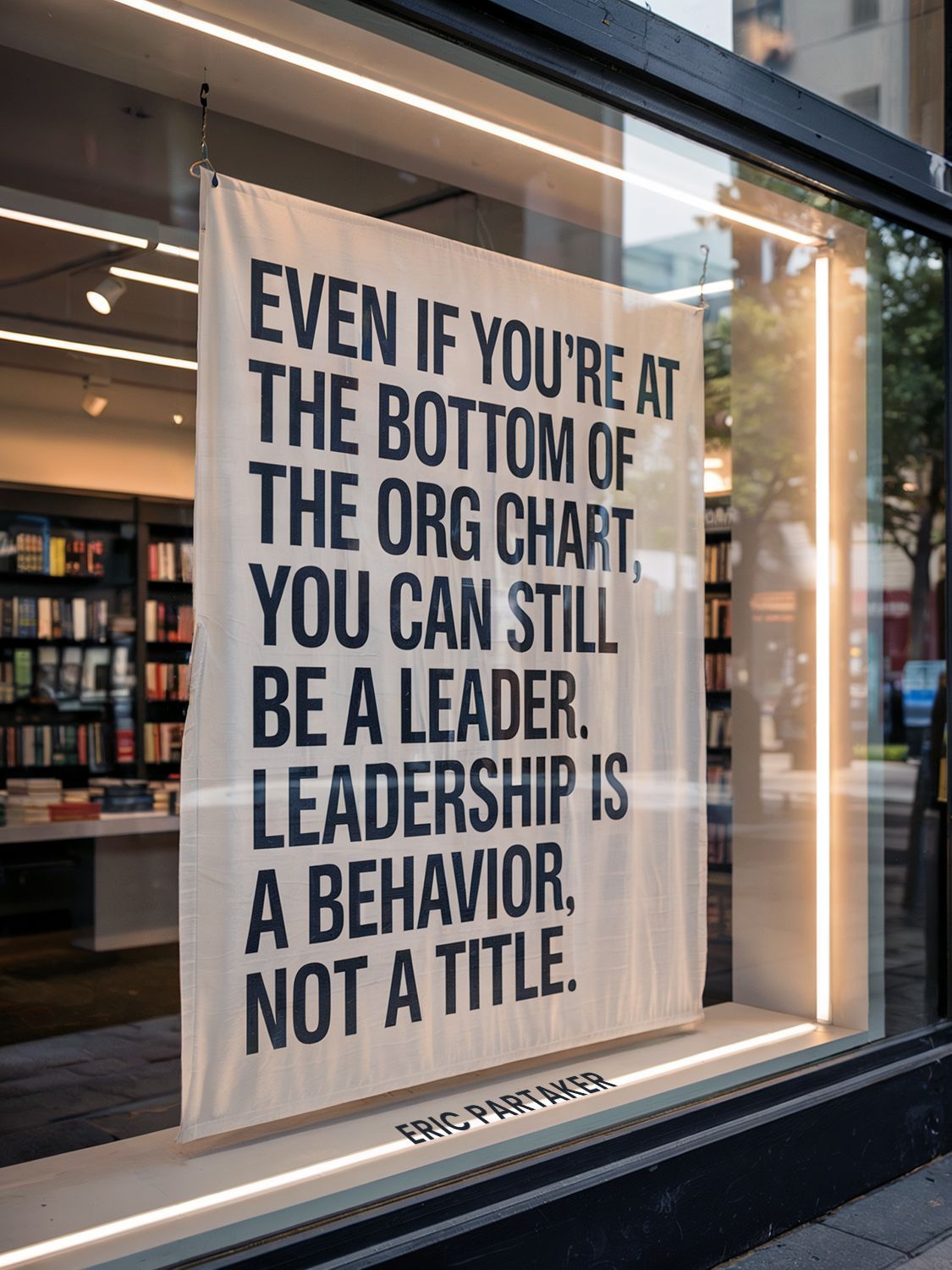
In a recent LinkedIn post, Eric Partaker challenges traditional notions of leadership, arguing that true leadership stems from actions and behaviors rather than hierarchical titles. Partaker emphasizes that leadership is accessible to anyone willing to step up and make a difference, regardless of their position within an organization.
He highlights instances where individuals, irrespective of their formal roles, have profoundly impacted projects and companies. Partaker writes:
“I’ve watched the quietest person on the team change the direction of an entire project with a well-timed question. I’ve seen new hires transform companies simply by seeing what others couldn’t.”
This perspective reframes leadership as an active, accessible quality. Partaker asserts that taking initiative, demonstrating empathy, and acting with integrity are the hallmarks of effective leadership, not the job title one holds.
Redefining Leadership Beyond the Org Chart
Eric Partaker argues that the traditional view of leadership, confined to those at the top of the organizational hierarchy, is fundamentally flawed. Instead, he proposes that leadership is a dynamic capability available to all employees. Partaker illustrates this point by observing that everyday actions can embody leadership.
He elaborates on what constitutes leadership in practice:
“When you speak up about that process everyone complains about but nobody fixes… That’s leadership. When you help a struggling colleague because you felt their frustration… That’s leadership. When you take ownership of a problem instead of waiting for someone else to solve it… That’s leadership.”
According to Partaker, these are the moments where genuine leadership emerges, driven by a willingness to contribute and support others, rather than by a desire for recognition or authority.
Key Behaviors of Accessible Leadership
Partaker identifies several key behaviors that define this accessible form of leadership. He suggests that true leaders exhibit the following qualities:
- Taking initiative without waiting for explicit permission.
- Doing what is right, even when unobserved.
- Supporting colleagues rather than competing with them.
- Perceiving and responding to the dynamics of a situation with awareness.
He further notes that the impact of an individual is not dictated by their rank or title but by their interpersonal conduct. Partaker states:
“Your impact isn’t determined by your rank, title, or position. It’s determined by how you treat others.”
This emphasis on behavior and empathy underscores Partaker’s belief that leadership is cultivated through consistent, positive actions and a commitment to ethical conduct.
Leading Through Example and Integrity
In Partaker’s view, some of the most influential leaders he has encountered did not possess conventional executive titles. Instead, their leadership was demonstrated through their conduct, compassion, and bravery.
He outlines these leadership qualities:
- Their behavior
- Their empathy
- Their example
- Their courage
Partaker concludes his post with an empowering message: individuals already possess the necessary qualities to become impactful leaders. He encourages readers to embrace their potential and lead with courage, kindness, and integrity, suggesting that the world needs more leaders who operate from these principles rather than solely from a position of authority. He believes that starting today, from one’s current position, is the key to unlocking this potential.
📝 About This Content
This article is based on insights shared by Eric Partaker on LinkedIn.
📅 Originally posted on May 24, 2026 | View original post on LinkedIn →