
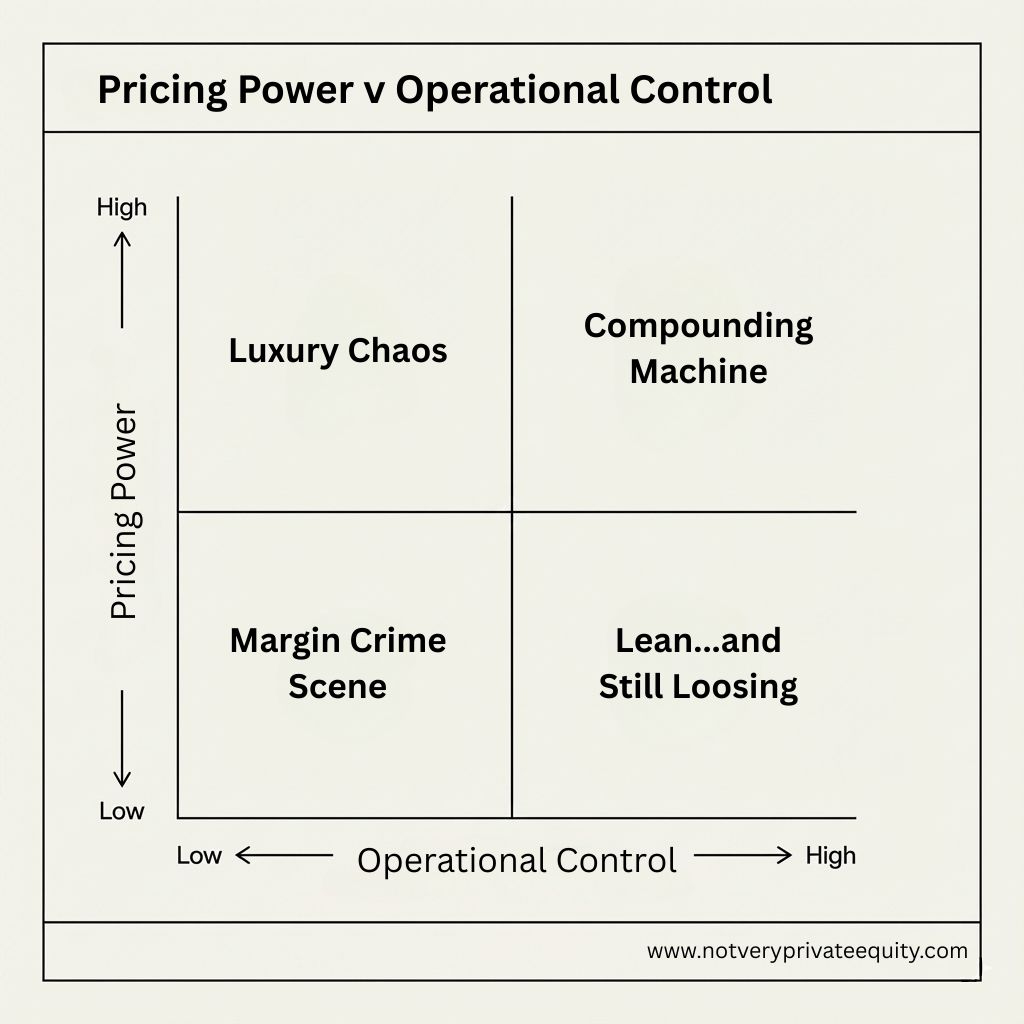
In a recent LinkedIn post, Lee McCabe delves into the often-misunderstood concept of “pricing power,” arguing that many businesses and private equity firms confuse mere activity with genuine control. McCabe, a figure associated with Claymore Partners, challenges the common boardroom narrative that equates pricing power with a company’s inherent strength, suggesting it’s far more complex than a simple line item on a spreadsheet.
Deconstructing the “Pricing Power” Myth
McCabe begins by dismantling the prevalent notion that “pricing power” is a readily achievable trait. He posits that for most businesses, what appears as pricing power is often a combination of financial maneuvering and optimistic projections, rather than a reflection of true market leverage. He notes the common scenario where:
“Most businesses don’t have pricing power. They have a CFO with a spreadsheet, a hope, and a sales team quietly discounting in the background.”
This highlights a critical disconnect between perceived strength and operational reality. According to McCabe, the fundamental error lies in overlooking the crucial second half of the equation: operational control.
The Crucial Role of Operational Control
Lee McCabe argues that true value creation, particularly the compounding growth sought after in private equity, resides in the “top right” quadrant of a strategic matrix – a space characterized by both premium pricing and consistent, repeatable delivery without excessive strain. This quadrant, as McCabe explains, is defined by deep understanding and mastery of unit economics across different channels, precise identification of margin leakage, and the ability to scale operations without descending into organizational chaos.
He contrasts this ideal scenario with other quadrants, illustrating the pitfalls of relying solely on brand or cost-cutting without foundational operational strength:
- Top Left (Premium Brand, Weak Ops): This is where a company might raise prices based on reputation or a captive audience, but the underlying operations are fragile. McCabe uses the metaphor, “The brand is doing cardio while the business smokes,” to describe this precarious state where revenue growth is disproportionately burdened by complexity and churn.
- Bottom Right (Efficient but Undifferentiated): Here, cost-cutting measures are implemented, leading to efficiency, but the business struggles due to a lack of differentiation in product, customer, or market approach. McCabe wryly calls this “becoming efficient at a bad business.”
- Bottom Left (No Power, No Control): This is the least desirable position, characterized by a constant chase for volume, heavy discounting, and an over-reliance on unfulfilled promises for future revenue.
Price as a Strategy, Fueled by Operations
McCabe emphasizes that value creation plans often falter by focusing on cost reduction first, as it’s easily measurable. Instead, he advocates for prioritizing operational control, which he believes creates the genuine ability to increase prices without suffering from increased churn, customer complaints, or service callbacks.
“Price is a strategy only when ops can keep up.”
In essence, Lee McCabe’s analysis suggests that genuine pricing power is not an abstract attribute but a tangible outcome of robust operational discipline. It’s the ability to not only set a premium price but also to consistently deliver value at that price point, efficiently and profitably. This distinction, he implies, is critical for businesses and investors aiming for sustainable, compounding growth rather than fleeting successes built on shaky operational foundations.
📝 About This Content
This article is based on insights shared by Lee McCabe on LinkedIn.
📅 Originally posted on February 10, 2026 | View original post on LinkedIn →