
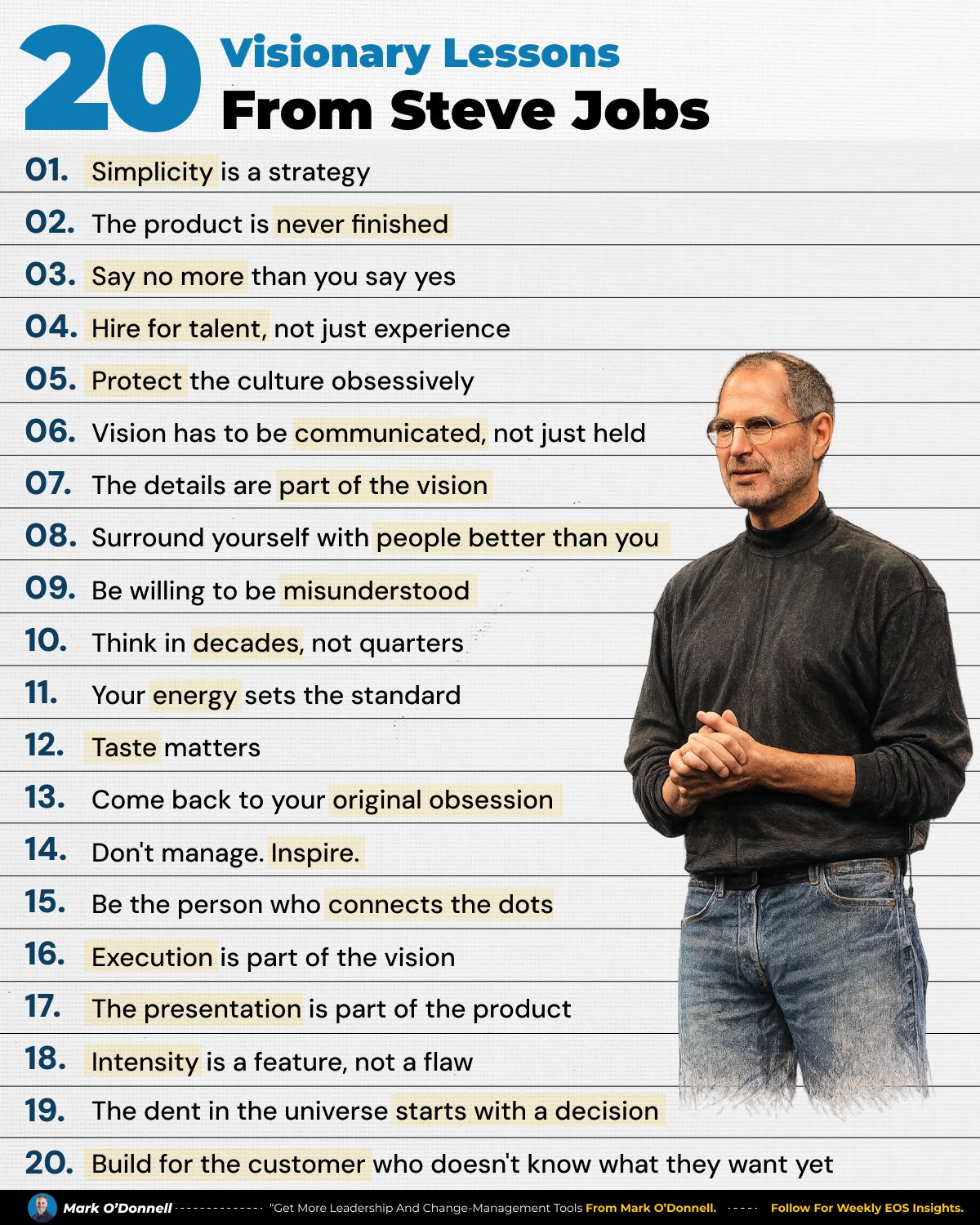
In a recent LinkedIn post, Mark O’Donnell explores the defining characteristics of historical visionaries, using Steve Jobs as a prime example. O’Donnell emphasizes that these leaders, often not the most vocal, are instrumental in shaping the very existence and direction of successful companies.
The Essence of Visionary Leadership
Mark O’Donnell posits that exceptional visionaries possess a unique ability to foresee future trends and opportunities long before others. He highlights that while they might not dominate conversations, their foresight is foundational to the group’s existence. As O’Donnell writes:
“In every great company, there’s someone who sees what’s coming before anyone else does.
They might not be the loudest person in the room.
But they’re usually the reason the room exists in the first place.”
According to O’Donnell, Steve Jobs serves as a quintessential illustration of this leadership archetype. The article suggests that founders and leaders can glean valuable lessons from Jobs’ approach to building Apple into a revolutionary enterprise.
Key Principles for Founders
O’Donnell outlines several actionable principles derived from Jobs’ leadership, offering practical advice for contemporary founders. These insights are presented not as abstract theories, but as concrete strategies for business growth and operational excellence.
Combating Complexity and Striving for Excellence
One of the core tenets Mark O’Donnell identifies is the relentless fight against complexity. He quotes Jobs’ philosophy:
“Complexity is the enemy
↳ Look at your product, your process, your meetings. Find one thing to cut this week.”
This principle extends to a commitment to continuous improvement, where ‘good enough’ is never truly finished. O’Donnell relays the advice to constantly seek enhancement, asking teams:
“Good enough isn’t finished
↳ Ask your team: what would make this 10% better right now?”
Strategic Focus and Talent Acquisition
O’Donnell also delves into the power of strategic prioritization and the critical role of talent. He notes that saying ‘no’ is a deliberate strategy for protecting core objectives. As O’Donnell puts it:
“No is a strategy
↳ List everything on your plate. Pick the three that actually matter and protect them.”
Furthermore, O’Donnell, reflecting O’Donnell’s analysis of Jobs, stresses the importance of prioritizing raw talent and demonstrated ability over credentials alone. He suggests that in hiring, the focus should be on what candidates have built, rather than solely on their work history. This emphasis on practical skill and potential is a recurring theme in O’Donnell’s breakdown of visionary leadership.
Maintaining Vision and Culture
The article further elaborates on the non-negotiable aspects of leadership: maintaining a clear vision and actively cultivating a strong culture. O’Donnell points out that a vision is ineffective if it cannot be clearly communicated and understood by the team. He highlights the need for leaders to articulate their long-term goals concisely and share them widely.
Moreover, O’Donnell underscores that culture requires constant vigilance and proactive management. He suggests that leaders must identify and address behaviors that contradict stated values, emphasizing that culture does not maintain itself. This commitment to holding standards and protecting the core vision, as O’Donnell argues, is what distinguishes the best visionaries and leads to the creation of historically significant companies.
📝 About This Content
This article is based on insights shared by Mark O'Donnell on LinkedIn.
📅 Originally posted on July 22, 2026 | View original post on LinkedIn →