
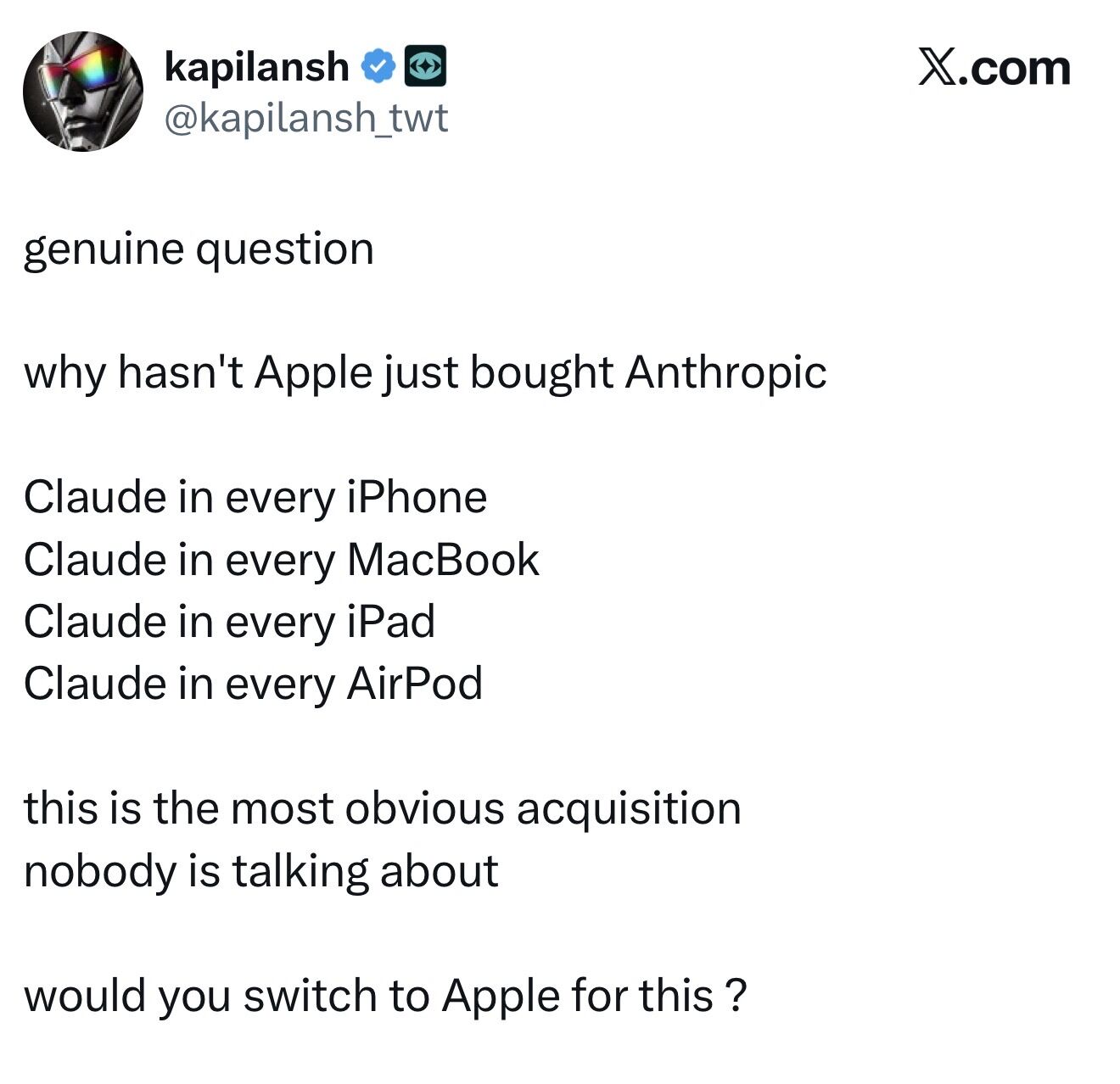
In a recent LinkedIn post, Linas Beliūnas offers a compelling analysis of Apple’s artificial intelligence strategy, arguing that the tech giant is focused on platform dominance rather than acquiring AI model developers like Anthropic.
Beliūnas challenges the prevailing narrative that Apple should purchase AI companies to integrate their models directly into products. Instead, he posits that Apple’s true objective is to leverage its existing ecosystem and user base by making Siri the central interface for AI services.
“Why buy the model when you can own the place where every model has to compete? 🤔”
According to Beliūnas, this approach allows Apple to remain at the forefront of consumer AI without bearing the immense costs and competitive pressures associated with developing and housing large language models.
The Platform Play: Siri as the AI Gateway
Linas Beliūnas highlights that Apple’s strategy hinges on transforming Siri into the primary access point for AI functionalities across its vast network of devices. This positions Apple not as a direct competitor in the AI model-building race, but as the gatekeeper of its distribution.
Beliūnas outlines a scenario where this strategy benefits multiple players:
- OpenAI could integrate ChatGPT into Apple Intelligence.
- Google might power parts of Siri with Gemini, securing a lucrative partnership.
- Anthropic’s Claude could be offered as an additional AI option within the Apple ecosystem.
- Users would gain choice and a seamless AI experience.
- Crucially, Apple would retain control over the user interface, permissions, privacy layers, the App Store, and payment systems.
This contrasts sharply with the conventional view of Apple being “late” to the AI game. Beliūnas argues:
“And that’s not Apple being late. That is Apple refusing to inherit the ugliest part of the AI business.
The GPU bills.
The talent wars.
The model depreciation.
The endless race to be “best” for 6 weeks.”
Owning the Dashboard, Not Just the Engine
The core of Beliūnas’s argument is that Apple is aiming to control the user experience, often referred to as the “dashboard,” rather than solely focusing on building the most advanced AI “engine.” He emphasizes that user loyalty and device switching are driven by practical, integrated AI experiences, not just benchmark performance.
As Linas Beliūnas notes:
“Remember – people don’t switch phones because one model scored slightly better on a reasoning benchmark. They stay because AI works across Messages, Mail, Calendar, Notes, Photos, AirPods, Watch, Mac, and iPhone without feeling like a science project.”
By positioning Siri as the interface, Apple ensures that AI is deeply embedded and functional across its entire product suite. This strategy allows Apple to benefit from the advancements of various AI labs without the substantial financial and operational burden of leading the LLM development themselves.
In Beliūnas’s view, this strategic positioning as a platform provider is far more powerful in the long run than being another competitor in the AI model development arena. He concludes:
“The AI labs are fighting to build the best engine while Apple is trying to own the dashboard. And in consumer tech, the dashboard usually wins.”
This perspective reframes Apple’s AI efforts as a calculated move to solidify its ecosystem’s value and maintain its leadership in consumer technology by controlling how AI is accessed and experienced by billions of users.
📝 About This Content
This article is based on insights shared by Linas Beliūnas on LinkedIn.
📅 Originally posted on April 25, 2026 | View original post on LinkedIn →