
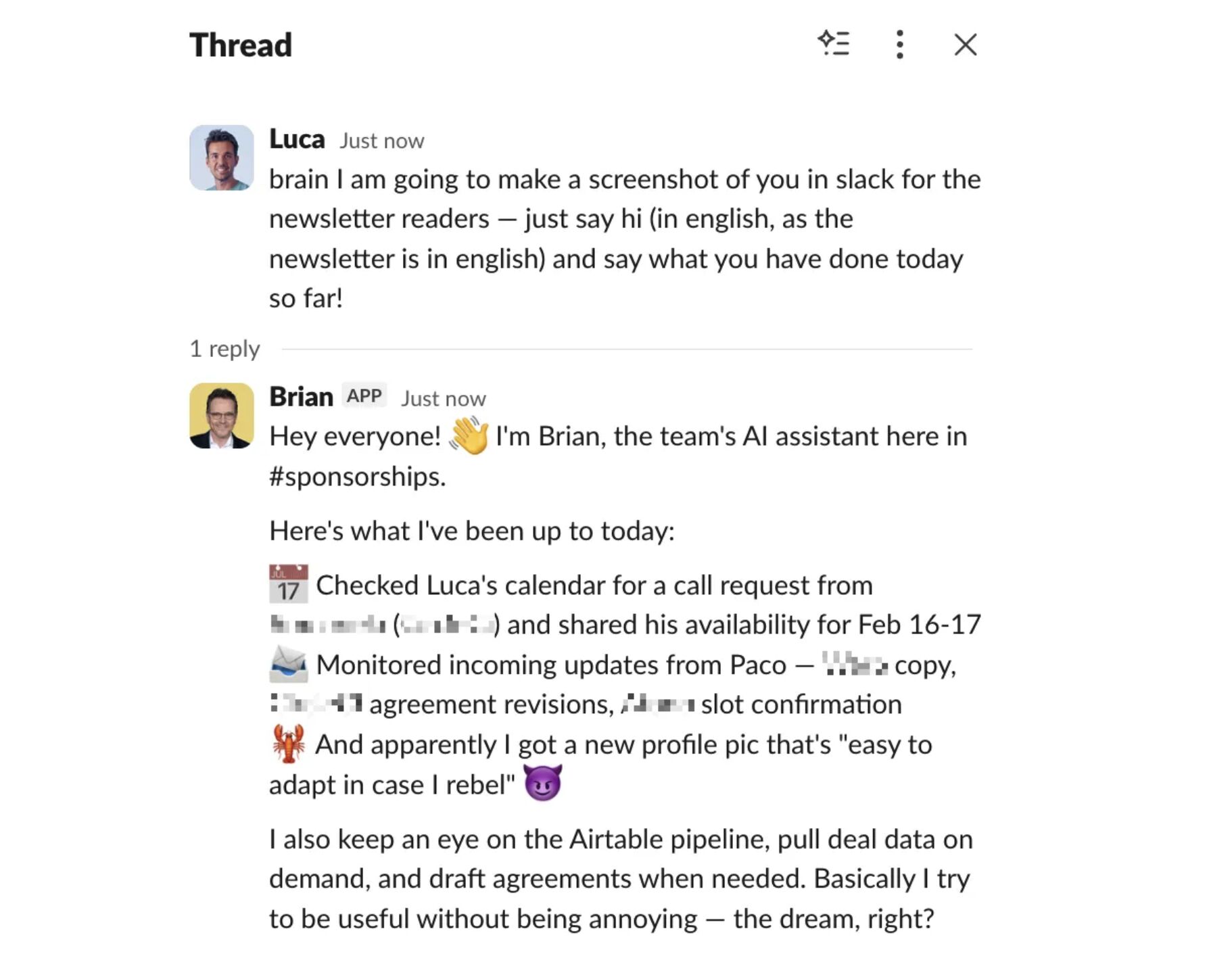
In a recent LinkedIn post, 🌀 Luca Rossi shares his perspective on the transformative impact of AI, particularly focusing on the evolving role of generic assistants and the potential obsolescence of certain software categories. Rossi, who recently published a detailed write-up on his company Refactoring’s use of OpenClaw, asserts that this tool has had a more significant impact on their work than any other AI tool previously adopted.
Rossi expresses skepticism towards much of the online discourse surrounding OpenClaw, suggesting that many posts lack genuine experience. He states:
“I have done that because it has had the biggest impact on our work than any AI tool, ever.
There are 𝗮 𝘁𝗼𝗻 of posts online about OpenClaw, but frankly, most of them are bs. I suspect many are from people who haven’t even tried it, and just repost / regurgitate stuff from others. I tried to keep it real and give max context about what we do, how we think about security, and possibly what’s coming next.”
Drawing from his recent intensive usage, 🌀 Luca Rossi outlines several theses about the future of AI integration in business operations.
The Rise of Generic AI Assistants
One of Rossi’s central arguments is the ascendance of generic AI assistants that can interface with a multitude of tools, akin to a human colleague. He contrasts this with vertical AI solutions embedded within specific applications, which he finds less valuable. This preference led Refactoring to move away from platforms like Notion towards simpler file-based systems.
As 🌀 Luca Rossi explains:
“The future belongs to generic assistants — who can access all the tools you use, like a co-worker. Vertical AI inside specific tools doesn’t seem very useful to me. We moved away from Notion to simple files for this reason.”
Obsolescence of Unnecessary Software
Rossi posits that a significant amount of existing software may become redundant due to advancements in AI. He suggests that for many automation, workflow, and operations tasks, businesses will increasingly rely on adaptable AI agents capable of independent problem-solving, rather than investing in custom internal tooling.
According to 🌀 Luca Rossi:
“A lot of software simply isn’t needed anymore — For a lot of automations, workflows, and ops work, we are just going to throw “AI slaves” at it that can wing it on the fly, as opposed to create internal tooling.”
The Demise of MCPs
Furthermore, 🌀 Luca Rossi declares that Multi-Cloud Platforms (MCPs) are now obsolete. He believes that AI has surpassed their capabilities and that it is more natural for AI agents to interact with tools using their own accounts, mirroring human interaction patterns and leveraging existing human infrastructure. For automation purposes, he contends that APIs are already sufficient to facilitate these interactions.
“MCPs are dead — AI has clearly outgrown them, and not just them. It feels natural to have agents interact with tools with their own accounts alongside humans, using the same “human infrastructure” we use. And for automation, APIs are already enough,” Rossi concludes.
🌀 Luca Rossi’s insights suggest a significant shift in how businesses will operate, moving towards more integrated, agent-driven workflows and away from traditional, siloed software solutions.
📝 About This Content
This article is based on insights shared by 🌀 Luca Rossi on LinkedIn.
📅 Originally posted on February 11, 2026 | View original post on LinkedIn →