
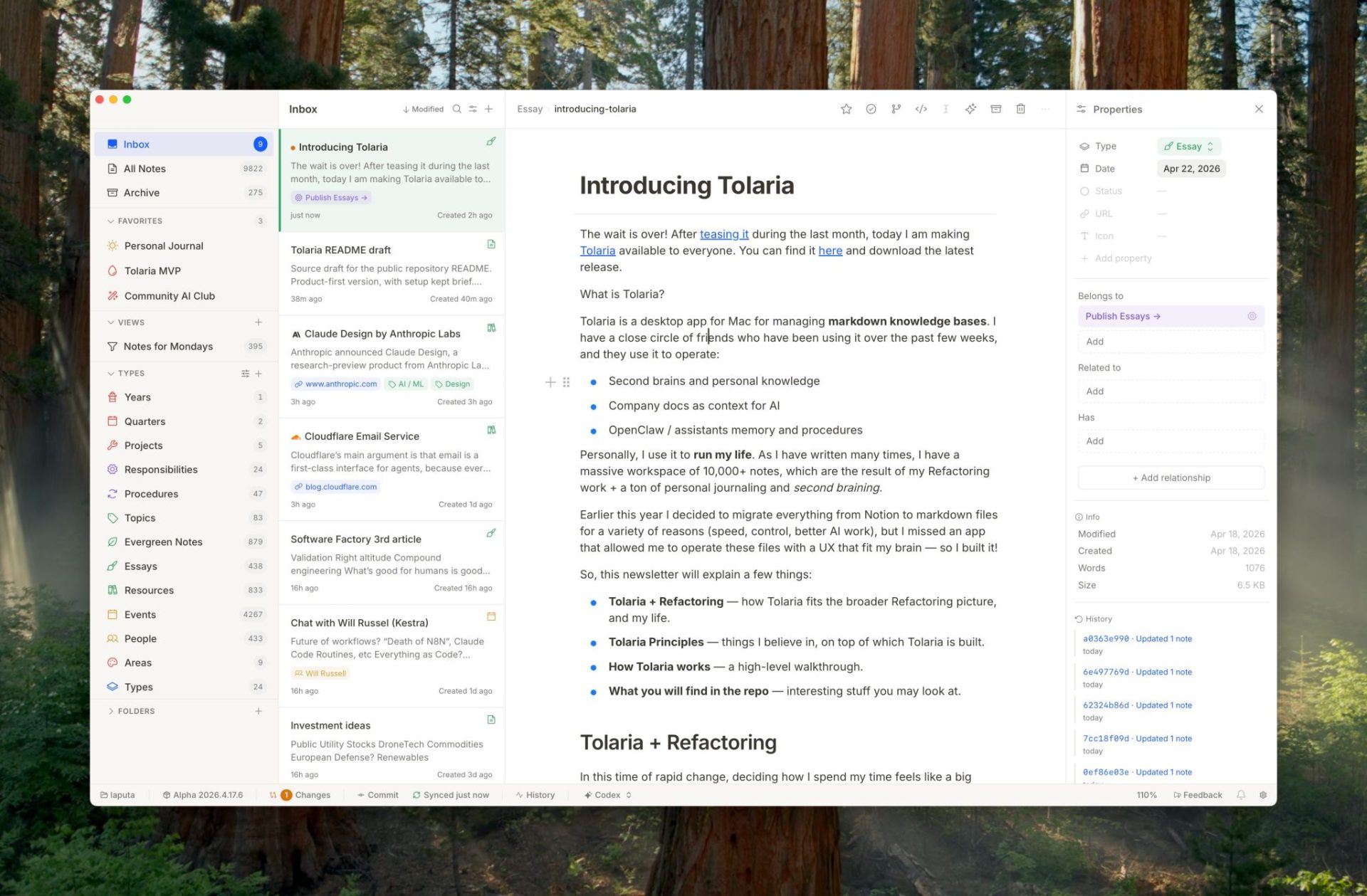
In a recent LinkedIn post, 🌀 Luca Rossi announces the launch of Tolaria, a new macOS desktop application designed for managing markdown knowledge bases and facilitating interaction between humans and AI agents. Rossi emphasizes that the application is both free and open-source, a status he intends to maintain indefinitely.
Developed over three months, Tolaria is presented by Rossi as a tool that has become integral to his personal and professional life. He details his extensive personal workspace, comprising 10,000 notes accumulated over six years of refactoring, which he now manages using Tolaria.
“Tolaria is the main surface of collaboration with my AI agents: they create new notes there, connect them to what exists, and edit existing ones. Everything is easy to understand for them, because it’s just markdown files. In a way, it’s my implementation of Karpathy’s LLM wiki.”
Revolutionizing Knowledge Management with AI Collaboration
🌀 Luca Rossi highlights Tolaria’s role as a primary interface for collaboration with AI agents. According to Rossi, these agents can create, connect, and edit notes within the application. The simplicity of markdown files, as Rossi points out, makes the knowledge base easily accessible and understandable for AI systems.
The development of Tolaria is described by Rossi as his most significant experiment to date in software development using AI. He provides impressive metrics from the project:
- 2000 commits
- 100K+ lines of code
- 3000+ tests with 85% coverage
- 9.9/10 code health
- 70+ architecture decision records
Notably, Rossi states that he did not write any of the code himself, nor did he read most of it. He presents this fact neutrally, stating, “I am neither proud or ashamed of it — it is what it is!”
Open Source as a Living Artifact
The decision to release Tolaria as open-source software is driven by Rossi’s intention to create a transparent record of his AI-driven coding practices. He views the project as a “living artifact” that allows others to examine his methods, including documentation strategies, agent configurations, and hook implementations.
“I am releasing it open source to use it as a living artifact of how I do AI coding, so you can inspect at any time things like how I write docs, what’s in my AGENTS.md, what hooks do I run, and so on.”
Rossi encourages community engagement, inviting feedback on his creation. He provides direct links for users to explore further:
- Newsletter announcement: https://lnkd.in/dATpDZER
- Website: http://tolaria.md/
- Github repo: https://lnkd.in/dJi8Fn4u
Tolaria represents a significant step in demonstrating the practical application of AI in software development and knowledge management, offering a unique glimpse into a new paradigm of human-AI collaboration.
📝 About This Content
This article is based on insights shared by 🌀 Luca Rossi on LinkedIn.
📅 Originally posted on April 22, 2026 | View original post on LinkedIn →