
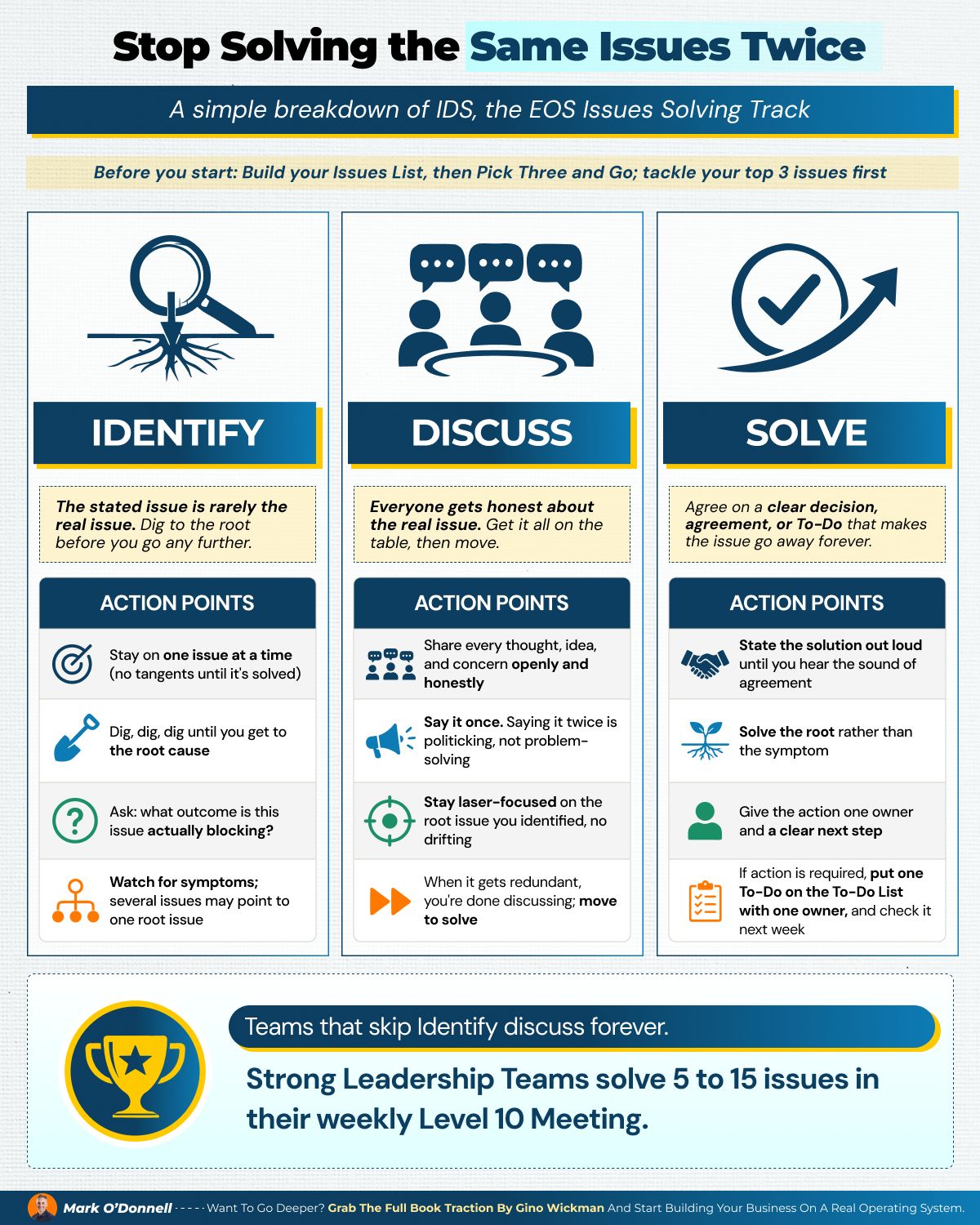
In a recent LinkedIn post, Mark O’Donnell discusses a common pitfall that hinders team productivity: prolonged discussions that fail to yield solutions. He highlights a structured problem-solving framework, referred to as IDS (Identify, Discuss, Solve), which he believes is often undermined by teams skipping crucial initial steps.
According to O’Donnell, the tendency for teams to get stuck rehashing the same issues stems from neglecting the “Identify” phase. He points out that teams often jump straight into discussing a problem without first ensuring they understand the true nature of the issue at hand. This leads to conversations that feel productive in the moment but ultimately fail to address the core problem.
“And too often, I see teams skip the first part by going straight into discussing, without stopping to figure out what they’re actually trying to fix.”
The Perils of Skipping the ‘Identify’ Step
Mark O’Donnell argues that the root cause of unproductive meetings is the failure to properly identify the problem. He likens it to a situation where a team might spend twenty minutes discussing an issue, only for it to resurface weeks later as if no conversation had occurred. This cycle, he contends, is precisely what the IDS framework is designed to prevent.
O’Donnell outlines a detailed process for the “Identify” phase, emphasizing the need to dig deeper than the surface-level problem presented. He advises asking critical questions such as what the issue is preventing the team from achieving and ensuring that only one issue is tackled at a time to avoid tangents.
Key Steps in Problem Identification
- The issue someone wrote down is rarely the real one.
- Keep digging until you hit the nerve underneath it.
- Ask what this is actually keeping you from.
- One issue at a time. No tangents until it’s done.
As Mark O’Donnell notes, “The issue someone wrote down is rarely the real one.” This underscores the importance of thorough investigation before moving to discussion.
The ‘Discuss’ and ‘Solve’ Phases
Following a robust identification process, O’Donnell details the subsequent “Discuss” and “Solve” phases. In the “Discuss” phase, the focus is on open and honest input from all team members, but it must remain locked onto the identified root cause. He warns that when discussions start to go in circles, it signifies the end of this phase.
“Everyone says what they think, openly and honestly. Say it once. Say it twice and you’re politicking. Stay locked on the root you named. When it starts going in circles, you’re finished.”
The “Solve” phase, according to O’Donnell, requires clearly articulating the solution, ensuring room-wide agreement, and assigning a single owner to the resolution. He stresses that the goal is to fix the root cause, not merely the symptom. This structured approach, he asserts, can lead to the resolution of multiple issues within a single meeting.
The Importance of Decision Over Perfection
A point O’Donnell anticipates pushback on is the emphasis on making a decision, regardless of whether it’s perceived as perfect. He observes that many teams falter by waiting for an ideal solution, which can lead to paralysis. In his view:
“It matters more that you decide than what you decide. So many teams will freeze waiting for the perfect answer. The win is making the call, handing it off, and moving on.”
By prioritizing decisive action and moving forward, teams can maintain momentum and avoid the stagnation that comes from perpetual deliberation. O’Donnell concludes by suggesting that this structured approach can dramatically increase the number of issues a team can effectively close out in meetings, contrasting it with the inefficiency of teams that “talk about the same thing for months.” He also promotes his new book, “Issues,” which further elaborates on this problem-solving methodology.
📝 About This Content
This article is based on insights shared by Mark O'Donnell on LinkedIn.
📅 Originally posted on July 7, 2026 | View original post on LinkedIn →