
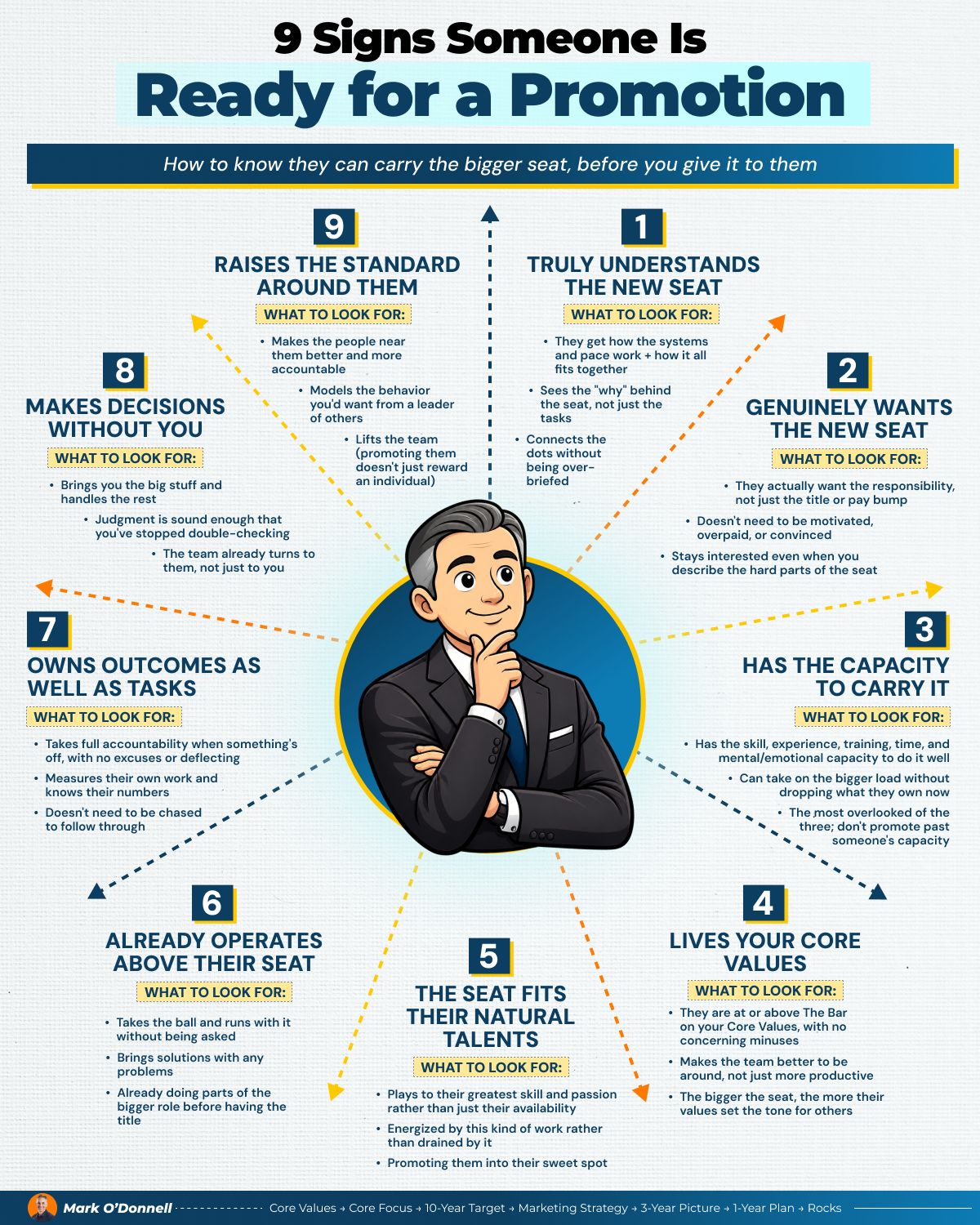
In a recent LinkedIn post, Mark O’Donnell discusses the critical pitfalls of promoting employees into new roles, emphasizing that true readiness goes far beyond loyalty or past performance. O’Donnell, writing for his business publication audience, argues that many leaders misjudge promotion potential by focusing on the wrong signals, leading to costly mistakes for both the individual and the organization.
O’Donnell highlights the significant expense associated with both hiring incorrectly and, more critically, placing the wrong person in a role they are not equipped to handle. He contends that promotions should be viewed not as a reward for past achievements, but as a strategic investment in future success.
“Ultimately, a promotion isn’t a reward for the past. It’s a bet on the future. And most leaders bet on the wrong signals.”
The EOS Framework for Promotion Readiness
Drawing on principles from the Entrepreneurial Operating System (EOS), O’Donnell outlines a clear framework for evaluating promotion candidates. He asserts that for any given role, an individual must meet three essential criteria: they must “get it, want it, and have the capacity to do it.” O’Donnell stresses that all three conditions are non-negotiable.
According to O’Donnell, overlooking an individual’s capacity is a particularly common and damaging error. He elaborates on this point:
“The third is particularly important, because promoting past someone’s capacity is one of the most expensive people mistakes you can make.”
Nine Signs of True Promotion Readiness
To guide leaders in making more informed decisions, O’Donnell presents nine key indicators that suggest an individual is genuinely prepared for a promotion. These signs are designed to serve as a proactive filter rather than a post-hoc justification.
Among the crucial indicators O’Donnell identifies are:
- Understanding the Role: The candidate must truly grasp the new seat, including its pace, systems, and overall purpose, not just the day-to-day tasks.
- Genuine Desire: The individual should desire the responsibilities of the role itself, independent of title or salary increases, and remain engaged even when faced with challenges.
- Sufficient Capacity: This encompasses having the necessary skills, time, and emotional bandwidth to excel in the new role without compromising existing responsibilities.
- Alignment with Strengths: The new position should leverage the candidate’s core skills and passions, energizing them rather than draining them.
- Operating Above Their Current Seat: O’Donnell notes that readiness is often demonstrated by individuals who proactively take initiative and bring solutions to the table.
- Owning Outcomes: Candidates who take full accountability for results, rather than just completing tasks, are better positioned for advancement.
- Independent Decision-Making: The ability to make decisions without constant oversight, and to be a go-to resource for their peers, signals readiness.
- Raising the Standard: A truly promotable individual elevates the performance and accountability of those around them, thereby lifting the entire team.
O’Donnell concludes by reiterating the profound impact of proper role alignment:
“Get the right person in the right seat, and everything downstream gets easier.”
By applying these criteria rigorously, O’Donnell suggests, businesses can mitigate the risks associated with promotions and foster a more effective and productive workforce.
📝 About This Content
This article is based on insights shared by Mark O'Donnell on LinkedIn.
📅 Originally posted on June 18, 2026 | View original post on LinkedIn →