
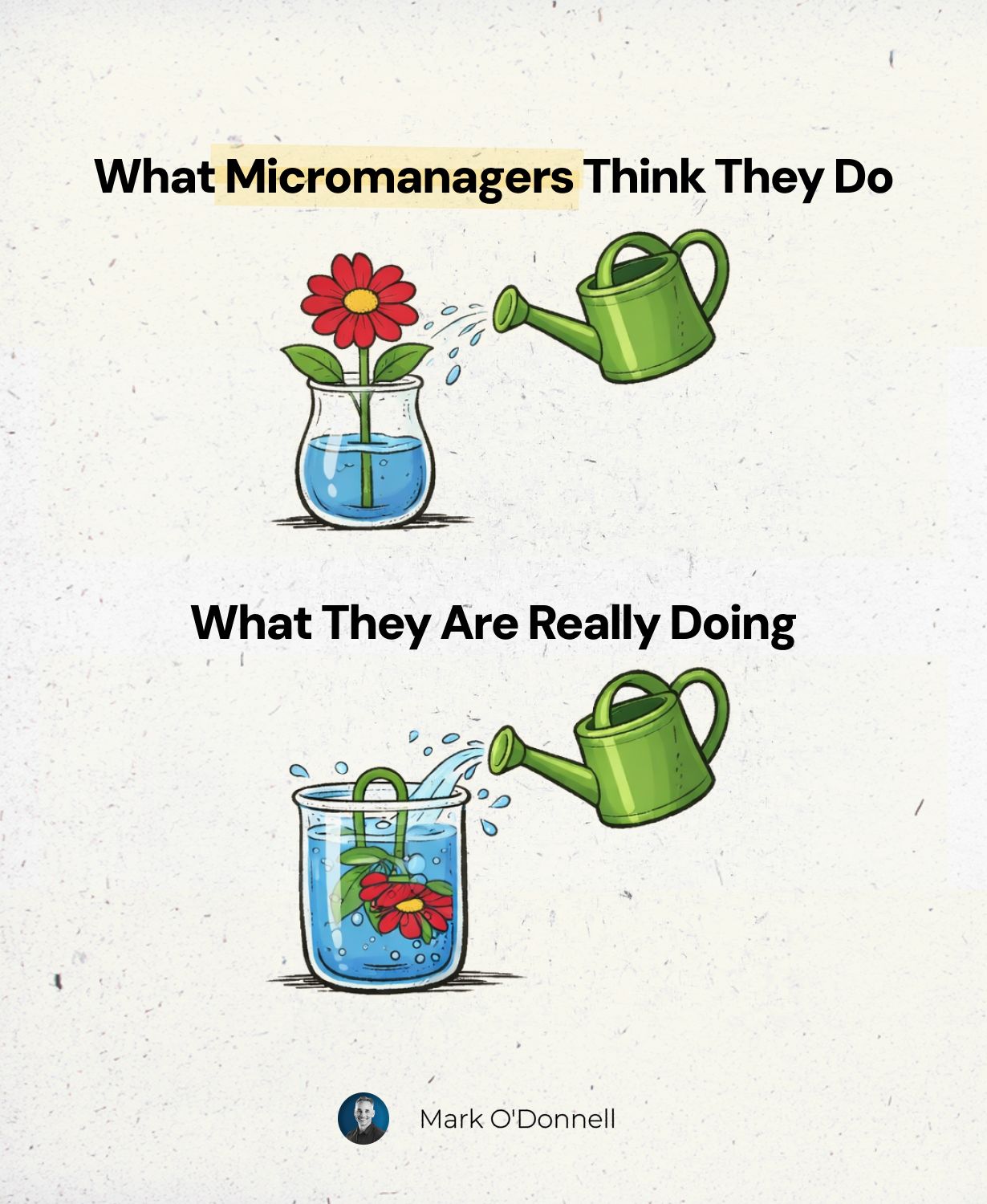
In a recent LinkedIn post, Mark O’Donnell discusses the common pitfalls of micromanagement, likening it to overwatering a plant and ultimately hindering team development. O’Donnell clarifies that many micromanagers are not driven by a desire for control but by a deep sense of care that has not yet evolved into effective delegation.
He shares his personal experience, stating:
“Once upon a time, I was that person. Checking in too often, rewriting things that didn’t need rewriting, sitting in meetings I should have stayed out of, telling myself it was about quality… When in reality, it was about not fully trusting the system around me.”
The Damage of Constant Oversight
O’Donnell argues that this constant oversight, while often well-intentioned, causes significant damage to both the team and the business’s potential. He explains the detrimental effects:
- It frustrates the team by signaling a lack of trust.
- It prevents individuals from developing the essential instinct to own their work and take initiative.
This is akin to a plant whose roots rot from too much water, according to O’Donnell. When a leader consistently intervenes and resolves issues, the team never learns to navigate challenges independently. This creates a bottleneck, as O’Donnell points out:
“The business can only move as fast as they can personally review, approve, and sign off.”
Strategies for Effective Delegation
To combat this leadership bottleneck, O’Donnell suggests a proactive approach focused on clarity and defined responsibilities before loosening the reins of control. He outlines three key steps for leaders to implement:
1. Define Ownership
Clearly establish who is responsible for each function within the team or organization. This eliminates ambiguity and ensures accountability.
2. Set Clear Standards
Establish measurable standards so that team members can self-assess the quality and progress of their work. This empowers them to take ownership and make informed decisions.
3. Delineate Decision-Making Authority
Explicitly identify which decisions require the leader’s input and which can be handled autonomously by the team. This builds trust and efficiency.
As O’Donnell emphasizes, implementing these strategies doesn’t mean caring less about the work. Instead, it’s about building a system that can operate effectively without the leader being involved in every single step.
“It’s not that you suddenly care less. It’s just that now, you’ve built something that doesn’t need you in every moment.”
A Call for Self-Reflection
O’Donnell concludes by posing a direct question to leaders, encouraging self-reflection on whether they are holding onto responsibilities that their team should ideally manage. He suggests his new book, “Issues,” as a resource for leaders seeking to move beyond being a bottleneck and foster self-sufficient teams. He also promotes his weekly newsletter for practical leadership advice.
📝 About This Content
This article is based on insights shared by Mark O'Donnell on LinkedIn.
📅 Originally posted on March 13, 2026 | View original post on LinkedIn →