
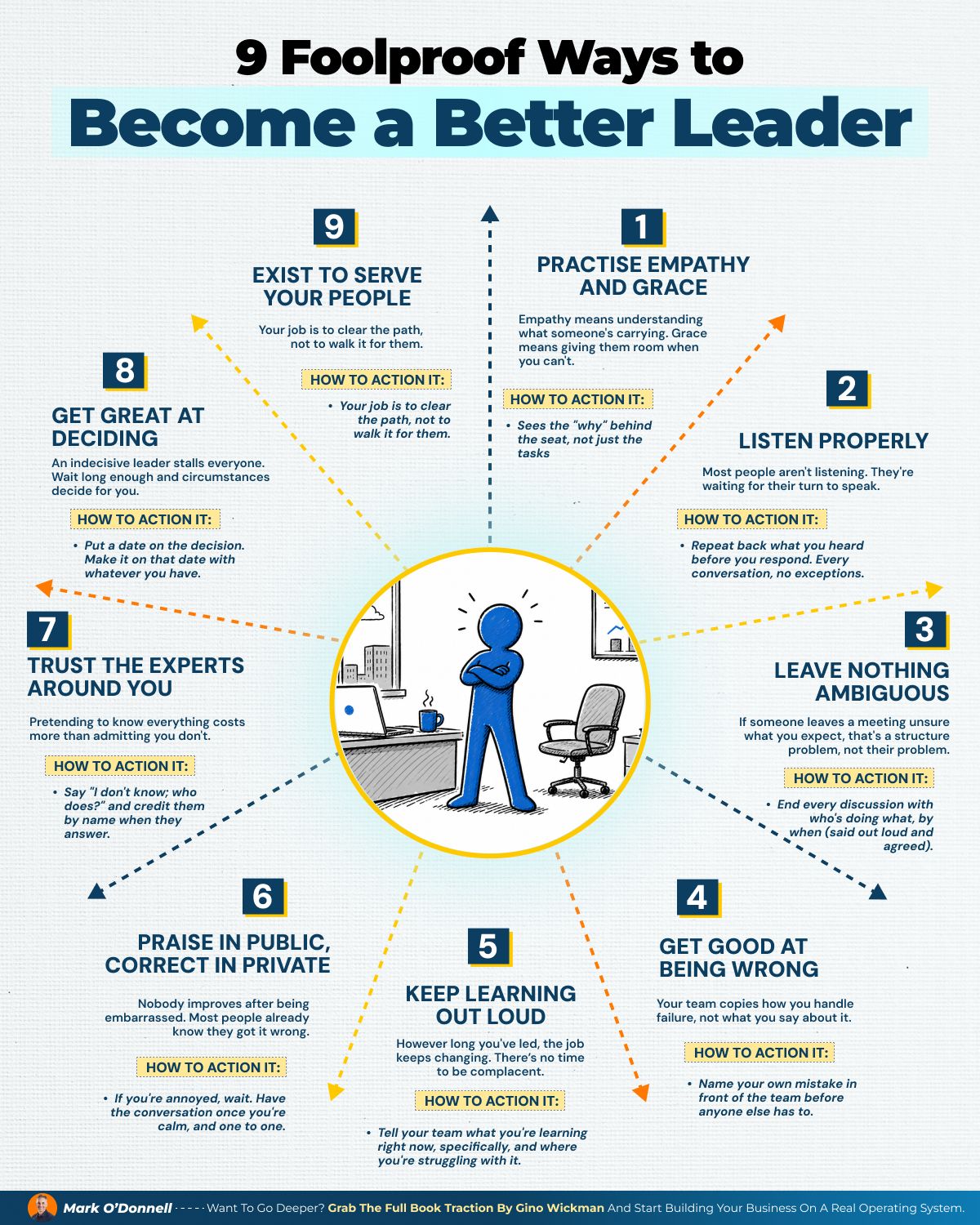
In a recent LinkedIn post, Mark O’Donnell delves into the core habits that distinguish effective leaders, arguing that true leadership is cultivated through consistent practice rather than innate talent. O’Donnell challenges the notion that poor team performance stems from a lack of initiative in team members, proposing instead that it often reflects a leader’s own lack of clarity.
The Root of Team Hesitation: Leader Clarity
O’Donnell begins by asserting that many perceived shortcomings in team members, such as excessive checking or seeking unnecessary permission, are frequently a reaction to the leader’s own communication style. He shares a personal realization: “I read that as a lack of initiative for years, when it was really feedback on how clear I’d been.” This insight shifted his perspective, leading him to identify nine fundamental habits that foster better leadership and, consequently, more proactive teams.
“Most of what makes a team slow is guesswork. And most of the guesswork is about you.”
He elaborates that when team members exhibit behaviors like waiting for approval or softening difficult news, they are often managing the uncertainty surrounding the leader’s potential reaction. O’Donnell contends that addressing this ambiguity is the leader’s responsibility, not the team’s failing.
Nine Habits for Cultivating Leadership
According to Mark O’Donnell, successful leaders consistently practice a set of nine habits. These are presented not as groundbreaking revelations, but as “fairly ordinary habits” that yield significant results when applied diligently.
Key Leadership Practices
- Empathy and Grace: Understanding team members’ situations and providing space when needed.
- Active Listening: Truly hearing what others say and reflecting it back before responding.
- Eliminating Ambiguity: Ensuring clear outcomes, responsibilities, and deadlines are explicitly stated. O’Donnell stresses the importance of clarity, stating,
“If people leave a meeting unsure what you wanted, that’s on you. Say who’s doing what by when, out loud, before they go.”
- Accountability for Mistakes: Leaders should openly acknowledge their own errors, setting an example for the team.
- Transparent Learning: Sharing ongoing work, challenges, and learning processes with the team.
- Constructive Feedback: Praising publicly and addressing corrections privately to avoid public embarrassment.
- Leveraging Expertise: Trusting and acknowledging the knowledge of experts within the team, rather than pretending to have all the answers.
- Decisiveness: Making timely decisions, recognizing that inaction can be more detrimental than a suboptimal choice. O’Donnell highlights this habit, noting,
“Making the call matters more than which call you make. A team can work around a wrong decision, but not one you haven’t made.”
- Service to the Team: Focusing on removing obstacles for team members rather than doing the work for them.
Clarity as the Foundation
O’Donnell emphasizes that effective leadership is fundamentally about clarity, management, and accountability. He points out that four of his listed habits—listening, eliminating ambiguity, feedback, and serving people—are direct applications of what he refers to as “LMA” (Leading, Managing, and Holding Accountable) in practical terms.
He reiterates that while charisma might be appealing, it’s the consistent application of these habits, particularly decisiveness, that truly drives team performance. As Mark O’Donnell concludes, the focus should be on making the right decisions in a timely manner, as a team’s ability to adapt to a wrong decision far exceeds its capacity to function without any decision at all.
📝 About This Content
This article is based on insights shared by Mark O'Donnell on LinkedIn.
📅 Originally posted on September 13, 2026 | View original post on LinkedIn →