
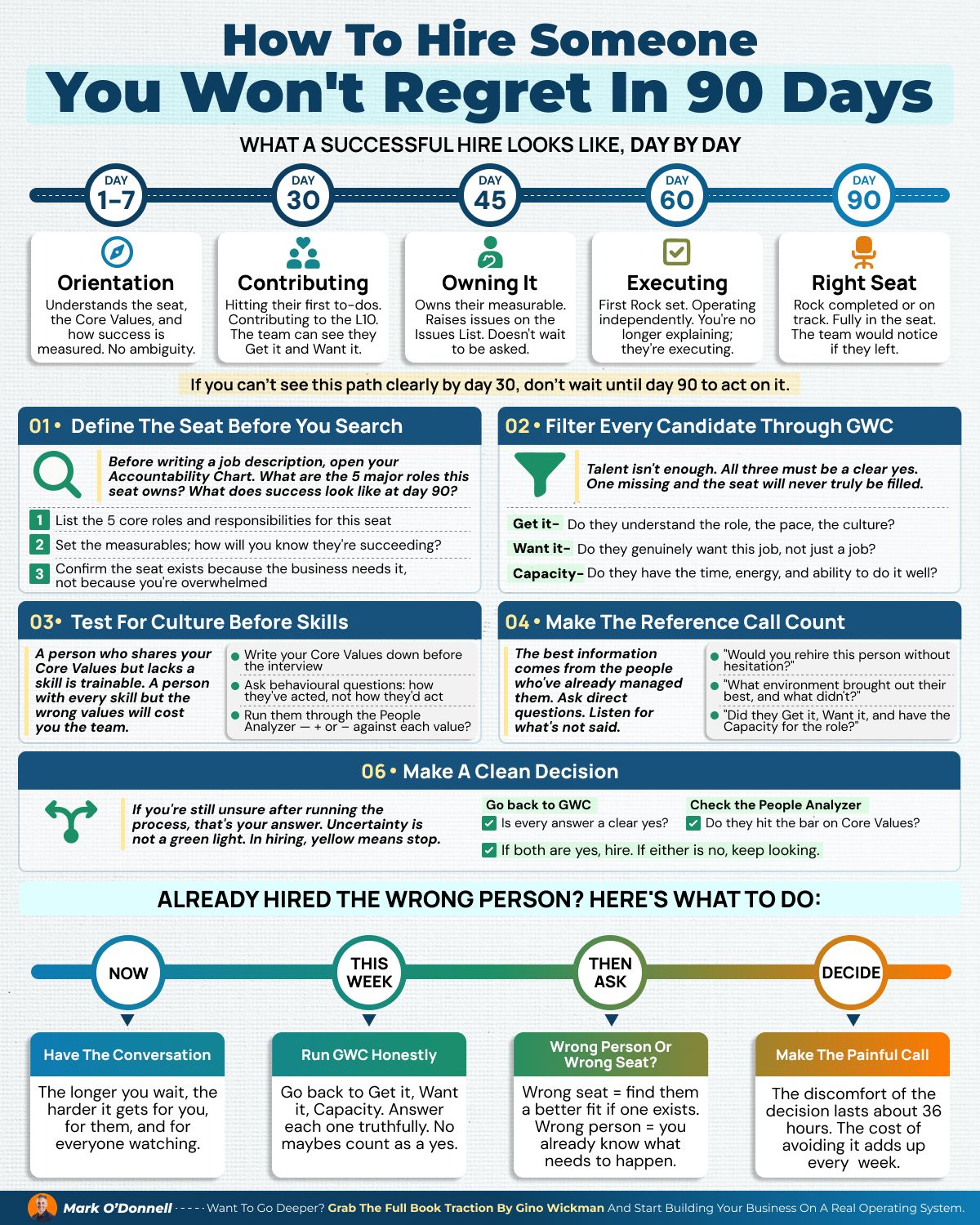
In a recent LinkedIn post, Mark O’Donnell discusses a critical framework for evaluating new hires, emphasizing the importance of early assessment to avoid prolonged hiring mistakes. O’Donnell argues that leaders often delay acknowledging a poor hiring decision, leading to significant self-inflicted pain and cost.
“You’ll know by day 30 if the hire was right. The problem is most leaders wait until day 90 to admit it.”
The leadership expert highlights that hiring is one of the most challenging aspects of a leader’s role and that many pitfalls are avoidable with a structured approach. O’Donnell proposes a benchmark system, dividing the crucial first 90 days into distinct phases with clear indicators of a successful integration.
The 90-Day Hiring Benchmark Explained
Mark O’Donnell outlines specific milestones to track a new hire’s progress, starting from their first week. According to O’Donnell, the initial days should focus on ensuring the new employee understands their role, the company’s core values, and how success is measured, leaving no room for ambiguity.
As O’Donnell notes, by Day 30, a successful hire should be contributing to team objectives and demonstrating an understanding of their responsibilities. He states:
“They’re hitting their first to-dos. Contributing to the L10. The team can already see they Get it and Want it.”
Further progression is marked at Day 45, where the new hire should be taking ownership of their key performance indicators. By Day 60, O’Donnell suggests they should be operating independently, setting initial goals, and executing tasks without constant guidance. The ultimate goal, as detailed by O’Donnell, is reached by Day 90, where the employee is fully integrated, successfully completing their initial major objectives, and is seen as an indispensable part of the team.
Key Strategies for Effective Hiring
To support this benchmark, Mark O’Donnell presents a five-step process designed to improve hiring outcomes:
1. Define the Role Before Searching
O’Donnell stresses the foundational importance of clearly defining the position before posting it. This involves identifying the core responsibilities and outlining what success looks like within the first 90 days. Building this detailed picture upfront is crucial for attracting the right candidates.
2. Implement the GWC (Get It, Want It, Capacity) Framework
According to Mark O’Donnell, talent alone is insufficient. He advocates for rigorously assessing candidates through the GWC lens: Do they ‘Get It’ (understand the role), ‘Want It’ (are motivated), and have the ‘Capacity’ (ability to perform)? O’Donnell insists that any hesitation on these three points should result in a rejection.
“Talent alone won’t fill the seat. All three have to be a yes: Do they Get it? Do they Want it? Do they have the Capacity?”
3. Prioritize Core Values Over Skills
Mark O’Donnell argues that cultural fit and shared values are paramount. He points out that an employee with strong values but lacking certain skills is trainable, whereas someone with all the skills but misaligned values can undermine team cohesion and prove costly in the long run. He recommends using assessment tools like a ‘People Analyzer’ for finalists.
4. Maximize the Value of Reference Checks
O’Donnell emphasizes that reference checks offer insights that interviews cannot. He advises asking direct questions about rehire potential and paying close attention to what is said, and unsaid, by previous managers.
5. Make Decisive Hiring Choices
Finally, Mark O’Donnell advises leaders to trust their gut if, after following the process, uncertainty remains. He states that indecision in hiring is not a positive sign and encourages revisiting the GWC assessment and People Analyzer. If these assessments are not a clear ‘yes,’ the search should continue. For those who have already hired the wrong person, O’Donnell suggests honestly re-evaluating whether the issue lies with the person or the role definition. He concludes by noting that while the discomfort of making a difficult decision is temporary, the cost of delay and a bad hire is not.
📝 About This Content
This article is based on insights shared by Mark O'Donnell on LinkedIn.
📅 Originally posted on April 30, 2026 | View original post on LinkedIn →