
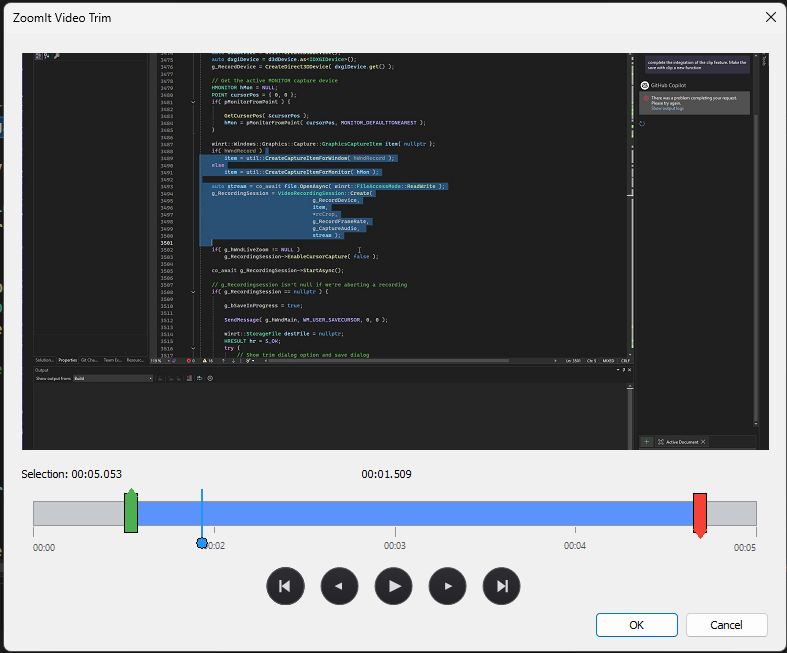
In a recent LinkedIn post, Mark Russinovich shares insights into how artificial intelligence has dramatically accelerated the development of a new feature for his widely-used Sysinternals utility, ZoomIt. Russinovich, a prominent figure in system utilities and Windows internals, highlighted his experience integrating an AI-powered clip editor directly into ZoomIt.
Traditionally, users of ZoomIt, often employed for screen recordings and demonstrations, have had to rely on separate video editing software to trim the beginning and end of captured clips. Russinovich aimed to streamline this process by embedding editing capabilities within ZoomIt itself.
For my own use, I want Sysinternals ZoomIt to be a one-stop shop for capturing screen recordings, like for demos, but I almost always have to use a video editor after a capture just to trim a clip’s start and end.
The core of Russinovich’s post details the surprising efficiency gained through AI assistance. Despite his familiarity with AI’s coding acceleration capabilities, he expressed astonishment at the speed at which a functional editor was produced.
AI-Driven Development Speed
Russinovich recounts his experience using AI prompting to develop the integrated editor. He emphasizes that the entire process, involving prompting and evaluating AI suggestions between meetings, took a minimal amount of his personal time, estimating it at around 30 minutes.
I decided to try to use AI to help me create a built-in ZoomIt clip editor for trimming clips after a recording. To my amazement – even after being used to getting a 10x AI coding boost – I was able to produce a professional trim editor in just two days of prompting and evaluating AI in between meetings, for a total of maybe 30 minutes of my time.
This rapid development cycle stands in stark contrast to traditional software development timelines for similar features. Russinovich points out the significant time savings, noting that the same functionality would have been a much more arduous undertaking without AI.
Comparing Development Efforts
According to Russinovich, the pre-AI development effort for such a feature would have been considerably more time-consuming.
This would have easily taken a dozen hours pre-agentic coding.
This stark comparison underscores the transformative potential of AI in software development, particularly for utility tools where specific, focused enhancements can have a significant impact on user experience. The ability to quickly iterate and integrate features based on AI-generated code, as demonstrated by Russinovich, represents a paradigm shift in how such tools can be enhanced.
Upcoming Features in ZoomIt
Russinovich concluded his post by announcing the upcoming release of this new functionality. Users can expect to see the AI-powered clip editor integrated into ZoomIt in the December update.
Look for this in the December Sysinternals update, along with GIF format support!
In addition to the built-in editing capabilities, the update will also introduce support for the GIF format, further enhancing ZoomIt’s utility for creating and sharing visual content. Russinovich’s proactive approach to leveraging cutting-edge technology like AI for user-centric improvements continues to solidify the Sysinternals suite’s reputation for powerful and evolving tools.
📝 About This Content
This article is based on insights shared by Mark Russinovich on LinkedIn.
📅 Originally posted on November 8, 2025 | View original post on LinkedIn →