
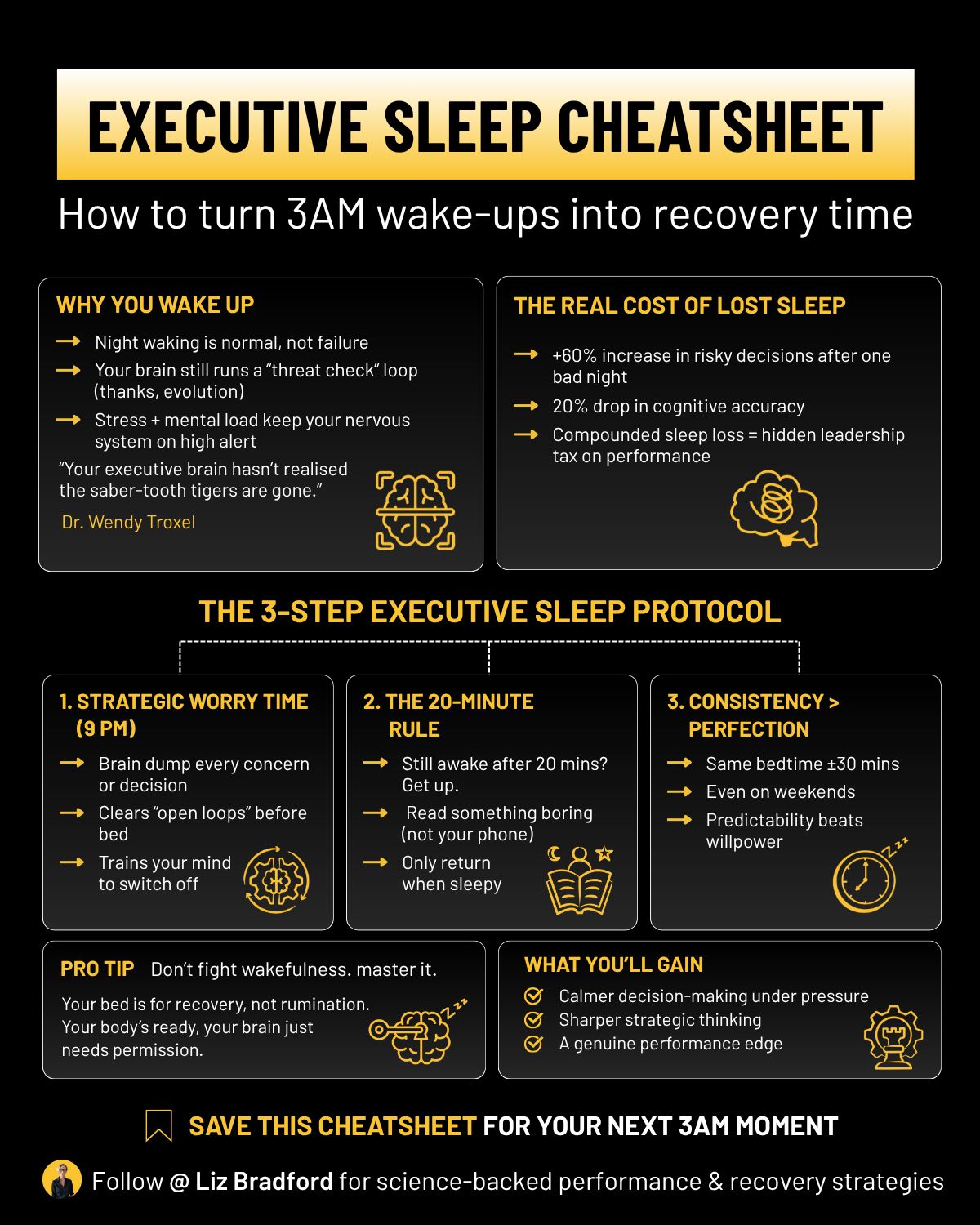
In a recent LinkedIn post, Liz Bradford explores a common yet disruptive experience for many executives: waking up in the middle of the night. She frames this not as an anomaly, but as a normal biological response that can be managed with the right strategies, offering insights drawn from sleep research to help leaders regain control of their nights and, consequently, their performance during the day.
Bradford highlights the evolutionary basis for nocturnal awakenings, suggesting that the brain’s ancient threat-detection mechanisms may still be active. She quotes Dr. Wendy Troxel, a leading sleep researcher, to illustrate this point:
“Our ancestors needed to wake periodically to check for threats. Your executive brain just hasn’t realised the saber-tooth tigers are gone.”
This evolutionary echo, Bradford argues, is not the core problem. Instead, the issue lies in how executives react to these wakeful periods. The post details the significant, often underestimated, costs of executive sleep loss on decision-making and productivity.
The High Cost of Fragmented Sleep for Leaders
Liz Bradford emphasizes that fragmented sleep directly impacts an executive’s ability to make sound judgments, particularly regarding financial matters. She points out the measurable decline in cognitive performance following even a single night of poor sleep. When this occurs across leadership teams, the cumulative effect can lead to substantial losses in overall productivity and strategic effectiveness.
“Leaders running on fragmented sleep make riskier financial decisions,” Bradford states, underscoring the tangible business impact of sleep deprivation. She further notes the compounding effect across teams, leading to what she terms “massive productivity loss.”
A Counterintuitive Approach to Night Waking
Bradford introduces a surprising yet effective approach: instead of fighting wakefulness, executives should learn to master it. She references Dr. Troxel’s research, which indicates that stimulus control therapy is more effective than sleeping pills. The core principle is to prevent the bed from becoming associated with anxiety and wakefulness.
“When you lie awake for more than 20 minutes, your bed turns from a recovery zone into a worry zone.”
This association, Bradford explains, can train the brain to expect wakefulness and worry when in bed, perpetuating the cycle. Her strategy focuses on breaking this pattern by disassociating the bed from the act of worrying.
The 3-Step Executive Sleep Protocol
To combat night waking and its consequences, Liz Bradford outlines a practical, three-step protocol designed for executives:
1. Strategic Worry Time
Bradford suggests dedicating 15 minutes each evening, around 9 PM, to a “brain dump.” This involves writing down all pressing decisions, deadlines, and concerns. As Bradford notes, “It’s not therapy, it’s cognitive decluttering.” The goal is to provide the mind with evidence that these thoughts are acknowledged and will be addressed, thereby reducing their tendency to resurface at 3 AM.
2. The 20-Minute Rule
This step directly addresses what to do when waking up during the night. Bradford advises getting out of bed if one remains awake for more than 20 minutes. The recommendation is to go to another room and engage in a non-stimulating activity, such as reading something mundane, and to return to bed only when genuine sleepiness returns. This helps reinforce the bed’s association with sleep, not wakefulness.
3. Consistency Over Perfection
Finally, Bradford stresses the importance of maintaining a consistent sleep schedule, even on weekends, aiming for a bedtime window within a 30-minute range. She argues that “Your brain runs better on predictability than willpower,” suggesting that routine is more crucial for sleep regulation than striving for an unattainable ideal of perfect sleep every night.
The ultimate payoff, as outlined by Bradford, extends beyond improved sleep. It encompasses sharper strategic thinking, enhanced clarity, and better emotional regulation—qualities that distinguish exceptional leaders. By following these science-backed strategies, executives can leverage their body’s natural recovery processes for peak performance.
📝 About This Content
This article is based on insights shared by Liz Bradford on LinkedIn.
📅 Originally posted on November 5, 2025 | View original post on LinkedIn →