
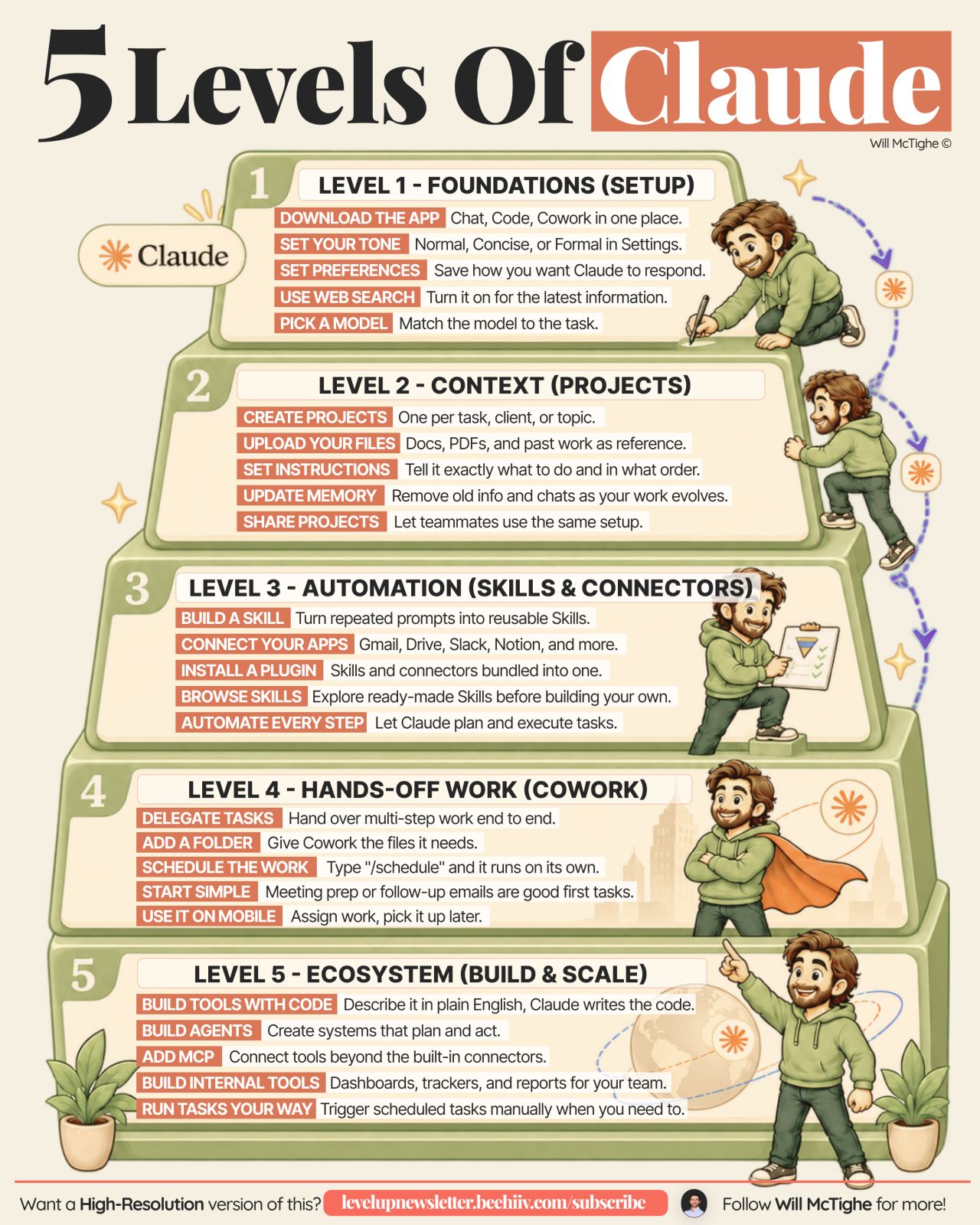
In a recent LinkedIn post, Will McTighe discusses a structured approach to leveraging AI tools, comparing the learning curve to the career progression at Goldman Sachs. McTighe emphasizes that true AI proficiency, much like achieving a Managing Director (MD) title, requires a foundational understanding and progressive skill development, rather than simply using AI for isolated, low-level tasks.
McTighe critiques the common approach of using AI for simple, one-off tasks, suggesting it can lead to a perception of inefficiency. He states:
“It’s easy to open Claude, hand it a one-off task like summarizing a PDF or replying to an email, then go off and do the main work manually. Do that 20 times a day and AI starts to feel manual… and not worth your time.”
The 5 Levels of AI Mastery
To move beyond this initial, often frustrating, stage, McTighe outlines a five-level framework designed to progressively integrate AI into workflows. This model moves from basic setup to a fully integrated AI ecosystem.
Level 1: Foundations (Setup)
The initial step, according to McTighe, involves properly configuring the AI tool. This includes selecting the appropriate model, defining the desired tone and preferences, and enabling features like web search for up-to-date information.
Level 2: Context (Projects)
McTighe explains that this level focuses on teaching the AI about specific workflows and knowledge domains. By creating distinct projects for different tasks, clients, or topics, and populating them with relevant files, past work, and instructions, users enable the AI to build context.
Level 3: Automation (Skills & Connectors)
At this stage, McTighe suggests automating repetitive tasks by converting common prompts into reusable ‘Skills’. Furthermore, he highlights the importance of connecting the AI to other essential business applications such as Gmail, Drive, Slack, and Notion to streamline operations.
McTighe shares a personal example:
“I have a Skill for finding post ideas so I can give Claude real examples of what I like instead of rebuilding the process every time.”
Level 4: Hands-Off Work (Cowork)
This level represents a significant shift towards delegating complete tasks rather than individual steps. McTighe advocates for providing the AI with a folder of necessary files and a clear definition of the desired outcome, allowing it to manage the subsequent steps autonomously.
Level 5: Ecosystem (Build & Scale)
The apex of McTighe’s framework involves embedding the AI into the core operational structure. This includes developing custom tools with code, creating autonomous agents capable of planning and execution, integrating external tools via specific connectors, and scheduling automated jobs.
McTighe reiterates the progressive nature of this learning journey:
“Nobody makes MD in year one, and nobody needs to hit level 5 this week either. Moving up just one level is enough to make the manual feeling start to disappear.”
By following this structured, multi-level approach, McTighe argues that individuals and organizations can move beyond superficial AI usage to unlock its transformative potential, making the technology feel less like a manual add-on and more like an integrated, indispensable partner in their work.
📝 About This Content
This article is based on insights shared by Will McTighe on LinkedIn.
📅 Originally posted on September 5, 2026 | View original post on LinkedIn →