
In a recent LinkedIn post, Alvin Huang delves into a common pitfall for early-stage business leaders: the tendency to do everything themselves, which he argues is a significant impediment to growth.
Huang asserts that this hands-on approach, while seemingly productive in the short term, ultimately creates a bottleneck that prevents scaling. He recounts his own early experiences, stating:
“When I was first starting out in business, I spent years trying to be everything: The strategist… operator… firefighter… therapist… Basically, the entire company.”
This approach, Huang explains, leads to a situation where the founder becomes the ceiling for the company’s potential. “But if everything depends on you, you just have a very stressful job. Not a business,” he writes.
The Perils of the Founder as Bottleneck
Huang highlights that when a founder is involved in every decision, the business cannot scale effectively. He likens this to having a very stressful job rather than a sustainable business. The core issue, according to Huang, is the lack of effective delegation, which is crucial for any leader aiming for growth.
Alvin Huang’s 7 Levels of Delegation
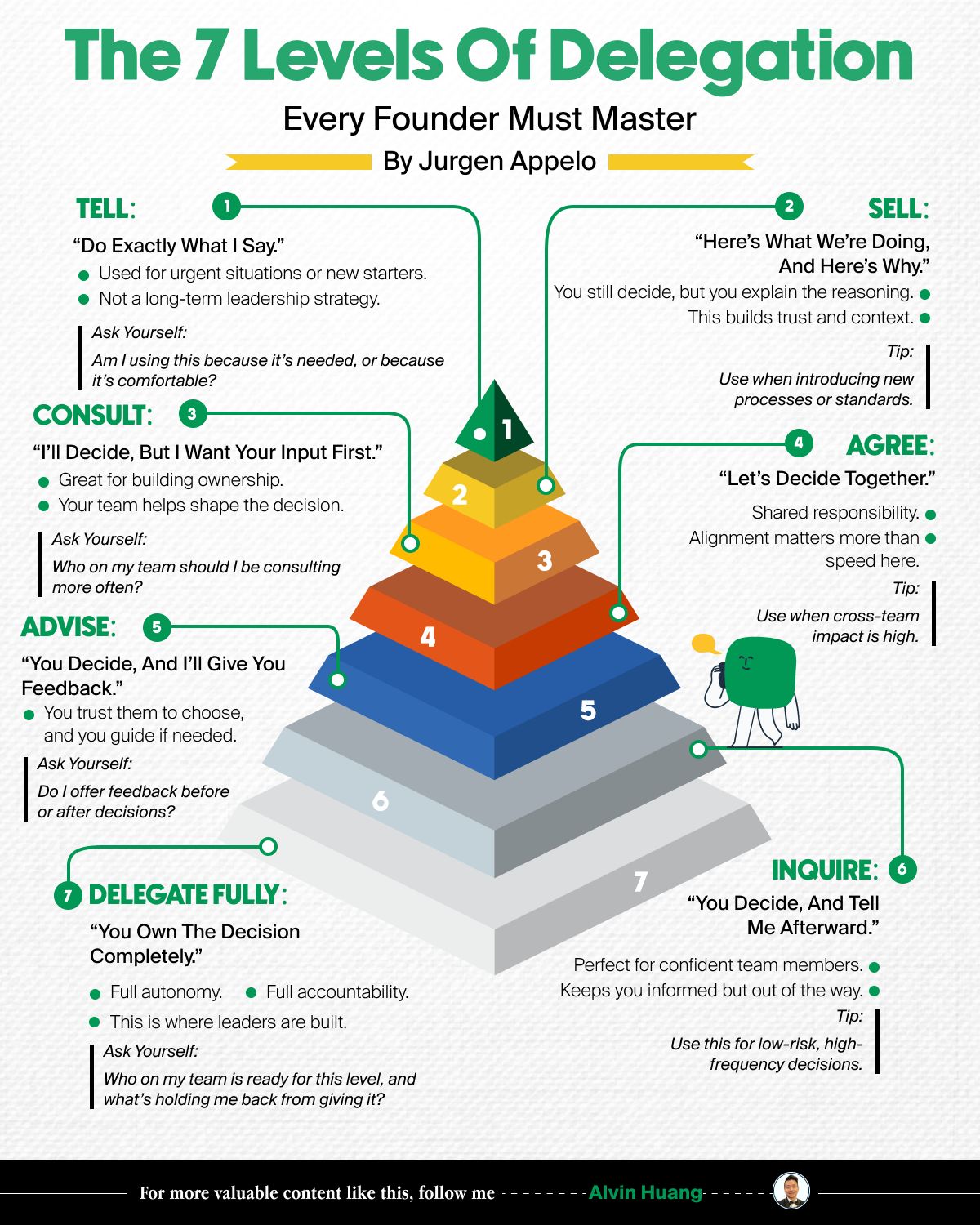
To address this challenge, Huang outlines a seven-level framework for delegation, designed to help founders gradually empower their teams and step back from being the central decision-maker. He categorizes these levels as follows:
Level 1: Tell
This is the most basic form of delegation, where instructions are explicit: “Do exactly this.” Huang notes this is useful for urgent tasks or onboarding new hires but is detrimental as a long-term strategy, as it keeps leaders mired in details.
Level 2: Sell
Here, the leader explains the task and the rationale behind it: “Here’s what we’re doing, and here’s why.” This level begins to teach team members how to think about the work, not just execute it.
Level 3: Consult
At this stage, the leader still makes the final decision but actively seeks input: “I’ll decide, but I want your input first.” Huang emphasizes that if a team never reaches this level, they risk becoming “order-takers” rather than empowered contributors.
Level 4: Agree
This level involves collaborative decision-making: “Let’s decide together.” While potentially slower, Huang argues that this fosters alignment, which builds speed across departments in the long run.
Level 5: Advise
The dynamic shifts here, with the leader offering feedback on decisions made by the team: “You decide, and I’ll give you feedback.” This, according to Huang, is a critical step in testing and building a team’s judgment.
Level 6: Inquire
In this stage, the team makes decisions independently and reports back afterward: “You decide, and tell me afterward.” Huang suggests this is ideal for trusted individuals, as it removes the leader as a bottleneck while maintaining awareness.
Level 7: Delegate Fully
This represents the highest level of delegation, where the team member owns the decision completely: “You own the decision completely.” Huang states this is where “real leverage, and real leadership growth happens.”
Avoiding Founder Burnout Through Effective Delegation
Huang concludes by reiterating that many founders experience burnout because they fail to delegate tasks and decisions in a timely manner. He advises leaders that:
“If you want your company to grow, you’ve got to stop wearing every hat. Your team can’t step up if you never step back.”
The post prompts reflection on common delegation struggles among founders, encouraging them to evaluate their own practices to foster team growth and prevent personal burnout.
📝 About This Content
This article is based on insights shared by Alvin Huang on LinkedIn.
📅 Originally posted on December 10, 2025 | View original post on LinkedIn →