
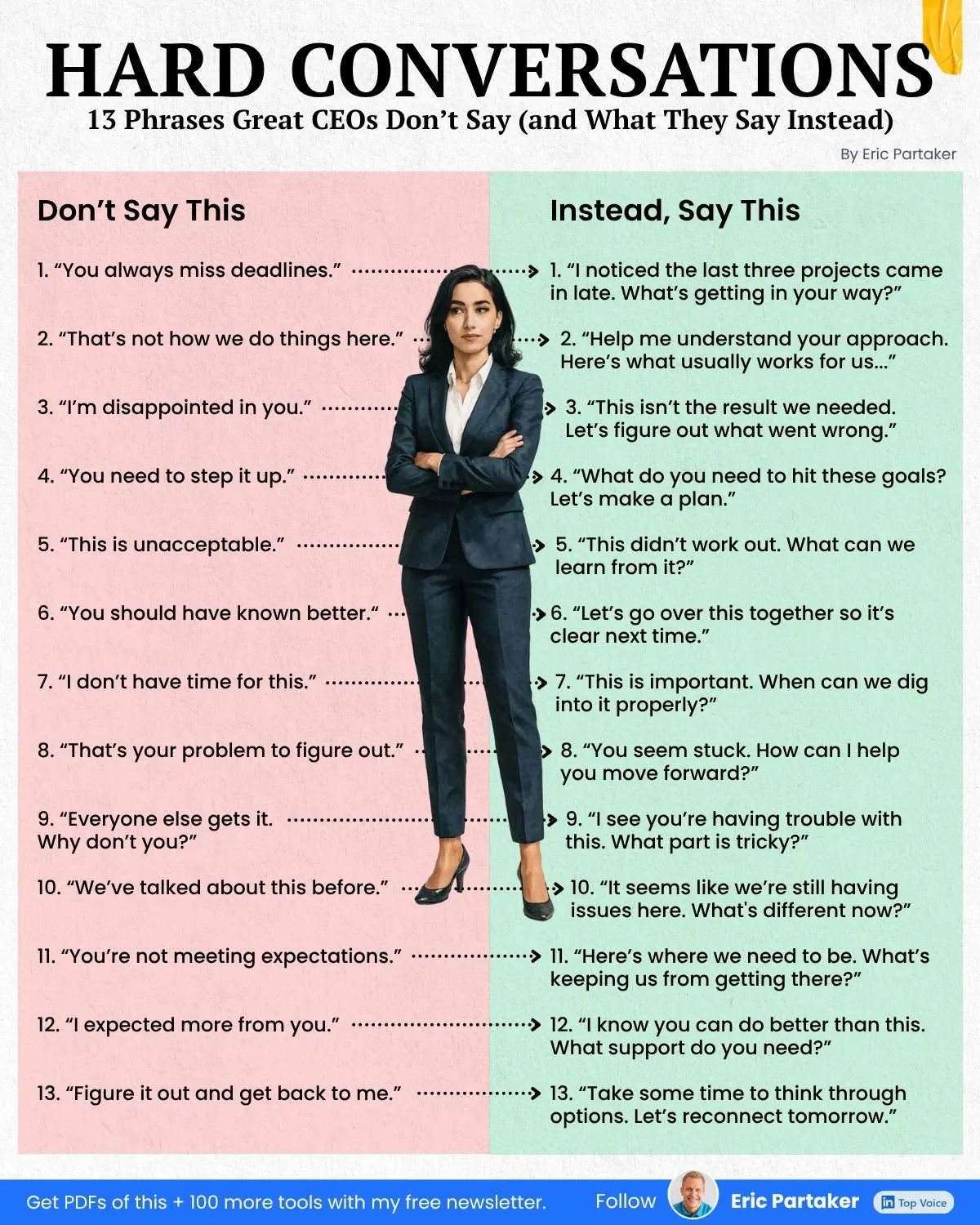
In a recent LinkedIn post, Eric Partaker delves into the critical skill of navigating difficult conversations, asserting that a leader’s ability to handle these interactions effectively is a key differentiator in building successful companies. Partaker contrasts the approaches of what he terms “weak leaders” with those of “exceptional CEOs,” suggesting that the former often avoid necessary discussions, while the latter leverage them for growth and trust-building.
The Impact of Difficult Conversations
Eric Partaker begins by highlighting a stark statistic: “87% of leaders avoid hard conversations. The other 13% build successful companies.” This framing immediately sets the stage for his argument that confronting challenging topics is not a detriment to team cohesion, but rather a fundamental component of effective leadership. According to Partaker, it’s not the difficult conversations themselves that disrupt teams, but rather the poorly handled ones.
“Most CEOs think tough conversations disrupt teams. They don’t. Bad conversations do.”
Partaker’s extensive experience, gained from coaching over 400 CEOs, has allowed him to identify specific linguistic patterns that either shut down dialogue or foster productive engagement. He categorizes these into phrases used by “weak leaders” versus those employed by “exceptional CEOs.”
From Accusations to Inquiries
A core theme in Partaker’s analysis is the shift from making declarative, often accusatory statements to posing open-ended questions. He illustrates this with several examples, demonstrating how a leader’s choice of words can fundamentally alter the dynamic of a feedback session.
Replacing Statements with Questions
Partaker provides a list of common pitfalls and their constructive alternatives:
- Instead of “You always miss deadlines,” an exceptional CEO asks, “I noticed the last three projects came in late. What’s getting in your way?”
- When addressing performance issues, “I’m disappointed in you” is replaced by, “This isn’t the result we needed. Let’s figure out what went wrong.”
- Rather than stating “You need to step it up,” the effective leader inquires, “What do you need to hit these goals? Let’s make a plan.”
As Eric Partaker notes, the underlying pattern is clear: “Weak leaders make statements. Strong leaders ask questions.” This approach, he argues, moves away from creating fear and instead cultivates trust.
“Weak leaders shut down dialogue. Strong leaders open it up.”
The Benefits of Question-Based Feedback
The strategic use of questions, according to Partaker, yields significant benefits. When leaders inquire rather than accuse, they encourage employees to:
- Reveal the root cause of problems.
- Take ownership of finding solutions.
- Develop a greater sense of respect for their leader.
Partaker emphasizes that mastering these difficult conversations is not just about retaining talent, but about actively developing it. “The leaders who master difficult conversations don’t just keep their best people. They create them,” he asserts.
“When you ask instead of accuse: • People tell you the real problem • They own the solution • They respect you more (not less)”
Partaker concludes by encouraging leaders to save and utilize his provided list of phrases as a practical guide for their one-on-one meetings. He also offers a downloadable PDF of his “Hard Conversations cheat sheet” and promotes his Founder & CEO Accelerator program for leaders aiming to overcome growth plateaus.
📝 About This Content
This article is based on insights shared by Eric Partaker on LinkedIn.
📅 Originally posted on November 28, 2025 | View original post on LinkedIn →