
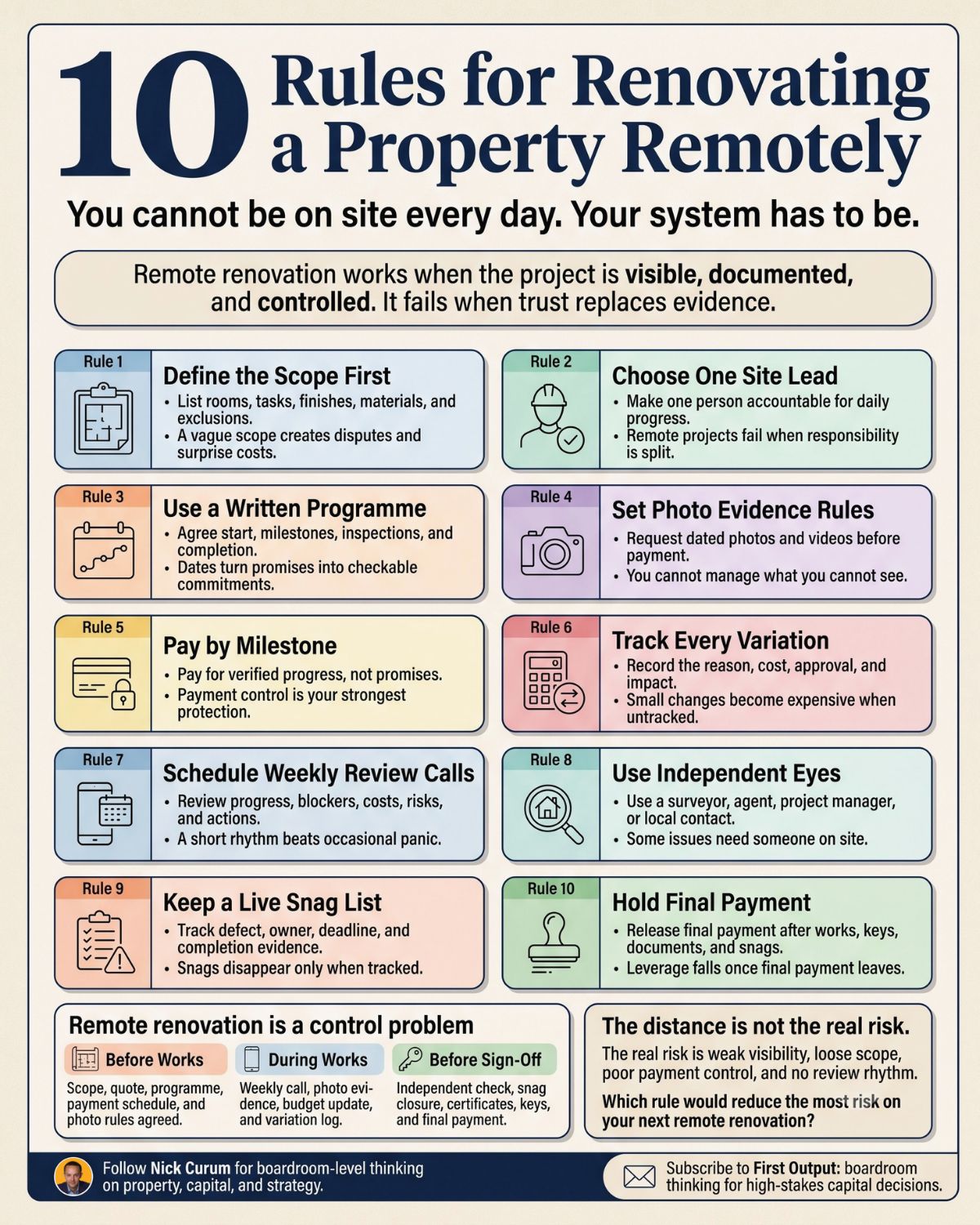
In a recent LinkedIn post, Nick Curum discusses the challenges of managing property renovation projects remotely, particularly when dealing with the demands that extend into weekends. He emphasizes that the key to maintaining a semblance of work-life balance while overseeing property investments is not about being present 24/7, but about establishing robust systems.
Curum recounts his early mistakes, noting the common investor pitfall of relying on trust rather than verifiable evidence. He states:
“Early on, I made the mistake most investors make: I relied on trust instead of evidence.”
This over-reliance on assumptions, such as believing that a good contractor automatically means a smooth project or that a lack of communication signifies no issues, proved detrimental. Curum argues that the critical shift required is not in the people involved, but in the operational framework.
Establishing Systems for Remote Project Control
Curum outlines ten essential rules designed to manage renovation projects effectively, even when direct, daily on-site supervision is not feasible. These rules are geared towards replacing implicit trust with explicit processes and evidence.
Key Principles for Oversight
Central to Curum’s strategy is the concept of moving from a trust-based model to an evidence-based control system. He highlights that the real risks in remote renovations are not the distance itself, but rather weak visibility, poorly defined project scopes, and premature payments.
He elaborates on the importance of clear documentation and accountability:
“Define the scope before work starts. List rooms, tasks, finishes, materials, and exclusions. A vague scope creates disputes and surprise costs.”
Furthermore, Curum stresses the need for a single point of contact for daily oversight and a structured project timeline. He introduces the concept of using photographic evidence as a crucial tool for project verification.
“Set photo evidence rules. Request dated photos and videos before releasing any payment. You cannot manage what you cannot see.”
Another cornerstone of his approach is milestone-based payments. As Curum points out:
“Pay by milestone. Pay for verified progress, not promises. Payment control is your strongest protection.”
He also details the necessity of meticulously tracking every variation, conducting regular review calls, and utilizing independent third parties for site inspections. Maintaining a live snag list and strategically holding the final payment are presented as vital mechanisms for ensuring project completion and quality.
Shifting the Paradigm from Trust to Evidence
Curum concludes by reiterating that remote renovation success is fundamentally a control problem. The risks are magnified by a lack of transparency and accountability. By implementing these ten rules, property investors can gain better visibility and control over their projects, mitigating potential issues before they escalate into significant financial or logistical problems.
He prompts readers to consider which of his rules would offer the most risk reduction for their own projects, encouraging a proactive approach to project management.
📝 About This Content
This article is based on insights shared by Nick Curum on LinkedIn.
📅 Originally posted on June 27, 2026 | View original post on LinkedIn →