
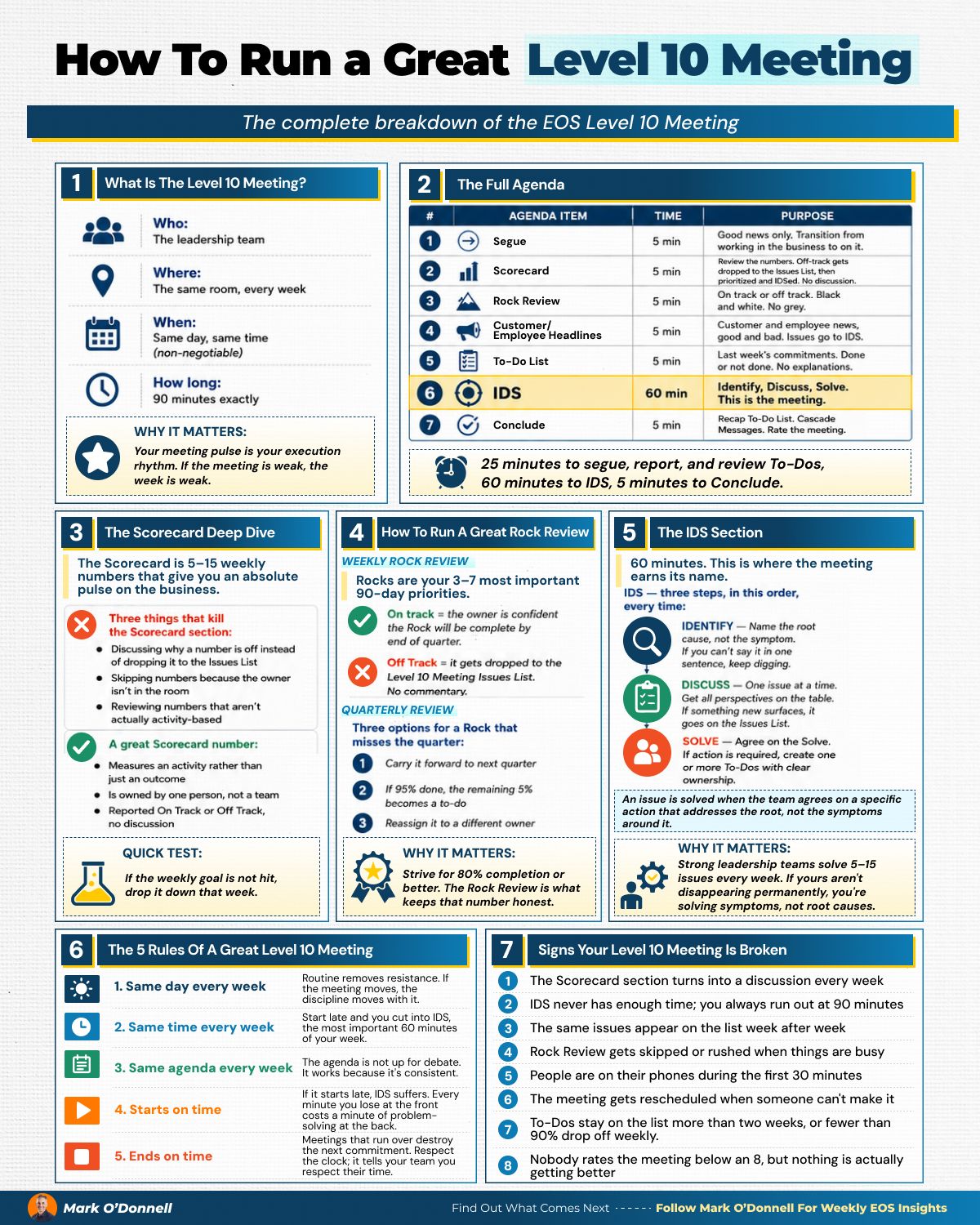
In a recent LinkedIn post, Mark O’Donnell illuminates a critical, yet often overlooked, component of high-performing teams: the weekly meeting. O’Donnell argues that a structured, consistent approach to these gatherings is the “secret to all teams that execute well.” He introduces the “Level 10 Meeting,” a format derived from the Entrepreneurial Operating System (EOS), as a powerful tool for enhancing team productivity and problem-solving.
The Foundation of Effective Team Meetings
O’Donnell emphasizes that while the concept of a weekly meeting is simple, its effective execution is rare. He outlines the Level 10 Meeting structure, a 90-minute session with a fixed agenda, designed to be run identically every week. This consistency, he suggests, is key to its efficacy. As O’Donnell states:
“90 minutes, a fixed agenda, run the same way every single week. It sounds simple, but most teams have never actually done it.”
The author breaks down the agenda into seven distinct sections, each with a specific time allocation and purpose. This meticulous structure is designed to transition teams from the day-to-day operational focus to a more strategic, problem-solving mindset.
Deconstructing the Level 10 Agenda
According to Mark O’Donnell, the agenda is carefully crafted to maximize efficiency and impact:
The Meeting’s Core Components
- Segue (5 min): Beginning with “good news only” aims to shift the team’s focus from immediate tasks to broader strategic thinking.
- Scorecard (5 min): Reviewing weekly numbers ensures accountability, with any deviations immediately flagged for deeper analysis without lengthy discussion.
- Rock Review (5 min): Progress on key objectives, or “Rocks,” is assessed strictly as on track or off track, eliminating ambiguity.
- Headlines (5 min): Sharing customer and employee news provides a pulse on external and internal factors, with issues escalated as needed.
- To-Do List (5 min): A quick review of last week’s commitments, focusing solely on completion status.
Identify, Discuss, Solve (IDS): The Heart of the Meeting
The most substantial portion of the meeting, 60 minutes, is dedicated to the IDS section. O’Donnell highlights that this is where the real work of problem-solving occurs. He elaborates on the process:
“→ Identify: name the root cause, not the symptom. If you can’t say it in one sentence, keep digging. → Discuss: one issue at a time. If something new surfaces, it goes on the Issues List. → Solve: one action, one owner, seven days, reviewed next week.”
O’Donnell points out that strong teams can resolve a significant number of issues within this timeframe, typically between five and fifteen per week. He cautions against addressing symptoms rather than root causes, which leads to recurring problems.
Cultivating a Culture of Effective Meetings
Mark O’Donnell acknowledges that implementing the Level 10 Meeting might feel unusual at first. However, he assures readers that consistency is key to developing comfort and proficiency. As O’Donnell notes:
“Your first Level 10 will feel awkward. But by week four, it becomes natural. And by week eight, your team won’t want to miss it.”
He concludes by encouraging readers to save his post and implement the structure to improve their own team meetings. The adherence to a fixed schedule, agenda, and timekeeping is presented not just as a procedural requirement, but as a fundamental practice for fostering discipline and accountability within a team, ultimately driving better execution.
📝 About This Content
This article is based on insights shared by Mark O'Donnell on LinkedIn.
📅 Originally posted on June 20, 2026 | View original post on LinkedIn →