
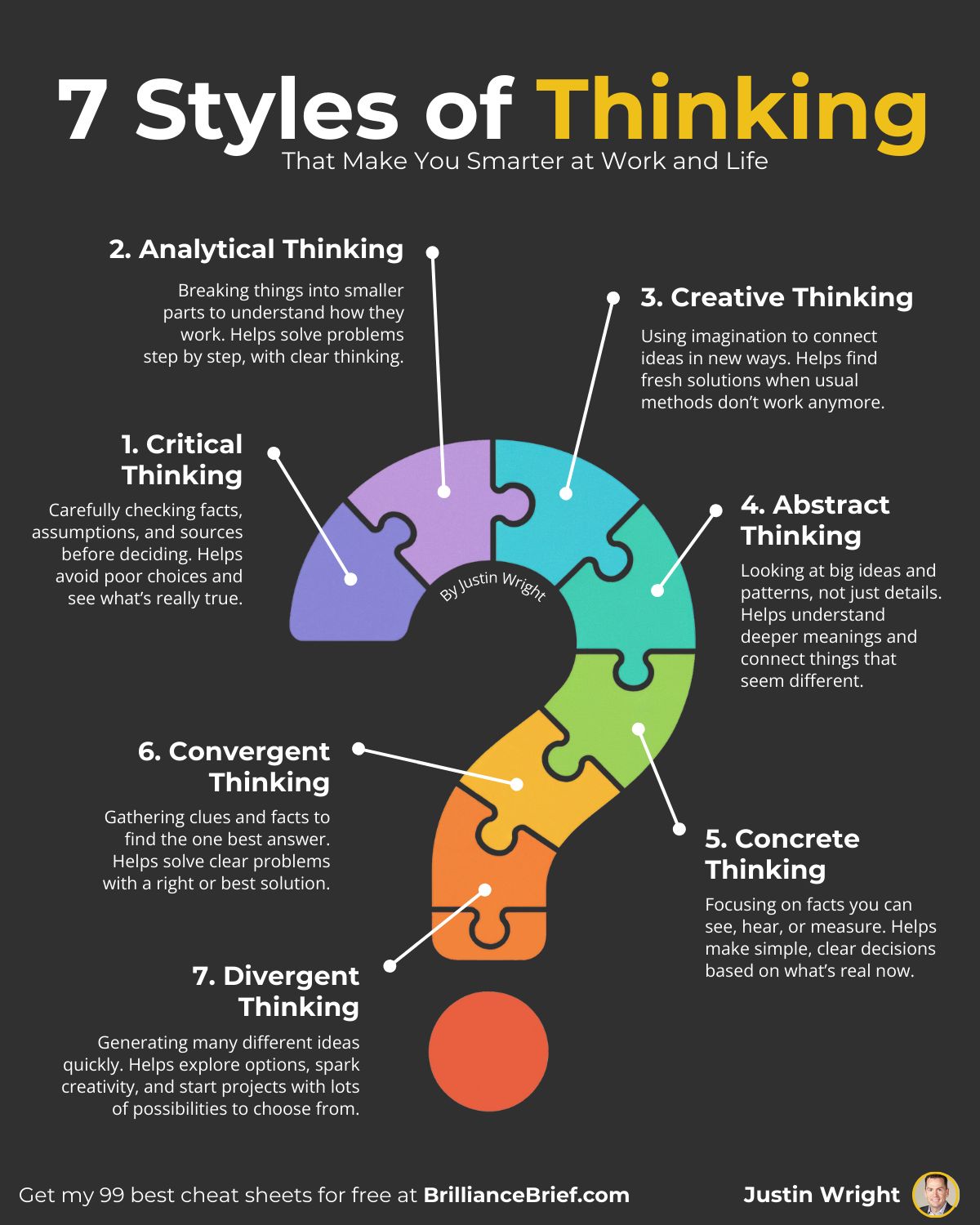
In a recent LinkedIn post, Justin Wright explores a comprehensive framework detailing seven distinct thinking styles that differentiate high-achievers from the general population. Wright argues that while most individuals rely on only one or two of these styles, the most effective leaders consciously employ all seven to navigate complex challenges and drive innovation.
Wright begins by introducing the foundational style:
“Critical Thinking is where it all starts. It means asking questions before believing things. Checking if something is really true. Not just accepting what you hear.”
According to Justin Wright, critical thinking acts as a vital “truth detector,” essential for preventing poor decisions based on misinformation. Without this ability, individuals are susceptible to making choices based on flawed data.
The Power of Analytical and Creative Approaches
Justin Wright then delves into Analytical Thinking, which he describes as the process of deconstructing large problems into manageable components. This approach, likened to solving a puzzle piece by piece, transforms seemingly insurmountable tasks into achievable goals.
Complementing this is Creative Thinking, highlighted by Wright as crucial when conventional methods fail. He emphasizes its role in forging novel connections and discovering unique solutions that set individuals apart.
“This is where breakthroughs happen.”
As Justin Wright points out, creative thinking is the engine of innovation, enabling the generation of ideas that challenge the status quo.
Seeing the Big Picture and Grounding in Reality
Wright introduces Abstract Thinking as the ability to perceive overarching patterns and connections, a skill that allows individuals to see the “big picture” while others are engrossed in minor details. This broader perspective enables the identification of deeper meanings and trends that might otherwise go unnoticed.
In contrast, Concrete Thinking is presented as the essential grounding force, focusing on tangible facts and measurable data. Wright asserts that this style is instrumental in translating abstract concepts and aspirations into tangible realities.
“This turns dreams into reality.”
In Justin Wright’s view, the interplay between abstract and concrete thinking allows for both visionary planning and practical execution.
Convergent vs. Divergent: Finding the Best Solution or Creating Many
The framework further distinguishes between Convergent and Divergent Thinking. Wright explains Convergent Thinking as the focused effort to identify the single, optimal solution to a problem, akin to following clues to solve a mystery. This style is about efficiency and precision when a definitive answer exists.
Conversely, Divergent Thinking is characterized by its generation of a wide array of potential solutions, encouraging the exploration of even unconventional ideas. Justin Wright suggests that this expansive approach leads to more robust decision-making by broadening the range of possibilities.
“More choices mean better decisions.”
According to Justin Wright, the ability to fluidly switch between these modes is a hallmark of effective leadership.
Integrating the Seven Styles for Leadership Excellence
A key takeaway from Wright’s post is that individuals already possess all seven thinking styles; the challenge lies in their conscious application and practice. He provides practical prompts for each style, such as questioning information (Critical), breaking down tasks (Analytical), asking “what if?” (Creative), looking for patterns (Abstract), focusing on facts (Concrete), finding the best solution (Convergent), and generating multiple options (Divergent).
Wright concludes by likening the skillful leader’s application of these styles to a driver changing gears, emphasizing the importance of knowing which style to deploy and when. He posits that unlocking the full potential of these seven thinking styles is key to enhanced cognitive power and leadership effectiveness.
📝 About This Content
This article is based on insights shared by Justin Wright on LinkedIn.
📅 Originally posted on April 12, 2026 | View original post on LinkedIn →