
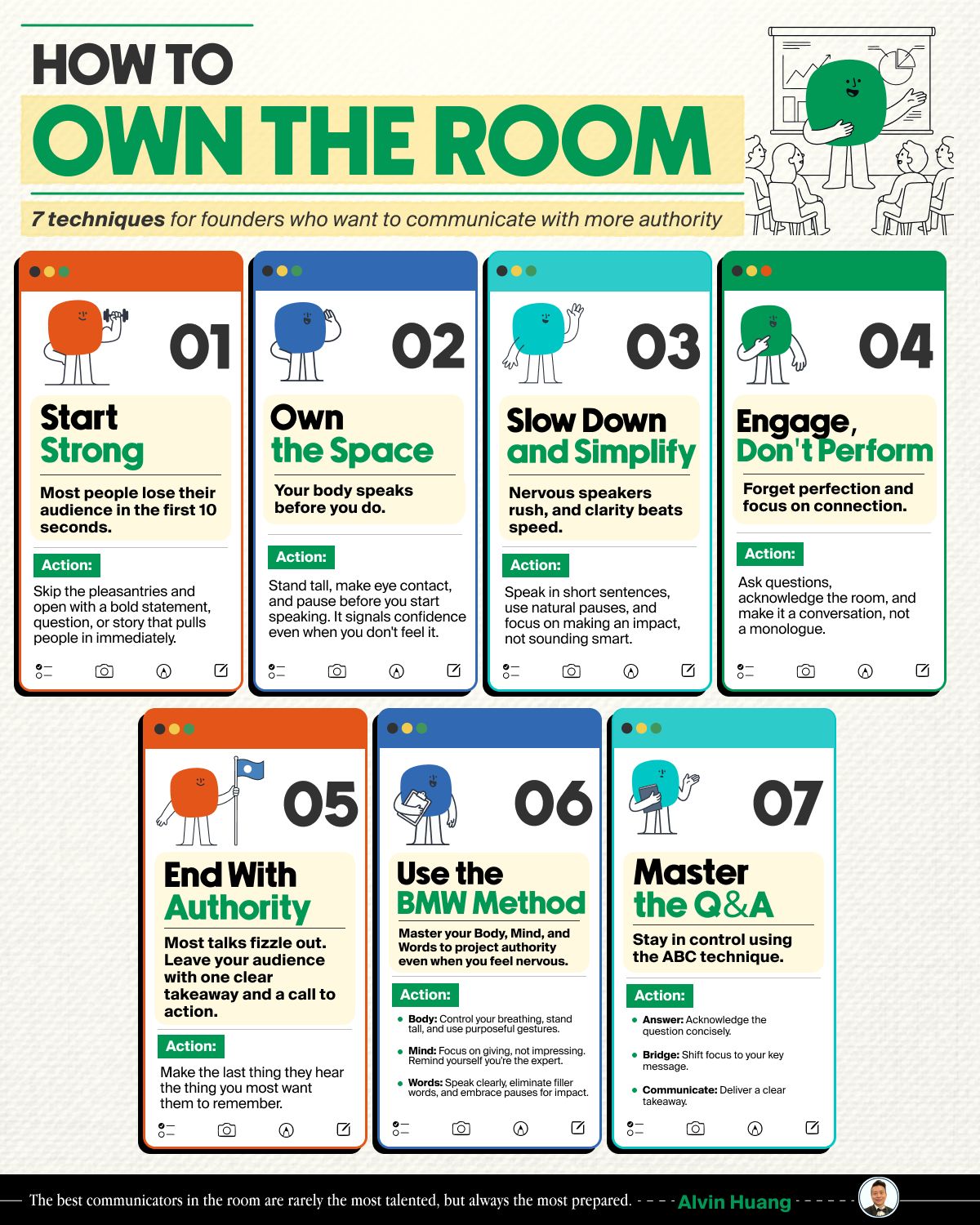
In a recent LinkedIn post, Alvin Huang explores the critical importance of commanding presence in business pitches and public speaking, asserting that a deal can be lost within the first minute, often unrelated to the product itself. Huang challenges the notion that public speaking prowess is an innate talent, instead presenting it as a skill honed through deliberate practice and specific techniques.
Building a Commanding Presence Through Technique
Alvin Huang argues that cultivating a strong presence is an intentional process, built over time through consistent effort. He dismisses the idea that some individuals are simply born with charisma, stating:
“That’s exactly why I don’t buy the idea that some people just have it and some people don’t.”
Huang emphasizes that these skills are transferable across various settings, from boardrooms to large stages. He outlines seven key techniques designed to help anyone develop a more impactful delivery.
Seven Techniques for Effective Delivery
Huang’s post details a practical, step-by-step approach to improving public speaking. He categorizes these techniques as actionable skills that require repetition to master.
1. Start Strong and Own the Room
According to Huang, presenters should immediately capture attention rather than resorting to polite pleasantries. His first technique advises, “Start With a Hook, Not a Pleasantry,” urging speakers to bypass standard greetings and open with impactful content. Furthermore, he highlights the importance of physical presence before speaking:
“Own the Space Before You Speak. Plant your feet, take a breath, and let the room settle before your first word.”
2. Clarity and Connection in Communication
Nerves often lead to speaking too quickly, which can undermine confidence. Huang suggests, “Slow Down and Simplify,” noting that deliberate pacing and clearer language are perceived as signs of greater confidence. He also advocates for a conversational approach, recommending speakers to “Treat It as a Conversation, Not a Performance.” This method, as Huang explains, reduces pressure and fosters a stronger connection with the audience.
3. Strategic Endings and Preparation
Huang stresses the importance of a decisive conclusion. He advises speakers to “End With a Clear Statement and a Call to Action,” ensuring their message lands with impact and provides direction. Before even uttering a word, Huang points out the significance of preparation through his “BMW Method”: Body, Mind, Words. This holistic approach underscores how physical and mental readiness primes the delivery.
4. Mastering Q&A Sessions
For handling questions, Huang introduces the “ABC Bridge” method: Acknowledge the question, Bridge to your key point, and Connect it back to your central message. This structured approach helps speakers maintain control and reinforce their core arguments during interactive segments.
The Power of Repetition and Pushing Through Discomfort
A core theme in Huang’s post is the necessity of practice. He observes that individuals often improve significantly within months when they commit to regular practice. He notes:
“A lot of people avoid the reps because the first few attempts feel clumsy, and they mistake that discomfort for proof they’re not cut out for it.”
Huang encourages speakers to push past initial awkwardness, asserting that consistent effort leads to a noticeable shift in audience response and self-perception, even before one identifies as a confident speaker.
The post concludes with an invitation for readers to share their own public speaking tips and promotes Huang’s weekly framework sharing for continuous improvement as an operator and communicator.
📝 About This Content
This article is based on insights shared by Alvin Huang on LinkedIn.
📅 Originally posted on August 5, 2026 | View original post on LinkedIn →