
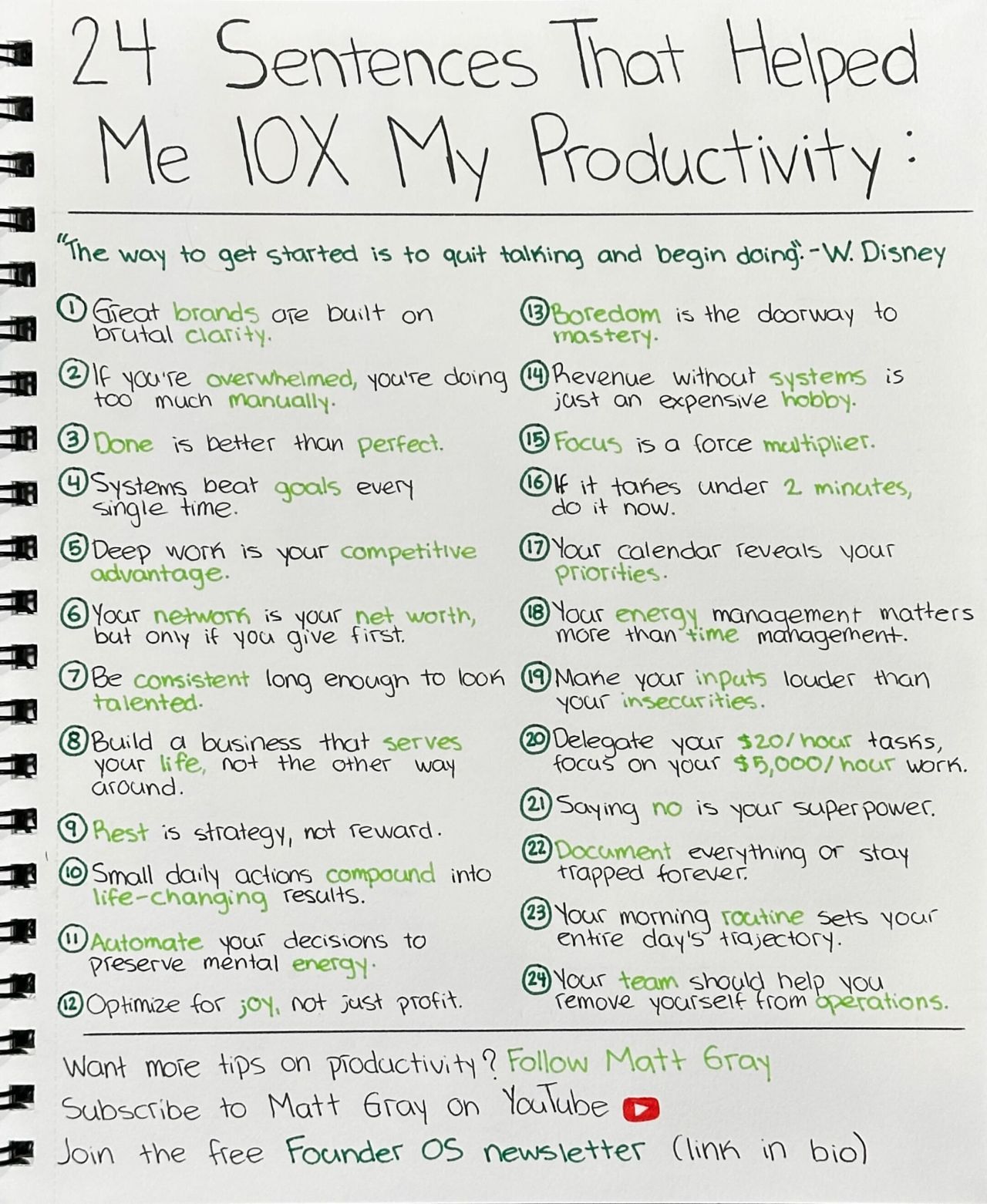
In a recent LinkedIn post, Matt Gray shares a distillation of his journey from intense stress to a more balanced, productive, and globally mobile business-building life. Gray outlines ten core principles he believes are instrumental in achieving a “10x productivity” boost, enabling entrepreneurs to design businesses that operate independently of their constant presence.
The Power of Invisible Moments and Consistent Effort
A cornerstone of Gray’s philosophy is the significance of “invisible moments” – the small, often unseen actions taken daily that lay the groundwork for future freedom and success. He emphasizes that dedicating even a short amount of time, such as 30 minutes daily, to building systems can yield substantial time savings over the long term. This ties into his second point, “Be Consistent Long Enough To Look Talented.” Gray argues that true success isn’t born from sporadic bursts of inspiration but from unwavering daily commitment. He shares his personal experience of posting content daily for three years, navigating challenges like travel, illness, and burnout, which he credits for building his substantial following, rather than innate talent.
“Your Future Is Built In Invisible Moments”
As Gray notes, “The actions nobody sees today create the freedom everybody will envy.” This principle underscores the long-term vision required for sustainable business growth.
Embracing Boredom and Automating for Freedom
Gray challenges the common notion that boredom should always be avoided, suggesting instead that “Boredom Is The Doorway To Mastery.” He posits that significant business breakthroughs have emerged from periods of quiet reflection and disengagement from constant work, citing experiences like walking in Joshua Tree or biking through the Dolomites as catalysts for innovation. This contrasts with the feeling of being overwhelmed, which Gray identifies as a symptom of excessive manual work.
“If You’re Overwhelmed, You’re Doing Too Much Manually”
According to Gray, feeling overwhelmed is a clear signal to automate, delegate, or eliminate tasks rather than simply working harder. “Being busy means you haven’t built systems to replace yourself,” he asserts, highlighting the trap of the “founder’s prison.” His advice is to view overwhelm not as a personal failing but as a systemic issue that requires strategic intervention.
The Role of Input, Execution, and Clarity
To combat internal doubts and insecurities, Gray advises making “Inputs Louder Than Your Insecurities.” He advocates for consuming high-quality content through books, conversations with successful peers, courses, and masterminds to counteract negative self-talk. Furthermore, Gray champions “Execution Speed > Creative Perfection,” arguing that shipping ideas quickly, gathering feedback, and iterating is far more valuable than striving for unattainable perfection. He states, “I’d rather ship 10 imperfect projects than obsess over one ‘perfect’ one that never sees the light of day.”
Focus, Brand Clarity, and Systematization
Gray also emphasizes the power of focus, suggesting that “Focus Is A Force Multiplier.” This involves deliberately reducing the scope of work, teams, meetings, and product lines, believing that doing fewer things exceptionally well is superior to mediocrity across many fronts. He links this to building “Great Brands Built On Brutal Clarity,” where messaging must be so concise that an offer can be explained in a single sentence to avoid losing potential customers. The overarching theme is to “Don’t Escape the Grind, Systematize It.” Gray explains that a business will eventually consume its founder unless repetitive tasks are documented, templated, and delegated, allowing the business to run effectively without constant founder intervention.
Rest as a Strategic Imperative
Finally, Gray reframes rest not as a reward for hard work but as an integral part of the strategy. “Rest Is Strategy, Not Reward,” he declares. He encourages scheduling time to disconnect completely, quoting Rick Rubin: “Distraction is not procrastination. Distraction is a strategy in service of the work.” Gray concludes that stepping away from the business is often when the most valuable ideas emerge.
📝 About This Content
This article is based on insights shared by Matt Gray on LinkedIn.
📅 Originally posted on February 13, 2026 | View original post on LinkedIn →