
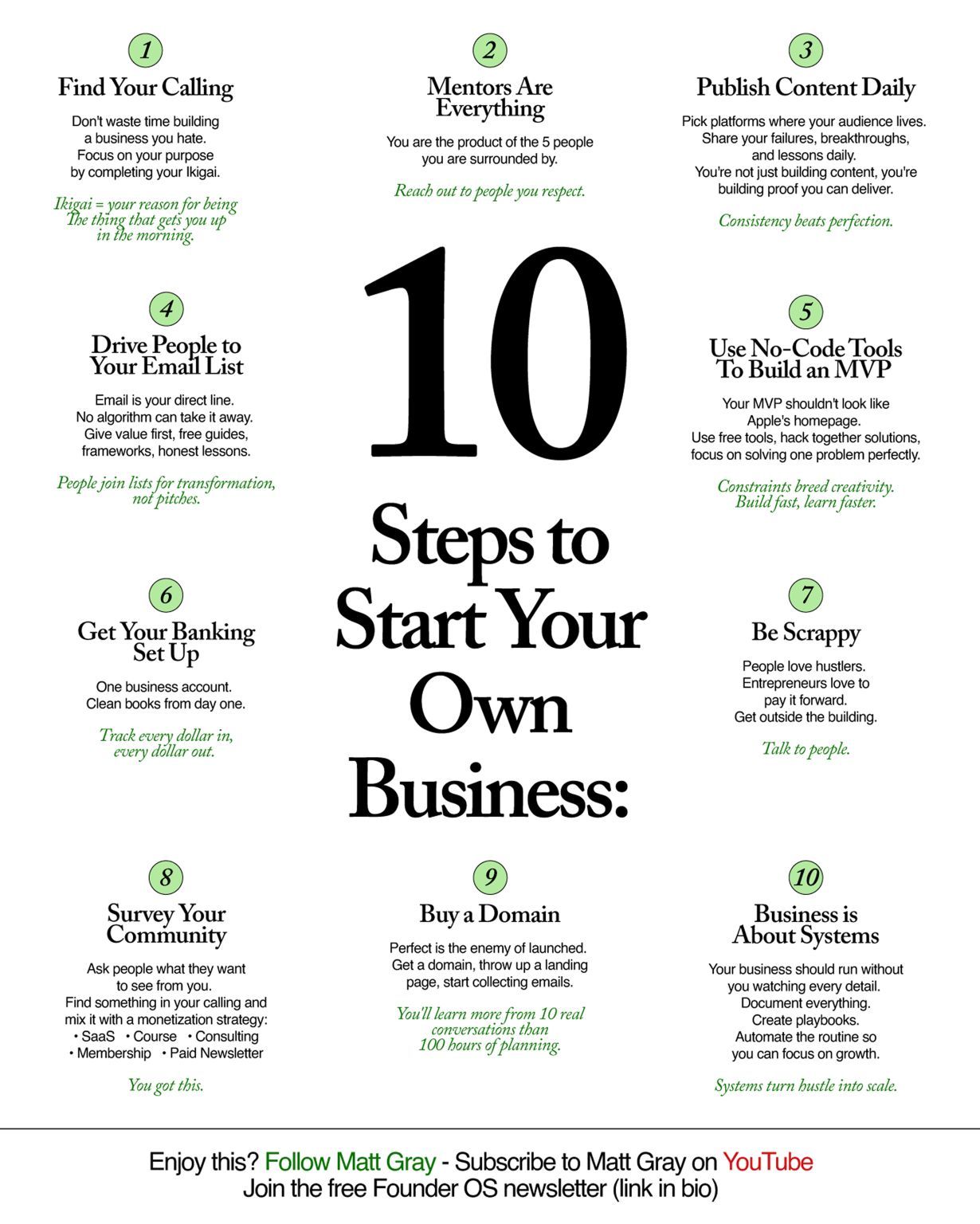
In a recent LinkedIn post, Matt Gray outlines a comprehensive 10-step framework for aspiring entrepreneurs looking to launch their own businesses. Gray emphasizes a practical, action-oriented approach, suggesting that speed and learning from real-world interaction are paramount.
Gray begins by stressing the importance of purpose, advising individuals to find their “calling” before diving into business creation. He suggests leveraging the concept of Ikigai, defined as one’s reason for being, to ensure passion and motivation. As Matt Gray notes:
“Don’t waste time building a business you hate. Focus on your purpose by completing your Ikigai.”
The Power of Mentorship and Consistent Content
Mentorship is highlighted as a critical component of entrepreneurial success. Gray posits that individuals are heavily influenced by their immediate circle, recommending reaching out to respected figures for guidance. “You are the product of the 5 people you are surrounded by,” he states, underscoring the impact of one’s network.
Another key strategy proposed by Gray is the daily publishing of content. He advocates for consistency over perfection, urging entrepreneurs to share their experiences on platforms frequented by their target audience. This practice, according to Gray, not only builds an audience but also serves as tangible proof of one’s capabilities.
“You’re not just building content, you’re building proof you can deliver. Consistency beats perfection.”
Building a Direct Audience and Minimum Viable Products
Gray then pivots to the importance of owning direct communication channels, specifically email lists. He argues that an email list provides a stable connection with the audience, immune to algorithmic changes. Value should be offered upfront, such as free guides or lessons, to attract subscribers who are seeking genuine transformation rather than sales pitches.
To validate business ideas, Gray suggests surveying the community to understand their needs and desires. He proposes mixing one’s calling with potential monetization strategies like SaaS, courses, consulting, memberships, or paid newsletters. This data-driven approach informs the development of a Minimum Viable Product (MVP).
Leveraging No-Code Tools for Rapid Development
Gray encourages the use of no-code tools to build an MVP quickly. He advises against striving for perfection in the initial stages, stating, “Perfect is the enemy of launched.” Instead, the focus should be on launching, collecting emails, and engaging in real conversations to gather feedback. He adds:
“Get a domain, throw up a landing page, start collecting emails. You’ll learn more from 10 real conversations than 100 hours of planning.”
Furthermore, Gray champions a “scrappy” mindset, encouraging entrepreneurs to be proactive and engage directly with people outside of their usual environments. He also stresses the significance of building systems within a business. Documenting processes and automating routine tasks are crucial for turning initial hustle into scalable growth.
Foundational Business Practices
Finally, Gray touches upon essential foundational elements, including setting up proper banking and maintaining clean financial records from the outset. Tracking all income and expenses is presented as a non-negotiable aspect of responsible business management.
Overall, Matt Gray’s LinkedIn post offers a pragmatic roadmap for entrepreneurs, emphasizing purpose, community engagement, rapid iteration, and robust systems as keys to building a successful business.
📝 About This Content
This article is based on insights shared by Matt Gray on LinkedIn.
📅 Originally posted on July 16, 2026 | View original post on LinkedIn →