
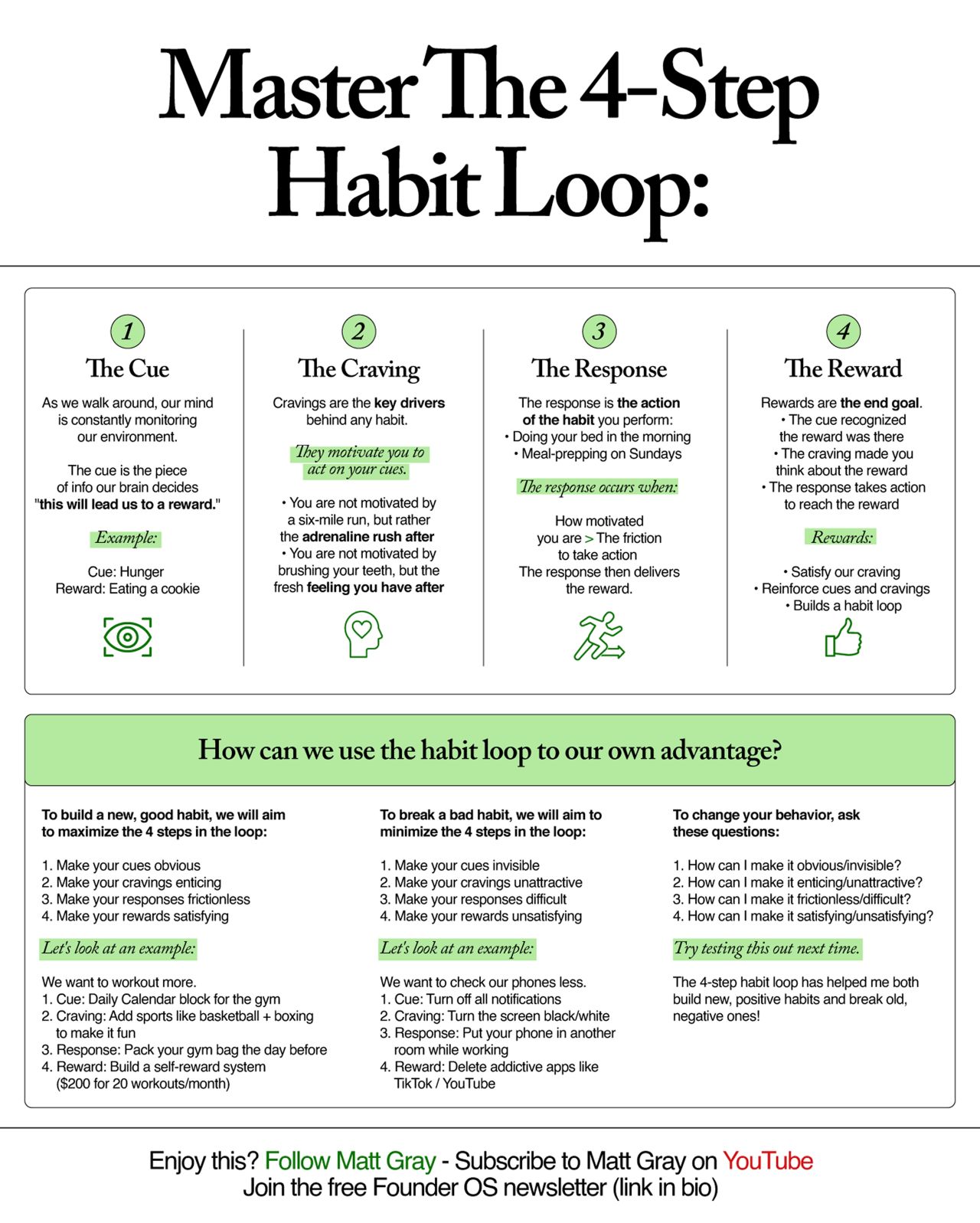
In a recent LinkedIn post, Matt Gray explores a structured approach to creating habits that endure. Gray emphasizes that the trajectory of personal and professional success is fundamentally shaped by the sum of our daily actions and routines. He proposes a practical framework, the “Habit Loop,” as a key to understanding and mastering habit formation.
Gray begins by establishing the profound impact of habits on various life outcomes, stating:
“Every outcome in your life can be traced to the sum of your habits: Fitness levels: Sum of exercise + nutrition Happiness levels: Sum of mindfulness + fulfillment Success levels: Sum of productivity + skill-building”
This foundational idea sets the stage for his discussion on how to deliberately engineer habits rather than passively succumbing to them. He posits that understanding the underlying mechanisms of habit formation is crucial for anyone looking to effect positive change.
Deconstructing the Habit Loop
According to Matt Gray, the process of building and maintaining habits can be effectively broken down into a four-step cycle: Cue, Craving, Response, and Reward. Each step plays a distinct and vital role in reinforcing the habit loop.
1. The Cue
Gray explains that cues are the triggers that signal the potential for a reward, prompting our brains to pay attention. These are environmental or internal signals that our minds interpret as leading to a desired outcome. For instance, feeling hungry serves as a cue that can lead to the reward of eating.
2. The Craving
As Matt Gray notes, cravings are the true engine behind habit formation, providing the motivation to act upon the cues. He clarifies that it’s not the action itself that we crave, but the anticipated satisfaction or feeling that follows the action. For example, the motivation for a run often stems from the desire for the post-exercise adrenaline rush, not the exertion itself.
“You are not motivated by a six-mile run, but rather the adrenaline rush after”
3. The Response
The response is the actual habit or action performed. Gray highlights that the likelihood of a response occurring is determined by the balance between one’s motivation and the perceived friction or effort required to act. If motivation outweighs the difficulty, the response is more likely to happen, thereby leading to the reward.
4. The Reward
The final step, the reward, is the ultimate payoff that satisfies the craving and reinforces the entire loop. Gray elaborates that rewards confirm the value of the cue and the craving, solidifying the connection in our minds and making the habit more likely to be repeated. This cyclical reinforcement is what ultimately embeds a habit.
“Rewards: Satisfy our craving Reinforce cues and cravings Builds a habit loop”
Applying the Habit Loop for Positive Change
Matt Gray provides actionable advice on how to leverage the four-step Habit Loop to cultivate new, beneficial habits. He advocates for a strategy that maximizes each component of the loop:
- Make your cues obvious: Ensure the triggers for your desired habit are easily noticeable.
- Make your cravings enticing: Frame the habit in a way that makes the associated feeling or outcome highly desirable.
- Make your responses frictionless: Reduce the barriers and effort required to perform the habit.
- Make your rewards satisfying: Implement a system where the reward for completing the habit is genuinely pleasing and reinforcing.
To illustrate his points, Gray offers a practical example of building a workout habit. He suggests making the cue obvious with a daily calendar block for the gym, making the craving enticing by incorporating enjoyable activities like basketball or boxing, making the response frictionless by packing a gym bag the day before, and making the reward satisfying through a self-reward system, such as allocating a specific amount of money for achieving a monthly workout goal.
Through this detailed breakdown, Matt Gray offers a comprehensive and accessible guide for individuals seeking to build habits that not only stick but also contribute positively to their overall well-being and success.
📝 About This Content
This article is based on insights shared by Matt Gray on LinkedIn.
📅 Originally posted on January 30, 2026 | View original post on LinkedIn →