
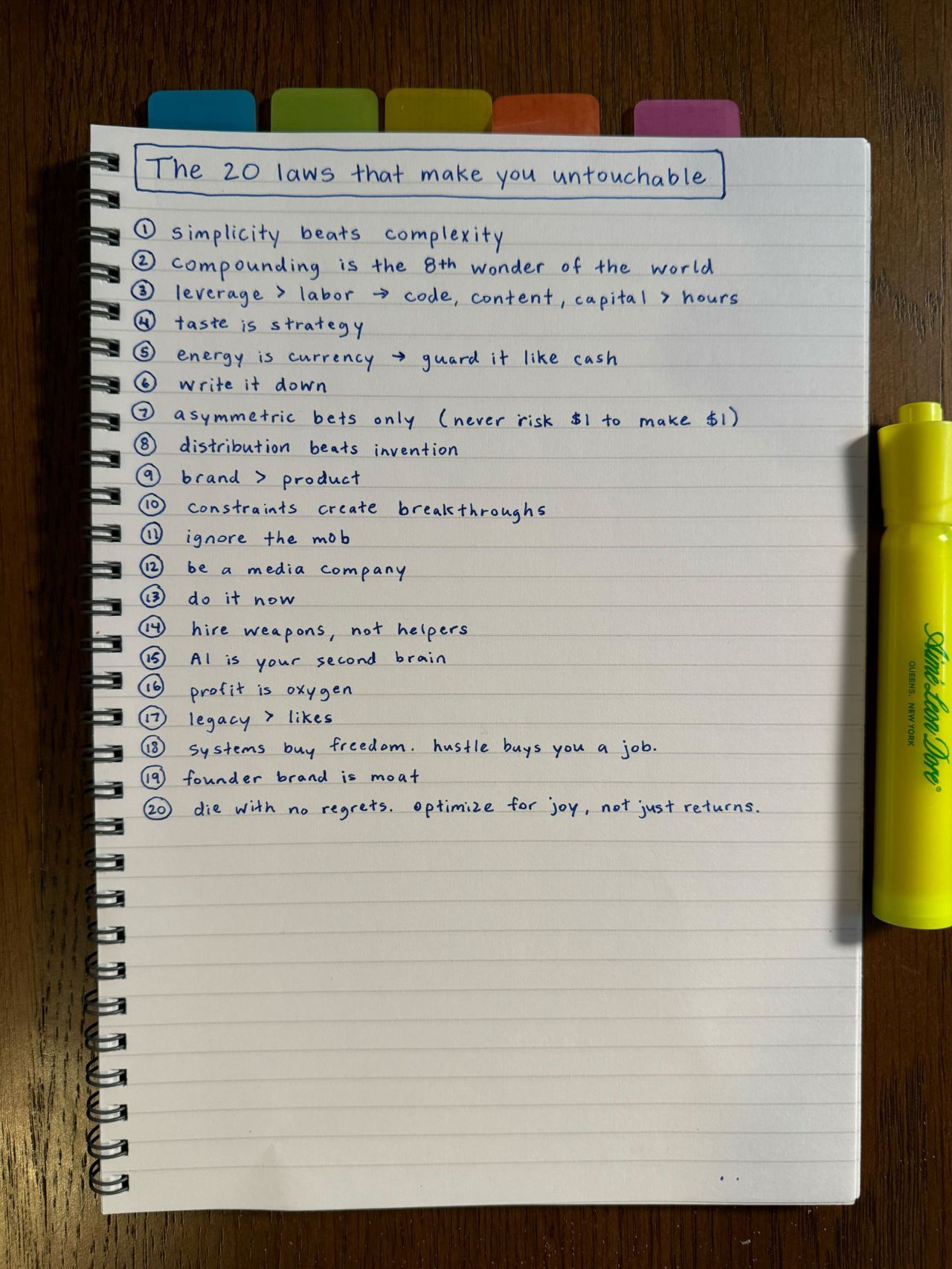
In a recent LinkedIn post, Matt Gray shares 20 fundamental principles he has adopted to reshape his operational approach. These are not abstract theories but practical, battle-tested rules he terms ‘laws.’ Gray emphasizes that adhering to these principles can lead to an ‘untouchable’ operational status, not through perfection, but through intense focus.
Early in his post, Gray introduces the concept of foundational truths, stating:
“Not theories from business school. Real principles tested in the trenches.”
Gray’s framework covers a wide array of business and personal development strategies, from product development to personal energy management.
The Power of Simplicity and Compounding
One of the core tenets Matt Gray highlights is the supremacy of simplicity. He argues that true clarity in business is demonstrated by the ability to distill a complex idea into a single, understandable sentence. As Gray puts it:
“The founder who can explain their business in one sentence wins. Strip away everything that doesn’t move the needle.”
This focus on essentialism extends to growth, where Gray champions the principle of compounding. He illustrates this with the powerful reminder that a consistent 1% daily improvement can lead to a 37-fold increase in effectiveness over a year. This concept underscores his belief in the cumulative impact of small, consistent actions over time.
Leverage, Strategy, and Energy Management
Gray strongly advocates for prioritizing leverage over sheer labor. He identifies assets like code, content, and capital as infinitely scalable, suggesting that building robust systems is key to achieving freedom from constant involvement. He states, “Build systems that work without you.”
Furthermore, Gray introduces a provocative idea: “Taste Is Strategy.” He contends that great taste is not merely subjective but a significant competitive advantage. Developing a discerning eye for quality across all aspects of a business is, in his view, a critical moat that is difficult for competitors to replicate. Complementing this is the principle of guarding one’s energy, which Gray equates to currency. “Guard your energy like cash,” he advises, warning that without adequate personal energy, productivity and effectiveness are impossible.
The Importance of Distribution and Brand
Addressing product-market fit, Gray asserts that “Distribution Beats Invention.” His analysis suggests that even the most innovative product will falter without effective reach and audience engagement. He advises building an audience *before* developing the product. This ties into his emphasis on brand building, arguing that “Brand Over Product.” While products can be quickly copied, a strong brand, built over years, provides a durable and inimitable competitive advantage.
Gray also touches upon the nature of innovation and decision-making. He posits that “Constraints Create Breakthroughs,” challenging the notion that unlimited resources lead to the best outcomes. Instead, he believes limitations foster creativity and sharpen focus. He further advises business leaders to “Ignore The Mob,” suggesting that public opinion is often a lagging indicator and that adherence to core principles is more valuable than chasing popular trends.
Operational Principles for Long-Term Success
In terms of execution, Gray stresses the importance of writing for clarity, stating, “Clarity comes from writing, not thinking. If you can’t write it, you don’t understand it.” He also advocates for decisive action, asserting that “Do It Now” is crucial, as procrastination often stems from unclear priorities.
When it comes to building a team, Gray’s philosophy is to “Hire Weapons, Not Helpers.” He believes that a single top performer can be exponentially more valuable than multiple average contributors. His perspective on modern business tools includes embracing AI, viewing it as a “Second Brain” that amplifies human capabilities rather than replacing them.
Gray also differentiates between revenue and profit, calling profit “Oxygen” and revenue mere “vanity.” He explains that substantial cash reserves provide the essential freedom to pursue strategic risks. Ultimately, his focus is on building a “Legacy Over Likes,” prioritizing endeavors that have lasting impact rather than fleeting social validation. He concludes by advocating for systems over constant hustle, asserting that true business ownership provides freedom, whereas excessive work hours merely create a demanding job.
Matt Gray’s comprehensive list offers a strategic blueprint for entrepreneurs and business leaders aiming for sustainable success and personal fulfillment.
📝 About This Content
This article is based on insights shared by Matt Gray on LinkedIn.
📅 Originally posted on March 4, 2026 | View original post on LinkedIn →