
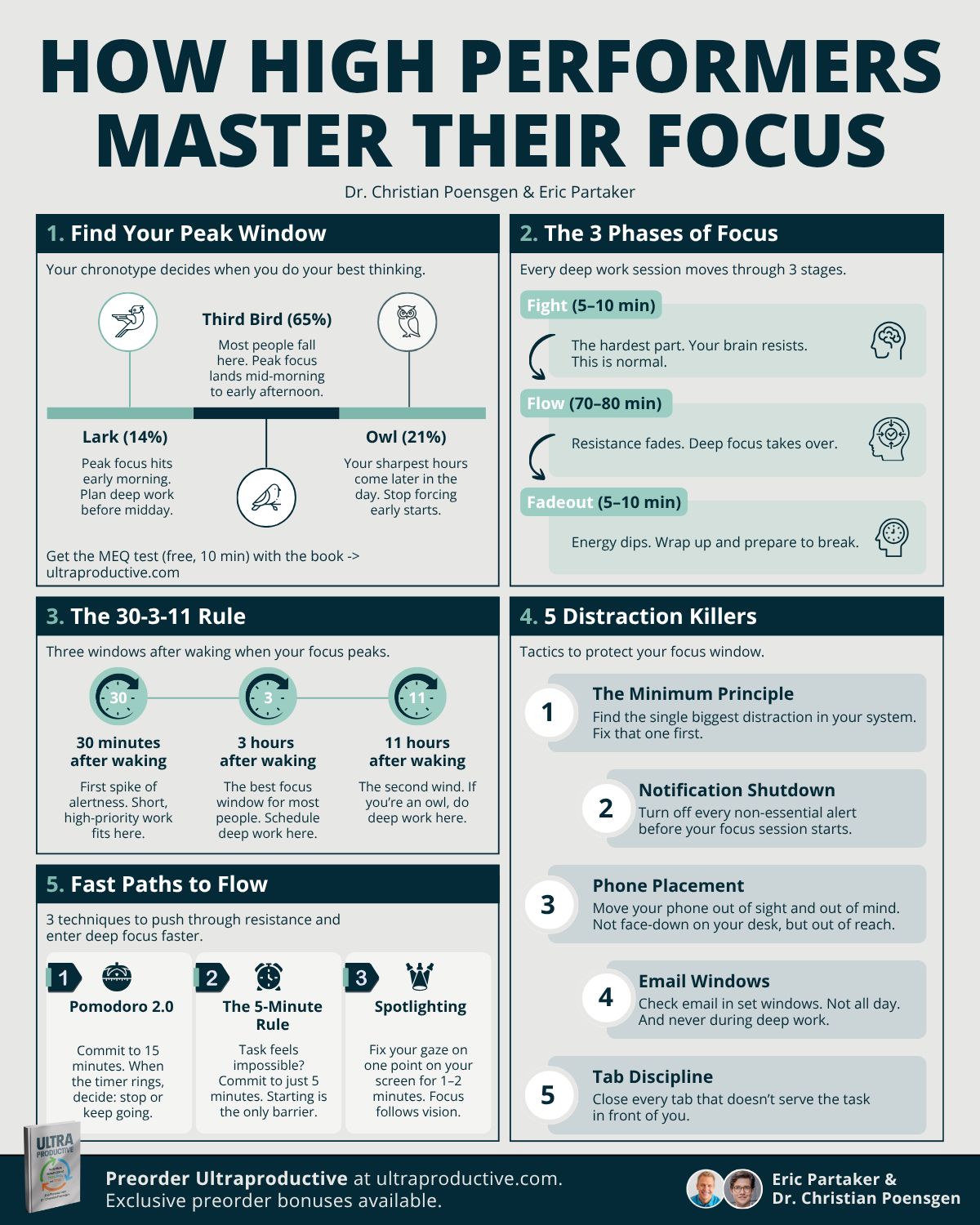
In a recent LinkedIn post, Eric Partaker explores the critical concept of deep work and how business leaders can significantly enhance their productivity by optimizing their focus windows. Partaker, co-author of the forthcoming book “Ultraproductive,” argues that most professionals are underutilizing the limited time they have for concentrated effort each day.
Partaker highlights a common pitfall: leaders often get only two to three hours of genuine deep work daily but squander a significant portion of it. He identifies common reasons for this inefficiency, including working at the wrong time of day, keeping notifications active, and lacking a clear plan for maintaining focus as it wanes.
“The average leader gets 2 to 3 hours of real deep work a day. Most waste at least one of those hours without realizing it.”
Understanding and Leveraging Peak Productivity Windows
A core theme in Partaker’s post is the importance of aligning work with individual biological rhythms. He introduces the concept of chronotypes, explaining that understanding one’s natural peak performance times is crucial for scheduling demanding tasks.
Finding Your Chronotype
Partaker outlines different chronotypes: ‘Larks’ who are most productive in the early morning, ‘Third Birds’ who peak mid-morning, and ‘Owls’ who are sharper later in the day. He points out that a significant majority of people, approximately 65%, fall into the ‘Third Bird’ category and may not be aware of it. This awareness, he suggests, is key to strategic scheduling.
The 30-3-11 Rule
To help individuals schedule their most important work, Partaker introduces the “30-3-11 Rule.” This rule suggests three potential windows after waking when focus is naturally high: 30 minutes, 3 hours, and 11 hours post-waking. As Partaker advises, the goal is to “Schedule your hardest work in the window that matches your type.” This personalized approach aims to maximize the effectiveness of deep work sessions.
Strategies for Sustaining Focus and Overcoming Resistance
Beyond identifying peak windows, Partaker provides practical strategies for maintaining focus during deep work sessions and overcoming the initial mental resistance that often arises.
The Phases of Deep Work
According to Partaker, every deep work session typically moves through three phases: Fight, Flow, and Fadeout. He explains that the initial ‘Fight’ phase, lasting about 5 to 10 minutes, is when the brain naturally resists starting. Pushing through this phase, he notes, allows individuals to enter the ‘Flow’ state, which can last for a more productive 70 to 80 minutes.
“Push through and Flow takes over for 70 to 80 minutes.”
Eliminating Distractions
Partaker emphasizes the need to proactively manage distractions. He recommends identifying and addressing the single biggest distraction in one’s work environment first. Specific tactics include turning off notifications, keeping phones out of sight, dedicating specific times for checking email, and closing unnecessary browser tabs.
“Find the single biggest distraction in your system and fix that one first.”
Accelerating Flow State
To help users transition into the ‘Flow’ state more quickly, Partaker suggests techniques like “Pomodoro 2.0,” where one commits to a 15-minute work interval before deciding whether to continue, and the “5-Minute Rule,” which posits that simply starting a task for five minutes is often enough to overcome inertia. The overarching message from Partaker is clear: enhancing productivity is less about finding more time and more about protecting and optimizing the time already available when mental sharpness is at its highest.
The insights shared by Eric Partaker underscore the value of intentionality and self-awareness in professional productivity, offering actionable advice for leaders seeking to make the most of their deep work capacity.
📝 About This Content
This article is based on insights shared by Eric Partaker on LinkedIn.
📅 Originally posted on July 30, 2026 | View original post on LinkedIn →