
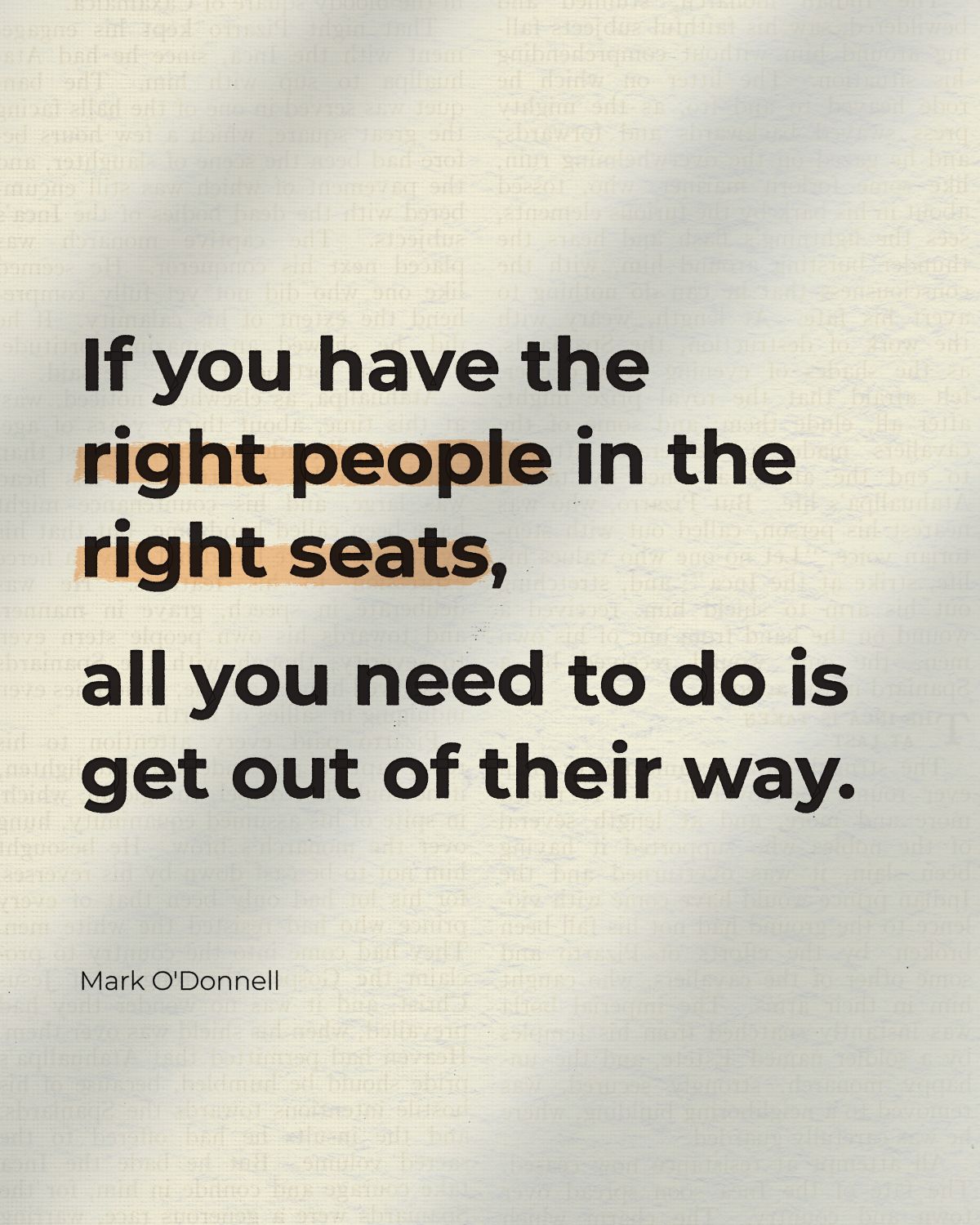
In a recent LinkedIn post, Mark O’Donnell challenges the conventional understanding of micromanagement, asserting that it is not a leadership style but rather a clear indicator that the wrong person is in a particular role. O’Donnell, a proponent of the Entrepreneurial Operating System (EOS), argues that effective leadership hinges on placing the right individuals in the right positions and then trusting them to perform.
O’Donnell begins by stating his core thesis: “Micromanagement isn’t a leadership style. It’s a symptom of the wrong person in the role.” He elaborates on the fundamental EOS principle, which suggests that once the right people are in the right seats, the leader’s primary job is to step back and allow them to work.
Defining “Right People, Right Seats”
According to Mark O’Donnell, the concept of having the “right people in the right seats” is often misunderstood. He breaks down the criteria for both:
The “Right People”
- Share core values.
- Fit the company culture.
- Do not need to be convinced to care about their work.
The “Right Seats”
- Their skills align with the role’s requirements.
- Their passion matches the demands of the role.
- They understand the role, want to perform it, and have the capacity to do so.
When these conditions are met, O’Donnell explains, trust becomes inherent. He illustrates this with relatable scenarios: a leader doesn’t question an employee needing to leave for a doctor’s appointment or an employee working from home. This trust, he emphasizes, is built on a consistent track record of delivered results.
“When you get it right, leadership gets easier. Trust becomes the default, and you stop policing and start leading.”
The Root Cause of Micromanagement
Conversely, O’Donnell argues that the impulse to micromanage stems from a fundamental mismatch between the individual and their role. He contends that attempting to track an employee’s every move is not a problem with remote work or accountability itself, but a signal that the individual is not the right fit, or is in the wrong position.
“Micromanagement is exhausting because you’re trying to compensate for a fundamental mismatch,” O’Donnell writes. He posits that leaders cannot force someone to be a good fit through increased control. Instead, he advocates for focusing energy on what is produced rather than when people are working. This approach, he believes, leads to better hiring practices and clearer role definitions, rather than tighter supervision.
“If you’re spending energy monitoring when people work instead of what they produce, you’re solving the wrong problem.”
EOS Tools for Assessment
Mark O’Donnell highlights how EOS provides specific tools to address these issues, such as the People Analyzer and the Accountability Chart. These tools are designed to facilitate honest discussions about whether an individual truly belongs in their current role. O’Donnell suggests that when these assessments are done correctly, leadership becomes less demanding, trust is established by default, and managers can shift from policing to genuine leadership.
“So ask yourself this: Am I micromanaging because I don’t trust the output? Or because I don’t trust that they’re working the hours I expect?”
He concludes by posing a critical question for leaders: is the concern about work hours or work output? O’Donnell asserts that if the concern is about hours, it’s the leader’s issue to address through setting expectations, whereas if it’s about output, it indicates a problem with the individual in the role, necessitating a change.
📝 About This Content
This article is based on insights shared by Mark O'Donnell on LinkedIn.
📅 Originally posted on February 6, 2026 | View original post on LinkedIn →