
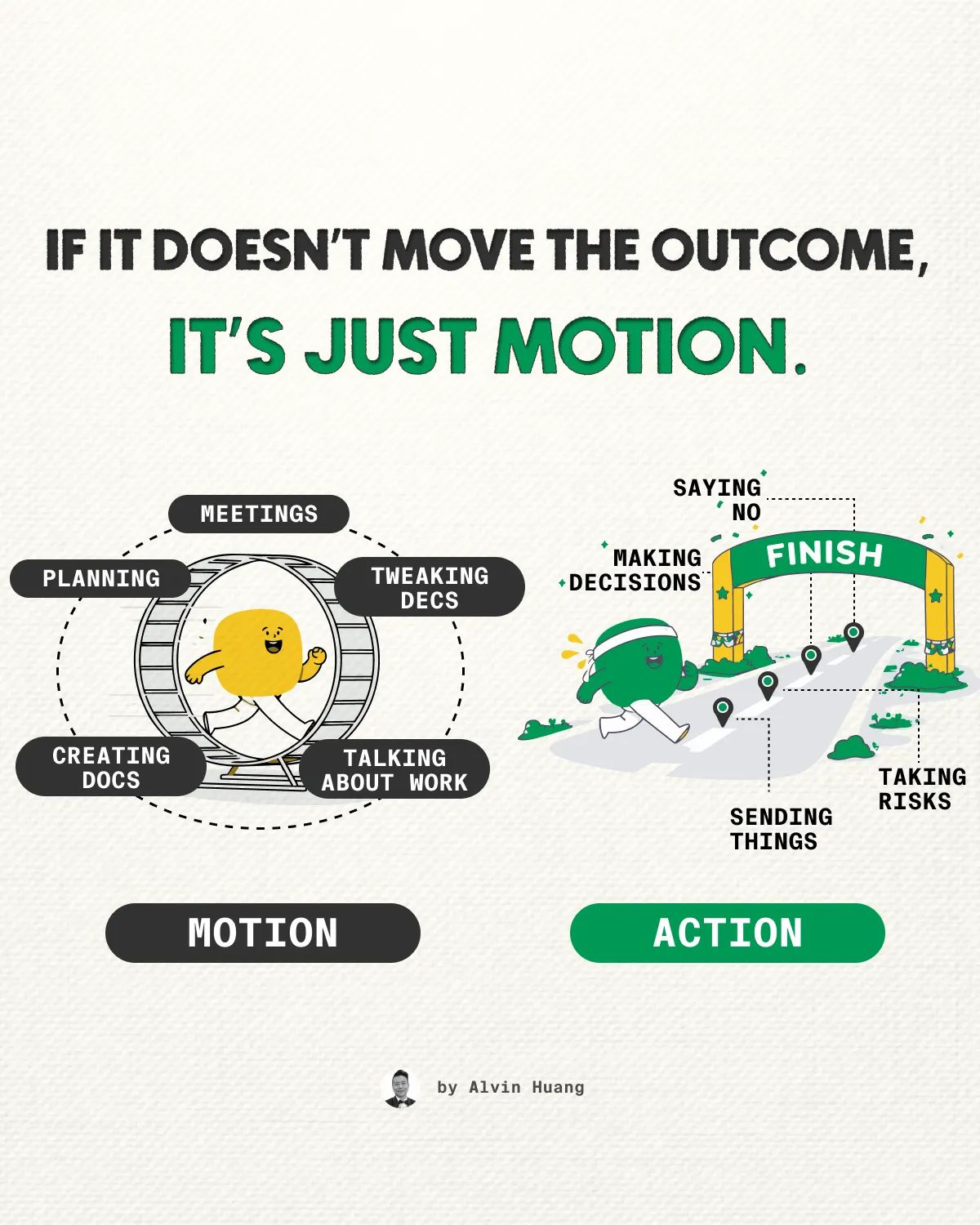
In a recent LinkedIn post, Alvin Huang discusses a common pitfall in professional life: mistaking constant activity for genuine progress. Huang, a business leader, highlights how individuals and teams can become trapped in a cycle of busyness without achieving meaningful results, a phenomenon he terms the “motion versus action” paradox.
Huang opens by describing a personal realization where a packed schedule, filled with meetings and strategy sessions, did not translate into improved business outcomes. This led him to question the effectiveness of his daily grind. He states:
“I used to think being slammed with meetings meant I was killing it. Back-to-back calls, strategy sessions, alignment meetings… The calendar was PACKED.”
The core of Huang’s argument centers on the distinction between “motion” and “action.” Motion, as described in the post, involves activities that appear productive but do not necessarily drive the business forward. This includes endless planning sessions, excessive revisions of the same work, unnecessary “syncs,” and discussions about what needs to be done without actually doing it.
The Perils of Perceived Productivity
Huang elaborates on the nature of motion, pointing out its deceptive safety. “The problem is, motion feels safe. You look busy. Nobody questions it,” he writes. This perceived safety can lead to a culture where busyness is rewarded, even if it yields no tangible results. Leaders, inadvertently, may reinforce this behavior by acknowledging the appearance of hard work rather than its impact.
He contrasts this with “action,” which he defines as taking steps that carry inherent risk but lead to tangible outcomes. Action involves making decisions with incomplete information, shipping products before they feel perfect, having difficult conversations, and strategically saying “no” to free up capacity for more critical tasks.
“Action is: Making the call when you don’t have full information. Shipping before it feels ready. Having the conversation you’ve been avoiding. Saying no so something else can actually move.”
According to Huang, the allure of motion lies in its low risk. “But action carries risk. You might be wrong, or worse… fail completely,” he notes. However, he argues that it is precisely this element of risk that makes action effective and essential for growth.
Identifying and Escaping the Trap
Huang shares his experience observing teams, including his own, fall into this trap of motion. The result is often exhaustion without significant accomplishment. He proposes a simple filter to distinguish between the two:
The “Nothing Changed” Filter
“If nothing changed after the work, it wasn’t action. It was just movement,” Huang asserts. This principle serves as a critical diagnostic tool for individuals and leaders seeking to ensure their efforts are truly productive. He emphasizes that engaging in activities like endless strategy meetings without seeing corresponding business growth is a clear indicator of being stuck in motion.
“You do A to get A. You do B to get B. Somehow we forget that.”
Huang concludes by posing a question to his audience, encouraging self-reflection on whether they tend to prioritize busyness over decisiveness. His insights serve as a vital reminder for professionals and leaders to critically evaluate their activities and focus on actions that drive measurable progress, rather than getting lost in the illusion of constant motion.
📝 About This Content
This article is based on insights shared by Alvin Huang on LinkedIn.
📅 Originally posted on January 27, 2026 | View original post on LinkedIn →