
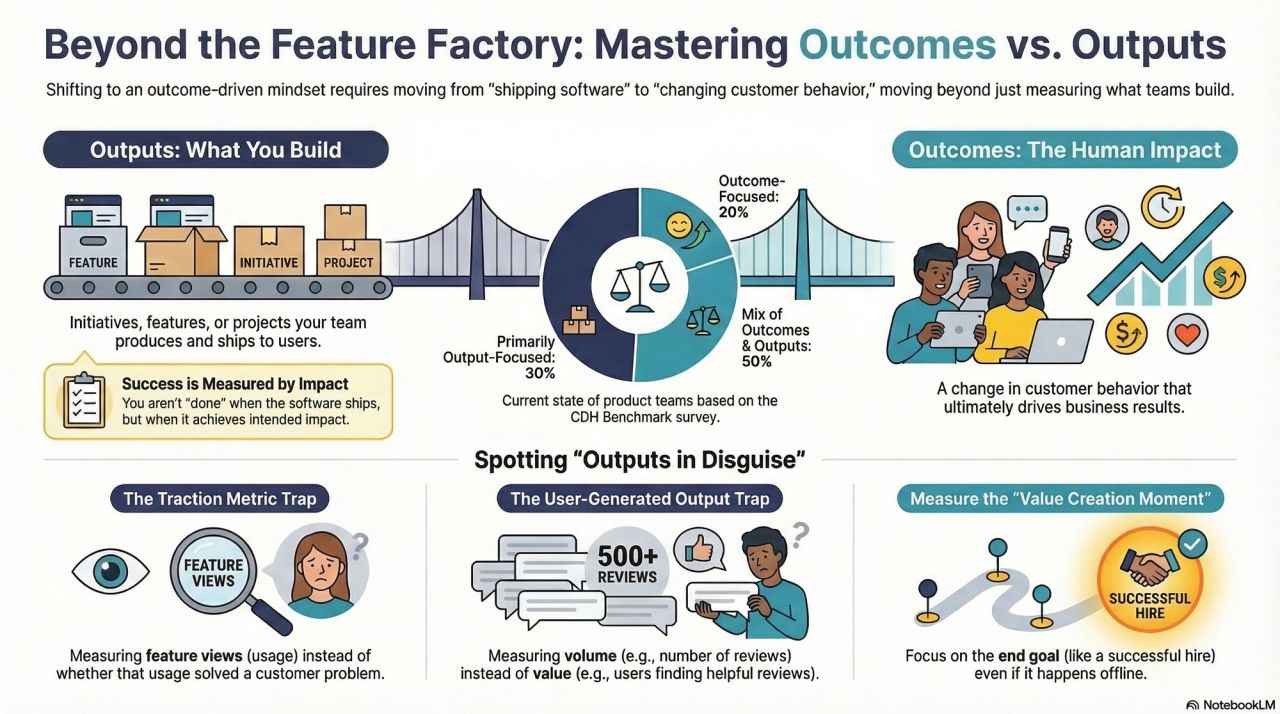
In a recent LinkedIn post, product discovery coach Teresa Torres discusses a common pitfall in product development: mistaking outputs for outcomes. Torres argues that a focus on shipping features, often driven by measuring success based on what is produced, leads to a “feature factory” rather than a team that genuinely creates value.
The Pitfall of Measuring Outputs
Torres highlights that when teams are tasked with delivering specific outputs, such as features or projects, their ability to innovate and find the best solutions is severely limited. This approach, she explains, fails to drive meaningful impact.
“When we measure success by what you ship, you get a feature factory. When you measure success by the impact of what you ship, you get a product team that learns, adapts, and creates real value.”
According to Torres, this distinction is crucial for fostering a product team that is agile and responsive to user needs. She emphasizes that true success lies not in the quantity of features delivered, but in the positive changes those features bring about.
Defining True Outcomes
Torres clarifies the difference between outputs and outcomes, defining outputs as tangible deliverables like features or projects. Outcomes, on the other hand, are the results of those deliverables, specifically changes in customer behavior or business performance.
Outputs vs. Outcomes
- Output: Something you build or produce—a feature, a project, an initiative.
- Outcome: The impact of that output—a change in customer behavior or a business result.
The core of Torres’s argument is that empowering teams with outcomes to achieve, rather than outputs to deliver, grants them the necessary freedom and responsibility to discover the most effective solutions.
“When teams are given outputs to deliver, they have very little latitude to explore the best solution.”
This freedom, as Torres points out, is essential for innovation and for truly understanding and meeting customer needs.
The Challenge of Measuring Impact
Torres acknowledges that implementing an outcome-focused approach can be deceptively difficult. She stresses the importance of pushing to measure value creation, even if that value is realized outside the direct control of the team’s service.
“Push to measure the value creation moment even if it happens outside of your service.”
Furthermore, Torres cautions against metrics that can be achieved without actually benefiting customers, labeling them as potential “outputs in disguise.” She advises product teams to be critical of their chosen metrics.
“If you can achieve the metric without actually helping customers, it’s probably an output in disguise.”
Finally, Torres reassures teams that the first outcome metric they identify may not be perfect. She normalizes the process of iteration, encouraging teams to expect and embrace the need to refine their outcome metrics over time.
Her insights, shared via LinkedIn, provide a valuable framework for product teams aiming to shift from a production-oriented mindset to one focused on delivering measurable impact and genuine customer value.
📝 About This Content
This article is based on insights shared by Teresa Torres on LinkedIn.
📅 Originally posted on March 18, 2026 | View original post on LinkedIn →