
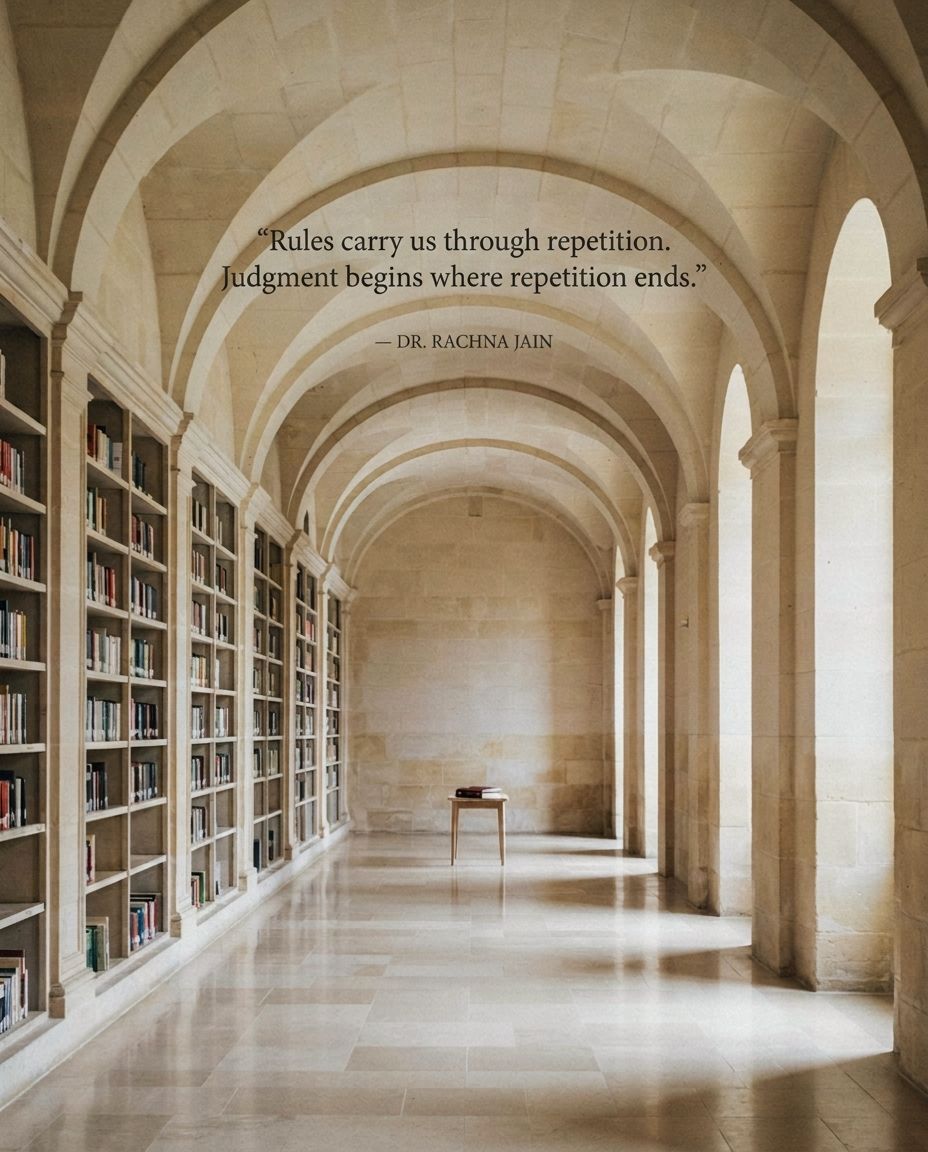
In a recent LinkedIn post, Dr. Rachna Jain explores the critical role of human judgment in leadership when established rules and policies fall short. Dr. Rachna Jain highlights that while organizational rules are designed to streamline decision-making by codifying prior understanding, they inevitably encounter situations that defy simple application.
As Dr. Rachna Jain notes:
“But eventually, a situation arrives that the rule cannot fully resolve. A policy may clearly specify what should happen, while applying it literally would violate another commitment the organization also considers important.”
Dr. Rachna Jain argues that these are the moments when leadership truly becomes visible, moving beyond mere compliance to active interpretation and discernment. These complex situations, often characterized by novel combinations of competing values, incomplete information, and uncertain consequences, cannot be entirely anticipated or resolved by rulebooks alone.
The Limits of Precedent
The core of Dr. Rachna Jain’s insight lies in understanding the boundary where rules cease to be sufficient. Organizations create policies and procedures to reduce the cognitive load of recurring decisions. However, Dr. Rachna Jain points out that the true test of a system isn’t just its ability to handle routine matters, but also its capacity to clarify when interpretation is necessary.
“Good systems reduce the number of decisions that require fresh interpretation,” Dr. Rachna Jain writes. “Better systems also make the boundary visible- clarifying when precedent can carry the decision and when discernment must take over.”
When Judgment Takes Center Stage
According to Dr. Rachna Jain, leadership is most consequential at this boundary. It is not about forcing certainty where it does not exist, but rather about the thoughtful navigation of competing truths to arrive at a coherent choice. This requires leaders to move beyond simply enforcing existing regulations and to actively recognize and weigh multiple important factors simultaneously.
Dr. Rachna Jain emphasizes that complexity demands more from leaders than just adherence to procedure. It requires a deeper capacity to understand context, values, and potential outcomes. The ability to make sound judgments in ambiguous circumstances is what distinguishes effective leadership in challenging environments.
The Essence of Leadership in Complexity
In essence, Dr. Rachna Jain posits that leadership in the face of complexity is an art of balancing. It involves acknowledging that sometimes, multiple legitimate principles are in conflict, and a literal application of one rule might undermine another equally important organizational commitment. In these scenarios, Dr. Rachna Jain suggests:
“Now there are two legitimate principles in the room. Following procedure is no longer enough. Someone has to interpret what matters here.”
This interpretive capacity, Dr. Rachna Jain explains, is where true leadership shines. It’s about understanding the spirit of the rules while being agile enough to adapt when the letter of the law becomes insufficient or even counterproductive. Dr. Rachna Jain’s analysis provides a valuable framework for leaders seeking to navigate the inherent ambiguities of the modern business landscape.
📝 About This Content
This article is based on insights shared by Dr. Rachna Jain on LinkedIn.
📅 Originally posted on September 12, 2026 | View original post on LinkedIn →