
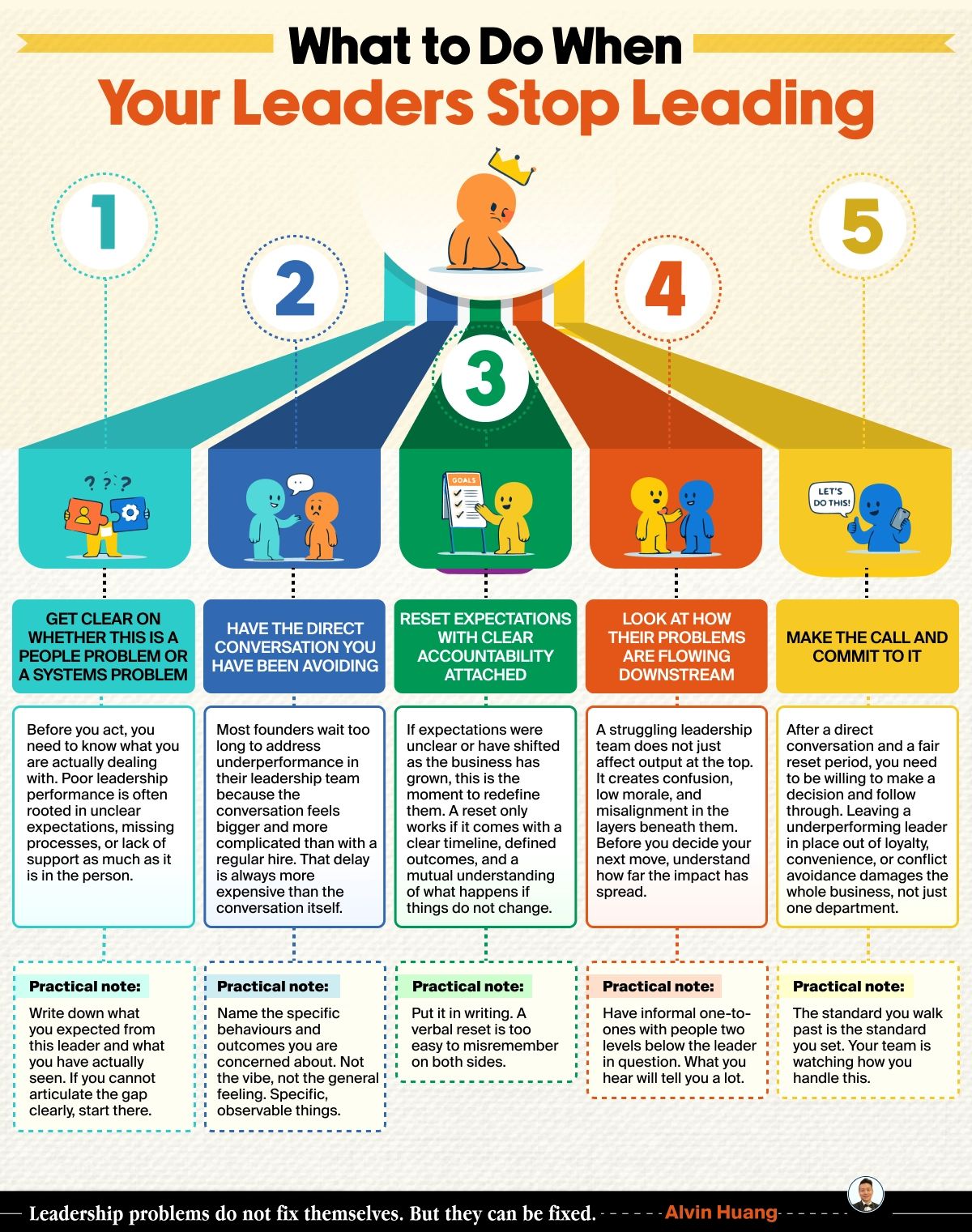
In a recent LinkedIn post, Alvin Huang addresses a critical challenge many founders face: a leadership team that isn’t pulling its weight. Huang emphasizes that a leadership team is intended to alleviate a founder’s burden, not add to it. When this isn’t happening, founders often resort to silence or explosive reactions, neither of which resolves the underlying issues, according to Huang.
Huang frames this situation as particularly difficult due to its high stakes and complex dynamics, noting its ripple effect throughout the entire business. He points out that the problem isn’t always solely a matter of individual performance but can also stem from structural or systemic issues. Identifying the root cause, he argues, is paramount to formulating an effective response.
“You didn’t build a leadership team to manage them like junior staff… But here you are.”
Diagnosing the Leadership Deficit: People vs. Systems
A core tenet of Huang’s advice is the necessity of accurately diagnosing the problem before taking action. He highlights that ineffective leadership often stems from unclear expectations or absent processes, rather than an inherent lack of capability. As Alvin Huang advises:
“Half the time, bad leadership is just unclear expectations and missing processes. Know what you’re actually dealing with before you act.”
This distinction is crucial, as Huang suggests that addressing a systems problem with a people-management approach, or vice versa, will inevitably fail.
The Imperative of Direct Communication and Accountability
Huang stresses the importance of confronting the issue directly and promptly. He argues that founders often delay these necessary conversations, allowing the problem to escalate. According to Alvin Huang, the longer a founder waits, the more difficult the situation becomes.
Once the conversation has occurred, Huang advocates for resetting expectations and attaching clear accountability. He cautions against vague agreements, stating:
“A reset with no timeline or consequences is just a chat. Put it in writing. Define what good looks like and what happens if nothing changes.”
This structured approach ensures that the reset is taken seriously and that progress is measurable.
Assessing Downstream Impact and Making the Tough Call
Alvin Huang also emphasizes the need to understand how a leadership team’s underperformance affects the broader organization. He suggests a practical method for this:
“Talk to people two levels below. What you hear will tell you more than any leadership meeting will.”
This provides a ground-level perspective on the actual impact of leadership decisions and behaviors. Ultimately, Huang concludes, founders must be prepared to make difficult decisions and follow through, even when it involves letting go of someone they trusted. He underscores that inaction is also a decision, one that a team observes closely.
The founder’s handling of such situations, Huang implies, sends a powerful message to the rest of the organization about their leadership effectiveness and commitment to performance standards.
📝 About This Content
This article is based on insights shared by Alvin Huang on LinkedIn.
📅 Originally posted on April 21, 2026 | View original post on LinkedIn →