
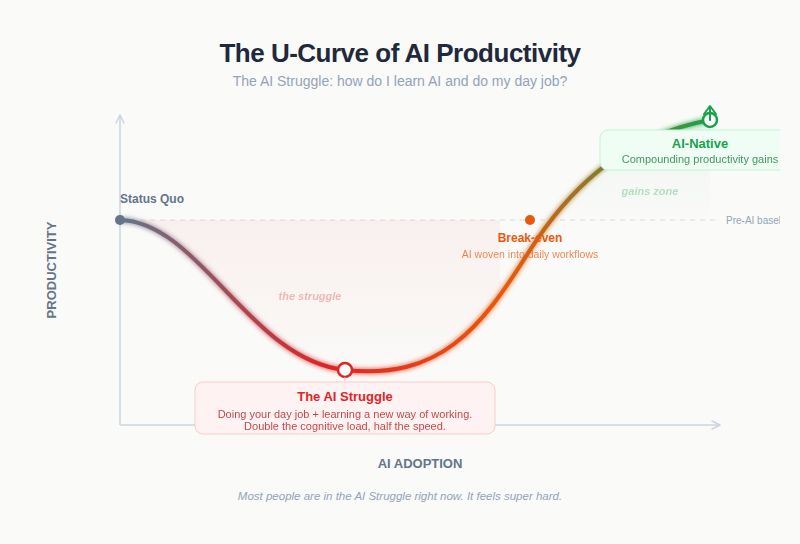
In a recent LinkedIn post, Kieran Flanagan addresses the common stress and productivity challenges many professionals face as they grapple with the rapid integration of Artificial Intelligence into the workplace. Flanagan highlights a critical, often overlooked, phase in AI adoption where initial productivity declines, leading to significant professional anxiety.
Flanagan’s central argument revolves around the personal commitment required to navigate this learning curve. He points out that while companies may offer some support, the onus ultimately falls on the individual to dedicate time outside of core work hours to understand and integrate AI effectively.
“This chart is the reason most people are stressed about AI right now. There’s a period of time when it makes you less productive. It’s also near impossible to do your day job and keep up with AI.”
The U-Curve of AI Adoption
Flanagan illustrates this challenge using what he describes as a U-shaped curve, where initial productivity dips significantly. This phase is characterized by individuals attempting to perform their existing job duties while simultaneously learning a new, complex technology. This dual effort, he explains, not only reduces efficiency but also increases overall working hours.
According to Flanagan, this period can feel overwhelming, leading to the common question: “How do I carve out hours during my work to learn AI?” His candid response suggests that external support is often insufficient.
“The reality is, you can’t depend on others to help with this. Sure, your company might offer hackathons, training, and more. But, the honest answer is, for a lot of people, AI is a nights and weekends thing until it’s deeply embedded into how you work.”
Personal Choice and the ‘Struggle’ Phase
The crux of Flanagan’s message emphasizes personal agency. He asserts that overcoming this productivity slump is largely a matter of individual choice and commitment. The decision to invest personal time, even when difficult, is presented as critical for future career relevance.
The Brutal Commitment
Flanagan does not shy away from the demanding nature of this commitment. He acknowledges the significant personal sacrifices involved, noting that working late nights and weekends is a “brutal commitment.” He shares his own experiences, admitting to personal challenges that make this dedication even harder, yet reinforcing its necessity.
“Like anything good, there is gold at the end of the rainbow (or U-Curve), you just need to struggle your way there, even if it means crawling at times :)”
He argues that this dedication is essential for reaching the ‘compounding gains stage’ of AI integration, where the technology becomes a seamless part of one’s workflow, leading to increased efficiency and innovation. Flanagan’s insights serve as a call to action for professionals to proactively manage their AI learning journey, recognizing that while challenging, the long-term rewards are substantial.
Ultimately, Kieran Flanagan’s post provides a realistic perspective on the AI learning curve, framing it not as a corporate training problem, but as a personal development imperative. He encourages professionals to embrace the struggle as a necessary step towards future success in an increasingly AI-driven landscape.
📝 About This Content
This article is based on insights shared by Kieran Flanagan on LinkedIn.
📅 Originally posted on May 7, 2026 | View original post on LinkedIn →