
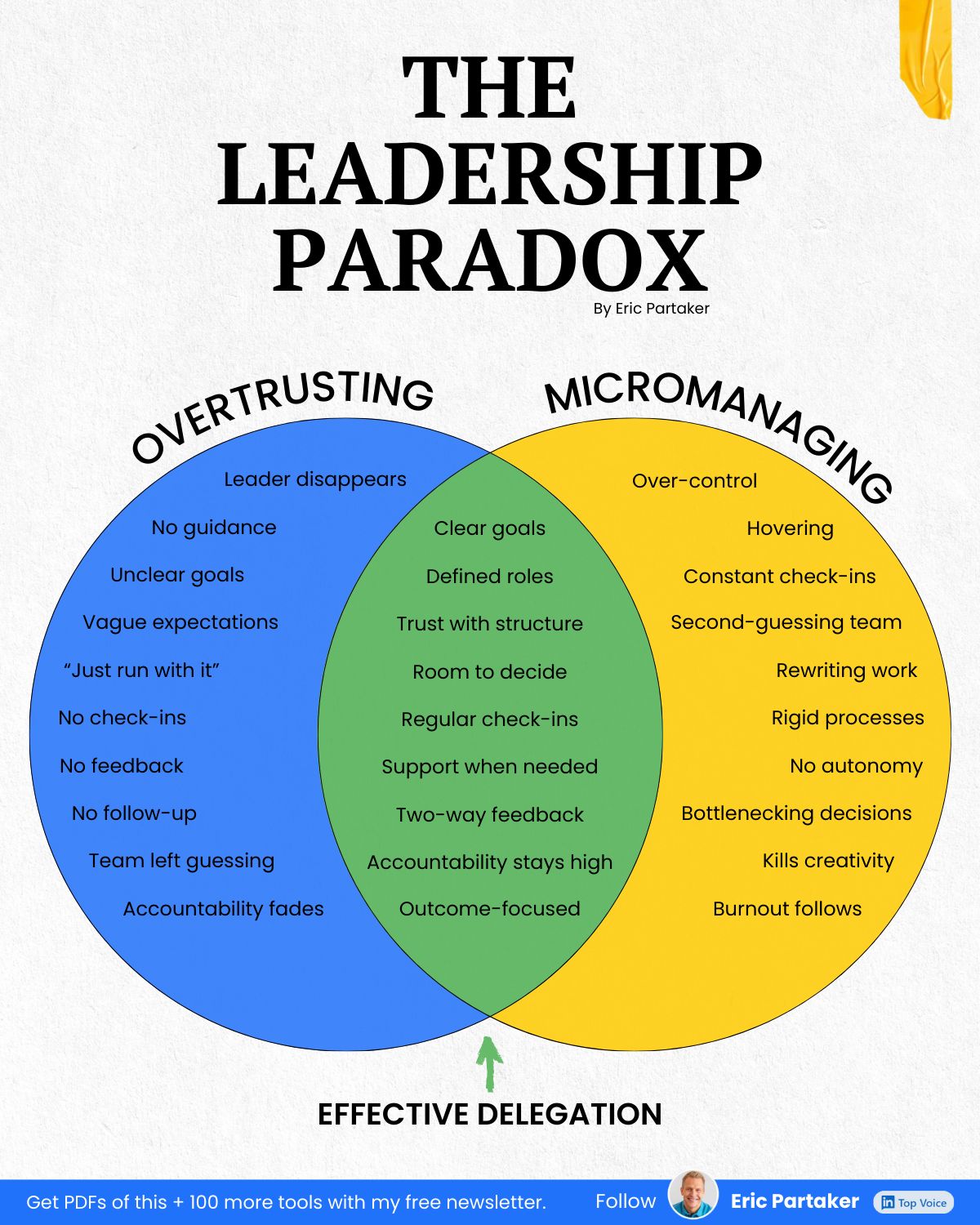
In a recent LinkedIn post, Eric Partaker dives into a fundamental challenge faced by every chief executive: the ‘leadership paradox.’ He argues that leaders must strike a delicate balance between stepping back enough to empower their teams and stepping in too closely, which can stifle initiative.
Partaker frames this dilemma starkly: “Step back too far → things fall apart. Step in too close → people stop trying.” He elaborates on the negative consequences of leaning too heavily on either extreme. According to Partaker, micromanaging can lead to a decline in creativity, with the leader becoming a bottleneck and ultimately fostering burnout.
“Micromanage too much? • Your team stops thinking • Creativity dies • You become the bottleneck • Burnout follows”
Conversely, he warns that trusting too much without clear structures can result in a lack of ownership and missed deadlines.
“Trust too much? • Goals get fuzzy • No one owns the outcome • Deadlines slip • Accountability fades”
The Danger of Extremes
Partaker asserts that both pitfalls stem from a common root: a genuine care for the work. However, he emphasizes that the solution isn’t to choose one approach over the other, but rather to master the space in between.
Finding the ‘Middle Ground’
The core of Partaker’s advice centers on effective delegation, which he breaks down into key components. He suggests that successful leadership involves setting clear goals, defining roles with autonomy for decision-making, implementing regular check-ins that are supportive rather than intrusive, providing necessary assistance, fostering two-way feedback, and establishing accountability that endures.
“The answer isn’t picking a side. It’s mastering the middle,” Partaker writes. He posits that this approach allows leaders to build teams that are capable and engaged, operating effectively without the leader needing to be constantly involved or, conversely, feeling distant from the team’s progress.
“This is how great leaders build teams that run without them (but not away from them). They don’t disappear. They don’t suffocate. They lead with clarity, trust, and rhythm.”
Enabling Both Control and Freedom
Partaker concludes by highlighting that the most effective leaders don’t see control and freedom as mutually exclusive. Instead, they create organizational structures that facilitate both. This, he argues, is crucial for any leader scaling a team or growing a business, as the paradox will be a daily reality. He encourages leaders to embrace this complexity, stating, “Master the middle. Your team — and your sanity — will thank you.”
The post ends with a question to engage readers on which aspect of the paradox they find more challenging, inviting further discussion on the practicalities of leadership.
📝 About This Content
This article is based on insights shared by Eric Partaker on LinkedIn.
📅 Originally posted on March 13, 2026 | View original post on LinkedIn →