
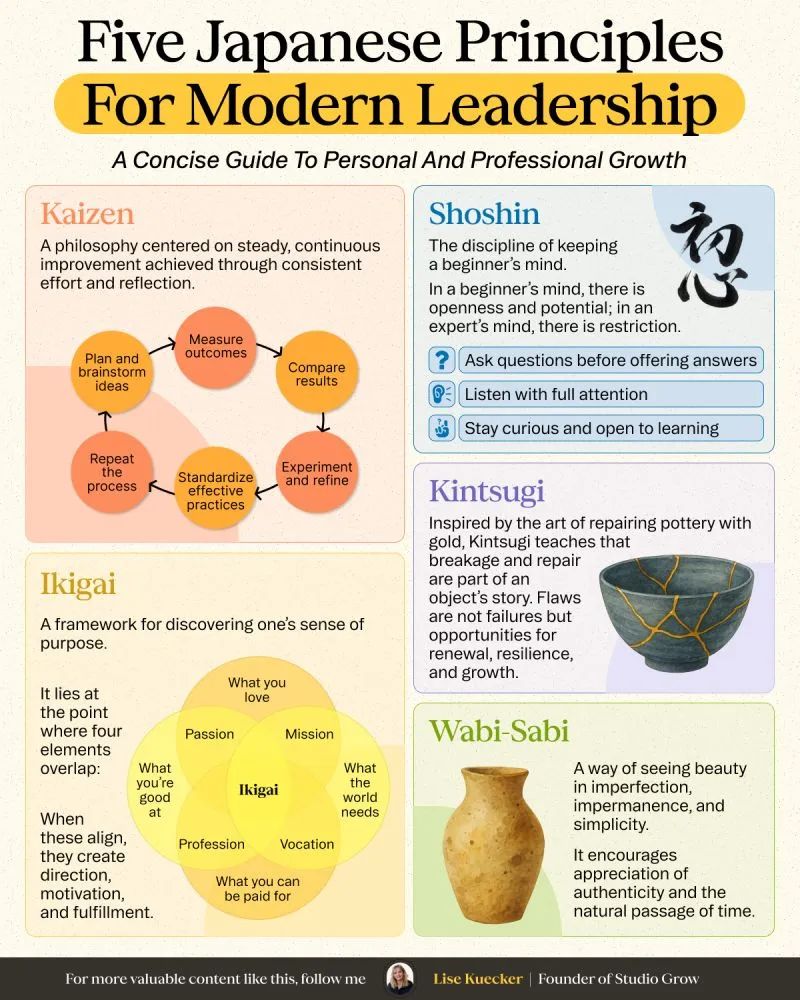
In a recent LinkedIn post, Lise Kuecker, an entrepreneur with experience building six businesses, shares five core principles that have guided her through the challenging phases of company development. Kuecker acknowledges the inherent difficulties in entrepreneurship, particularly the “messy middle,” where progress can feel slow and obstacles seem relentless. She offers these principles as grounding ideas to help founders recenter when facing such trials.
Embracing Continuous Improvement with Kaizen
One of the cornerstones of Kuecker’s advice is the principle of Kaizen, a Japanese philosophy focused on continuous improvement. Kuecker elaborates on this approach, suggesting a cyclical process for founders:
“Come up with messy ideas and plans. Measure the outcomes of what works. Compare the results. Experiment and refine the process. Standardize effective systems. Repeat the process.”
As Kuecker notes, this method encourages embracing imperfection in the initial stages and systematically refining processes based on measurable outcomes. It’s about iterative progress rather than seeking immediate perfection.
Maintaining Curiosity and Openness with Shoshin
Kuecker also highlights the importance of Shoshin, or the beginner’s mind, advocating for sustained curiosity even when one believes they possess the answers. This principle involves actively seeking input from others, particularly team members.
“Ask your team questions before offering answers,” Kuecker advises. “Listen to others with your full attention. Be open to learn from others.” This practice, according to Kuecker, fosters a more collaborative and innovative environment, preventing founders from becoming complacent in their knowledge.
Finding Beauty in Imperfection: Kintsugi and Wabi-Sabi
Two related principles, Kintsugi and Wabi-Sabi, address the acceptance and even appreciation of flaws and imperfections. Kintsugi, the Japanese art of repairing broken pottery with lacquer dusted or mixed with powdered gold, silver, or platinum, teaches that breaks and repairs are part of an object’s history, not something to disguise. Kuecker translates this to business by stating:
“None of us are perfect. Don’t feel discouraged when facing setbacks. Learn from them and come back stronger.”
Similarly, Wabi-Sabi encourages finding beauty in imperfection, simplicity, and the natural cycle of growth and decay. Kuecker suggests embracing this by accepting situations as they are and focusing on simplicity and balance, especially during times of change.
Reconnecting with Purpose Through Ikigai
To combat the potential loss of direction during tough times, Kuecker introduces Ikigai, the Japanese concept of finding one’s reason for being. She outlines its four key components:
- What you love
- What you’re good at
- What the world needs
- What you can be paid for
Kuecker emphasizes that discovering the intersection of these elements is where an individual’s most meaningful work resides. This principle serves as a powerful tool for founders to reconnect with their core purpose when the entrepreneurial journey becomes demanding.
Authenticity as a Foundation for Success
Ultimately, Kuecker concludes that these principles are valuable because they do not require individuals to adopt a false persona. “What’s interesting about these principles is that none of them ask you to pretend to be something you’re not,” she writes. Instead, they underscore the power of authenticity, curiosity, and resilience.
She challenges the immense pressure founders often place on themselves to be constantly right, asserting that true success comes not from avoiding mistakes but from the tenacity to persist. “We succeed by having the courage to keep trying when things are hard,” Kuecker concludes, offering a message of encouragement to those navigating the complexities of building a business.
📝 About This Content
This article is based on insights shared by Lise Kuecker on LinkedIn.
📅 Originally posted on February 15, 2026 | View original post on LinkedIn →