
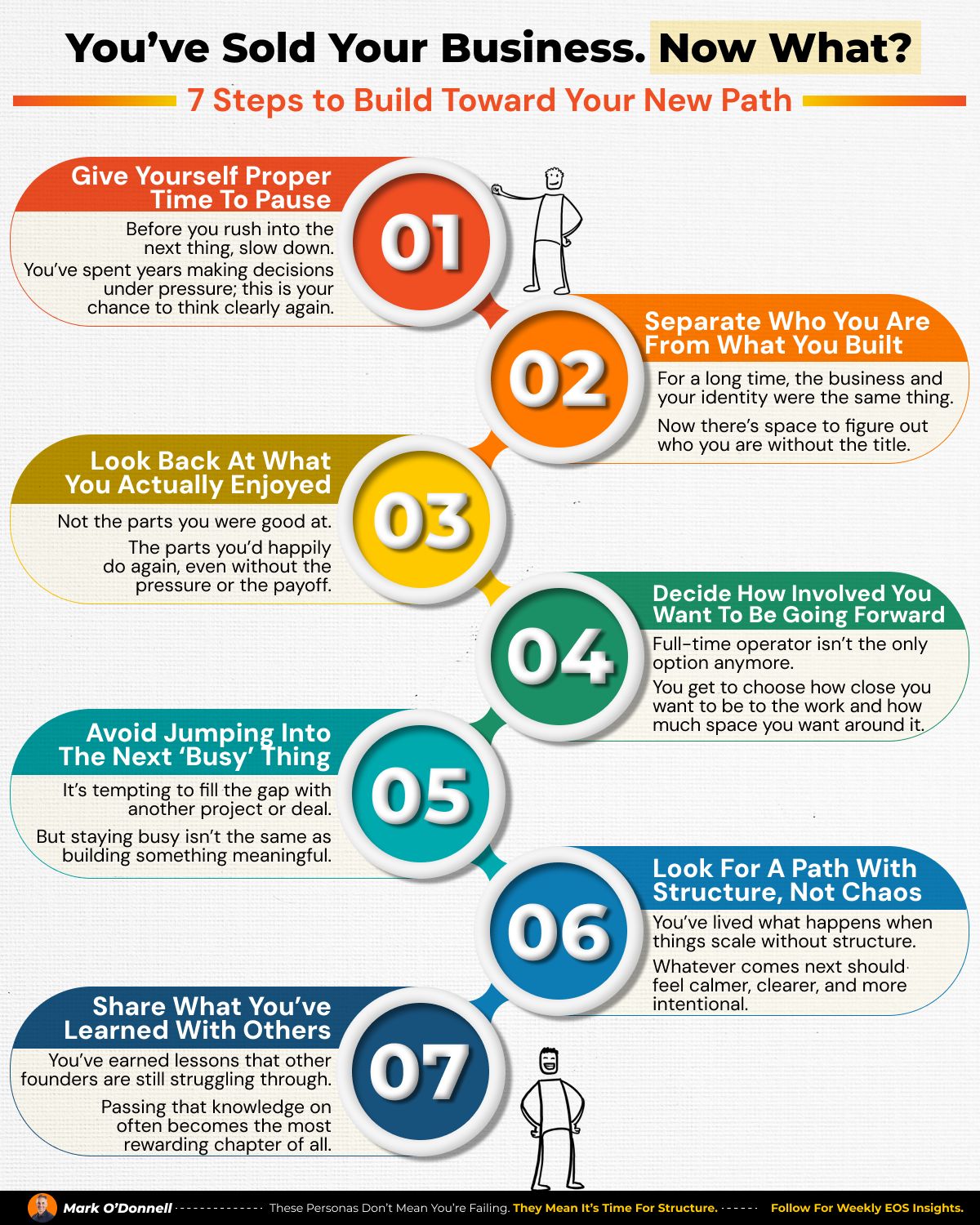
In a recent LinkedIn post, Mark O’Donnell offers guidance to entrepreneurs navigating the complex emotional and practical landscape following the sale of their business. O’Donnell, himself a figure with experience in business exits, addresses the often-unexpected feelings that arise after achieving such a significant milestone.
He highlights the common post-exit experience, noting the blend of relief, pride, and an unidentifiable emotion that can accompany the sale. For many founders, the immediate aftermath brings the pressing question: “What now?” O’Donnell observes that the instinct is often to rush into the next venture, whether it’s another deal, angel investing, or taking on new projects.
“And the temptation is to answer it immediately. Jump into another deal? Start angel investing? Say yes to the first interesting project that comes along? But that’s usually a mistake.”
The Importance of Intentionality Over Reaction
Mark O’Donnell argues that the most beneficial action a founder can take after an exit is to deliberately slow down. This pause, he emphasizes, is not about indefinite inaction but about creating space for intentional planning rather than reactive decision-making. He outlines a seven-step path for founders to consider during this transition period.
A Structured Approach to the Next Chapter
O’Donnell’s recommended steps focus on introspection and deliberate design for the future. The first crucial step, as he outlines, is to:
“Give yourself real time to pause. This might be the first time in a long time you can think clearly. Don’t waste it by rushing into the next thing.”
Following this period of reflection, O’Donnell advises founders to begin separating their identity from the business they built. He points out that for many, the business and personal identity become intertwined over years of dedication. The exit provides an opportunity to rediscover oneself outside of the roles, team, and daily pressures associated with the company.
Furthermore, Mark O’Donnell suggests revisiting what aspects of the entrepreneurial journey were genuinely enjoyable, not just what the founder was good at. This introspection aims to identify activities that can be pursued with enthusiasm, independent of external pressures or financial rewards.
Designing the Future, Not Defaulting
The post continues by encouraging founders to consciously decide their desired level of involvement in future endeavors. O’Donnell asserts that the traditional role of a full-time operator is no longer the only option, and founders have the agency to choose their proximity to work and the amount of personal margin they wish to maintain.
A key piece of advice from O’Donnell is to resist the urge to fill the void with mere activity. He warns against mistaking constant motion for genuine purpose, stressing the importance of intention over superficial busyness. As he puts it:
“Resist the urge to fill the gap with ‘busy.’ Staying in motion feels productive, but it’s not without intention. Don’t mistake another project for a real purpose.”
O’Donnell also advocates for seeking structure rather than chaos in future ventures, drawing from the lessons learned in scaling businesses without robust systems. The goal, according to his analysis, should be to create a future that feels calmer, clearer, and more sustainable.
Leveraging Experience to Guide Others
Finally, Mark O’Donnell proposes that founders consider passing on their hard-earned knowledge. He suggests that guiding other entrepreneurs through challenges already overcome can become a deeply meaningful and rewarding chapter. This approach, he believes, is about designing what comes next rather than passively falling into it. He concludes by pointing founders toward structured paths designed to help other entrepreneurs, offering support and community.
📝 About This Content
This article is based on insights shared by Mark O'Donnell on LinkedIn.
📅 Originally posted on February 2, 2026 | View original post on LinkedIn →