
The rapid advancements in Artificial Intelligence are sparking conversations about its potential to revolutionize various industries, including software development. Recently, Andrej Karpathy’s insightful interview on the Dwarkesh podcast offered a deep dive into the current AI landscape, the journey towards Artificial General Intelligence (AGI), and the emerging concept of agentic coding. These discussions have resonated with many, including myself, prompting a closer examination of AI’s capabilities and limitations in the realm of coding.
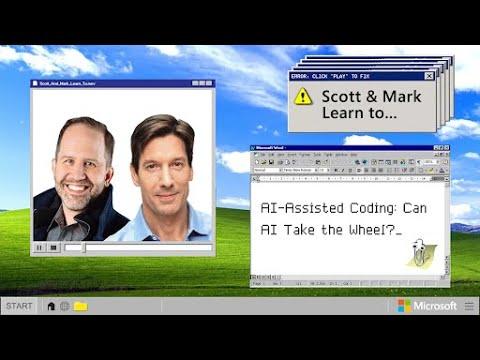
Agentic coding, the idea of AI agents independently handling software development tasks, is a particularly fascinating area. While the potential is significant, it’s crucial to approach this concept with a grounded perspective. My recent conversation with Scott Hanselman on our podcast, “Scott and Mark Learn To…AI-Assisted Coding: Can AI Take the Wheel?”, delved into this topic, exploring concrete examples that highlight both the power and the current boundaries of AI in software development.
Understanding the Current State of AI in Coding
The excitement around AI’s ability to generate code is palpable. Tools powered by large language models can now assist developers in writing, debugging, and even refactoring code with remarkable efficiency. However, the notion that AI can entirely take the wheel and lead to a future of “vibe-only” software development—where intuition and high-level direction suffice without deep technical engagement—is, at present, premature.
The Nuances of Agentic Coding
Agentic coding implies a level of autonomy and understanding that current AI systems are still striving to achieve. While AI can excel at specific, well-defined tasks, complex problem-solving, architectural design, and understanding nuanced business requirements often require human oversight and expertise. Our podcast episode explored scenarios where:
- AI-generated code might lack the robustness or scalability needed for enterprise-level applications.
- The interpretation of abstract requirements into concrete, efficient code remains a significant challenge for AI.
- Debugging complex, emergent issues often requires a developer’s deep understanding of the system’s context and history.
The Path Forward: Collaboration, Not Replacement
The future of software development likely lies in a collaborative model where AI acts as a powerful assistant, augmenting human capabilities rather than replacing them entirely. This partnership allows developers to:
- Focus on higher-level strategic thinking and problem-solving.
- Accelerate development cycles through AI-assisted code generation and testing.
- Reduce the burden of repetitive or mundane coding tasks.
As discussed in my conversation with Scott, while the trajectory of AI development is undeniably exciting, the path to fully autonomous AI-driven software creation is complex and fraught with challenges that require careful consideration. We are not yet at a point where developers can simply dictate requirements and expect a perfect, production-ready application to emerge without significant human involvement.
For a more in-depth exploration of these ideas and practical examples, I encourage you to listen to our latest podcast episode: “Scott and Mark Learn To…AI-Assisted Coding: Can AI Take the Wheel?” where we unpack the current realities and future potential of AI in software development.
📝 About This Content
This article is based on insights shared by Mark Russinovich on LinkedIn.
📅 Originally posted on October 22, 2025 | View original post on LinkedIn →