
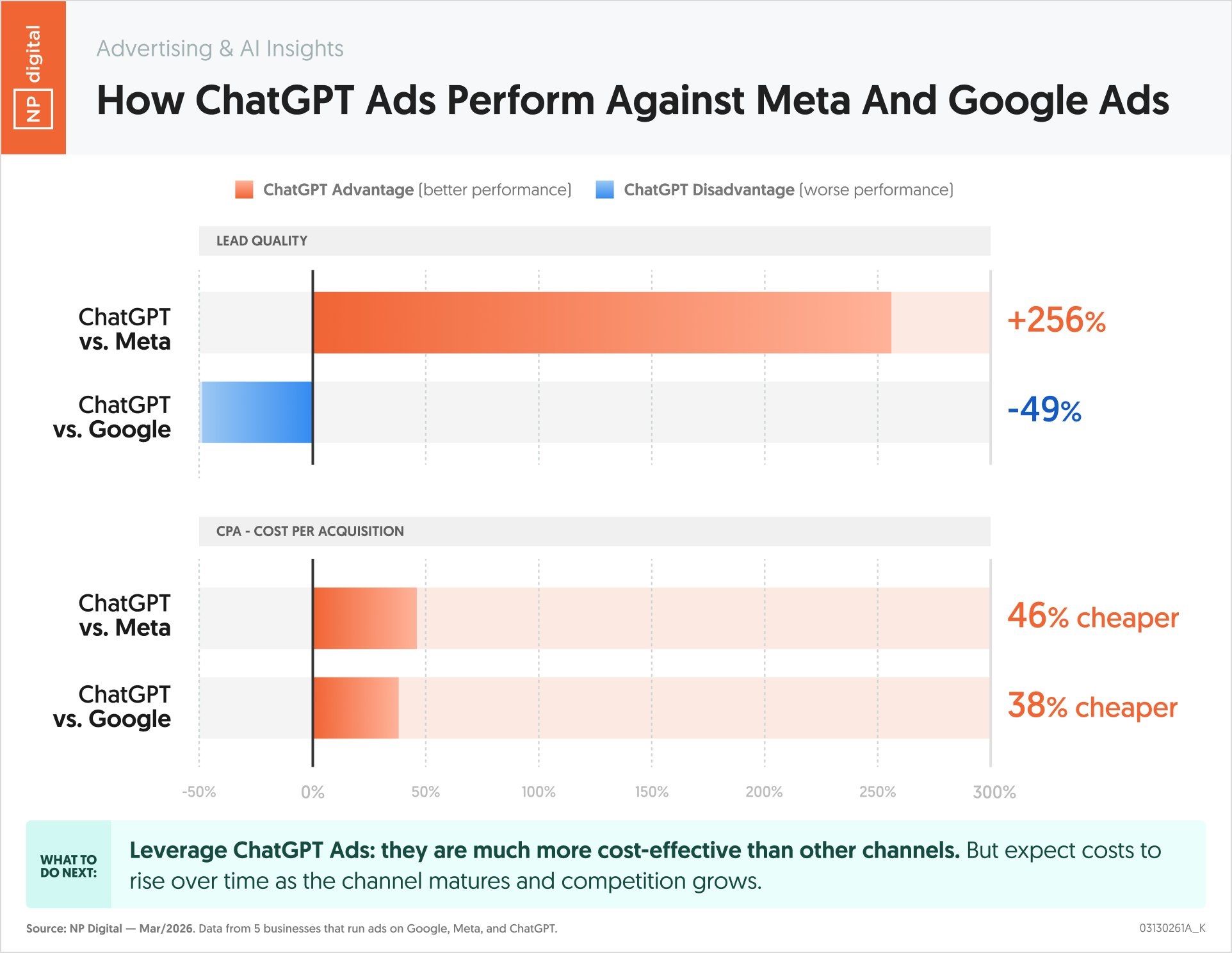
In a recent LinkedIn post, Neil Patel discusses the initial performance data of advertising campaigns leveraging ChatGPT, offering a comparative analysis against established platforms like Meta and Google. Patel emphasizes that while the data set is small, comprising only five businesses, it provides valuable early indicators for advertisers considering this new frontier.
ChatGPT Ads vs. Meta and Google: A Performance Snapshot
Patel’s analysis highlights significant differences in lead quality and cost-per-acquisition (CPA) when comparing ChatGPT-driven ads to those run on Meta and Google. He points out that the insights are derived from businesses that actively utilize all three advertising channels, allowing for a direct comparison.
“Compared to Meta, ChatGPT’s lead quality is roughly 256% higher.”
This substantial increase in lead quality when compared to Meta is a key takeaway from Patel’s observation. As Neil Patel notes, this suggests that the audience reached or the way leads are generated through ChatGPT-based advertising may be more receptive or qualified than those from Meta campaigns. However, he also provides a crucial counterpoint regarding Google’s performance.
Lead Quality and Cost-Per-Acquisition Insights
While ChatGPT ads show promise against Meta, Patel’s data indicates a different story when compared to Google Ads. According to Neil Patel, the lead quality from ChatGPT is considerably lower than that generated through Google’s advertising ecosystem.
“On the flip side, lead quality is 49% lower than Google’s.”
Despite this dip in lead quality relative to Google, Patel introduces a significant positive aspect: cost-effectiveness. He argues that the overall cost-per-acquisition (CPA) for ChatGPT ads is substantially lower than both Meta and Google, making it an attractive option from a budget perspective.
“But on the bright side, due to ad costs, it’s substantially cheaper from a CPA perspective than Meta and Google.”
This cost advantage, as highlighted by Neil Patel, could be a deciding factor for businesses looking to optimize their advertising spend. The implication is that while advertisers might need to adjust expectations or strategies to maintain lead quality comparable to Google, the potential for significant cost savings presents a compelling trade-off.
Early Data and Future Implications
Patel is careful to frame these findings as preliminary, given the limited sample size of five businesses. Nevertheless, these initial results offer a valuable glimpse into the evolving landscape of digital advertising. As Neil Patel suggests, the performance metrics indicate that ChatGPT ads possess unique strengths, particularly in lead quality relative to Meta and in cost-efficiency across the board. Advertisers may need to strategically integrate ChatGPT into their media mix, potentially using it to complement or optimize campaigns on platforms like Google and Meta, rather than as a complete replacement, at least based on this early data.
📝 About This Content
This article is based on insights shared by Neil Patel on LinkedIn.
📅 Originally posted on March 18, 2026 | View original post on LinkedIn →