
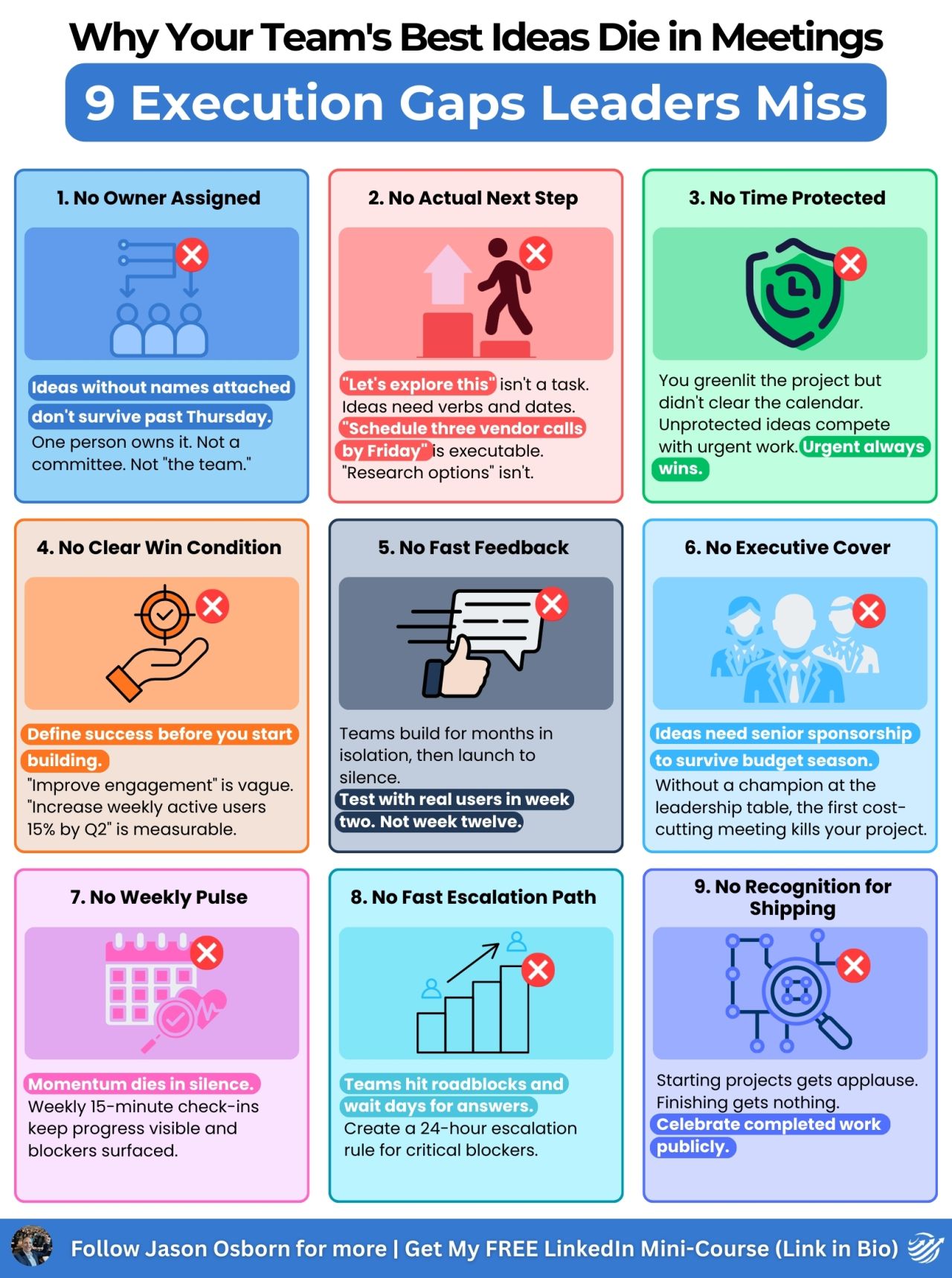
In a recent LinkedIn post, Jason Osborn tackles a common frustration in the business world: why promising ideas often fail to materialize. He argues that the death of good ideas is rarely due to their inherent quality, but rather due to critical execution gaps that leaders frequently overlook. Osborn lays out nine specific pitfalls that prevent innovation from moving from the meeting room to market.
Osborn begins by stating a core problem: “Great ideas come out of every meeting. Most of them die before Thursday.” He contends that the absence of clear ownership is a primary culprit. “Ideas without names attached don’t survive past Thursday. One person owns it. Not a committee. Not ‘the team.’ If everyone’s responsible, no one is,” Osborn writes.
The Criticality of Clear Ownership and Actionable Steps
A central theme in Osborn’s analysis is the need for unambiguous accountability and concrete next steps. He criticulates vague action items, emphasizing that phrases like “Let’s explore this” are insufficient. Instead, Osborn advocates for actionable tasks with defined outcomes:
“Ideas need verbs and dates. ‘Schedule three client calls by Friday’ is executable. ‘Research options’ isn’t.”
This highlights a recurring issue where good intentions lack the structured planning required for execution. Without clear, measurable objectives and defined timelines, even the most brilliant concepts can falter.
Protecting Ideas from Competing Priorities
Osborn also points out the struggle of unprotected ideas against the tide of urgent, everyday tasks. He notes that leadership might approve a project but fail to allocate the necessary time for its development. “You greenlit the project but didn’t clear the calendar. Unprotected ideas compete with urgent work. Urgent always wins,” he explains. This lack of dedicated time and resources means that innovative projects are easily sidelined.
Defining Success and Fostering Early Feedback
Furthermore, Osborn stresses the importance of defining success upfront and incorporating rapid feedback loops. He argues against building solutions in isolation for extended periods. “Teams build for months in isolation, then launch to silence. Test with real users in week two. Not week twelve,” Osborn advises, underscoring that early validation is crucial for saving time and resources. He also touches upon the necessity of executive sponsorship to shield ideas from budget cuts and the need for regular progress monitoring.
“If you’re not tracking it weekly, it’s not actually a priority.”
According to Osborn, a lack of a fast escalation path for blockers and insufficient recognition for completing projects also contribute to idea mortality. He concludes by reiterating that the failure of great ideas stems from execution, not from a lack of quality. “The best ideas don’t die because they’re bad. They die because execution wasn’t protected,” he states.
Osborn encourages readers to identify these gaps within their own organizations, suggesting that addressing these nine areas can significantly improve the likelihood of successful project completion.
📝 About This Content
This article is based on insights shared by Jason Osborn on LinkedIn.
📅 Originally posted on February 3, 2026 | View original post on LinkedIn →