
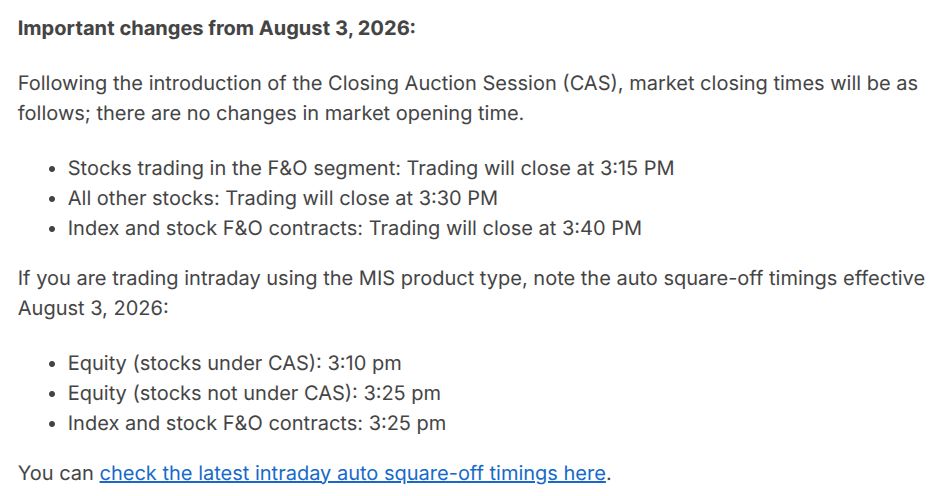
In a recent LinkedIn post, Nithin Kamath, founder of Zerodha, discusses a significant upcoming change in the Indian stock market: the introduction of a Closing Auction Session (CAS) for stocks with Futures and Options (F&O) contracts. Kamath clarifies that while not a new concept globally, with exchanges like the NYSE and LSE already employing similar mechanisms, this marks a shift from India’s current method of determining closing prices based on the volume-weighted average price (VWAP) of trades in the last 30 minutes.
Understanding the New Closing Auction Session
Kamath explains that under the new CAS system, buy and sell orders will be collected and then matched at a single equilibrium price. This is intended to address two primary concerns within the market.
Addressing Passive Fund Execution and Price Manipulation
Firstly, Kamath highlights the challenge faced by passive funds that track indices. These funds often need to execute large orders near the market close to align with the index’s closing price. He notes:
“These orders can move prices while they are being executed, increasing tracking error.”
This price movement can lead to discrepancies in how closely the fund tracks its underlying index. Secondly, Kamath points out that large orders placed in the final minutes of trading can disproportionately influence stock prices and, consequently, the indices themselves. He elaborates on the potential for market manipulation:
“There have been concerns that this can be used to push indices towards certain closing levels.”
The CAS aims to mitigate this by pooling all orders and matching them at a single price, making it more difficult to arbitrarily influence closing prices. According to Kamath, this pooling mechanism inherently makes manipulation harder.
Market Timings and Brokerage Impact
The introduction of CAS will also lead to a more complex schedule for market closing times, a point Nithin Kamath acknowledges will require clear communication.
Divergent Market End Times
Kamath breaks down the new timings:
- Stocks with F&O contracts will cease continuous trading at 3:15 PM and transition into CAS.
- All other stocks will continue their continuous trading session until 3:30 PM.
- Index and stock F&O contracts will have the latest trading cutoff, extending until 3:40 PM.
This differentiation in closing times, as Kamath points out, will be a key area for client communication. He anticipates:
“The more immediate challenge, though, will be explaining why different parts of the market now appear to close at different times. We’re braced for the flood of questions.”
Potential Revenue Impact for Brokers
On a more direct business level, Kamath candidly discusses the potential impact on brokerage income. As broking firms are now publicly listed and under greater scrutiny, he states:
“Now that broking is listed and people are looking more closely at the business, the honest bit: this will probably knock off some revenue, perhaps around 1–5% of brokerage income.”
Despite the revenue implications, Kamath frames the change as a necessary step towards market efficiency and fairness. He directs readers to a blog post for further details.
📝 About This Content
This article is based on insights shared by Nithin Kamath on LinkedIn.
📅 Originally posted on July 28, 2026 | View original post on LinkedIn →