
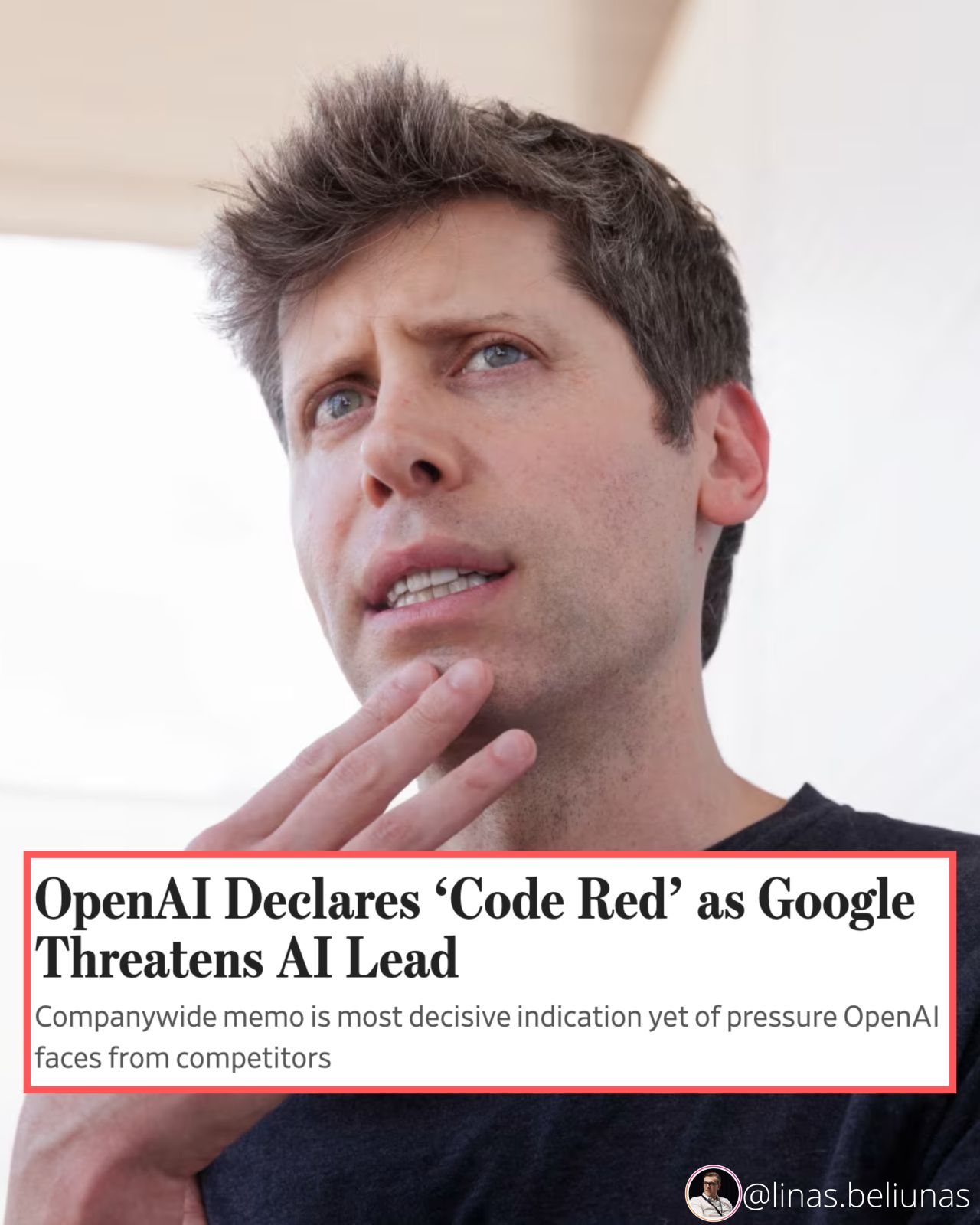
In a recent LinkedIn post, Linas Beliūnas discusses a significant shift in the artificial intelligence landscape, reporting on what he describes as a “Code Red” situation at OpenAI, mirroring an earlier response from Google.
Beliūnas highlights a report indicating that OpenAI has paused various projects, including ads and side ventures, to focus intensely on improving ChatGPT. This move, he suggests, is a direct response to Google’s Gemini 3 model reportedly surpassing GPT-5 in key areas like mathematics, coding, and reasoning.
“The unthinkable just happened: 3 years after Google hit “Code Red” over ChatGPT, OpenAI’s Sam Altman just hit Code Red over Google 😳”
The Stakes for OpenAI
According to Linas Beliūnas, the pressure on OpenAI is immense, stemming from its substantial valuation and significant operational costs. He points out the company’s reported $500 billion valuation and an $8 billion annual burn rate, juxtaposed with the rapid advancements of Google’s AI models.
Beliūnas emphasizes the critical juncture OpenAI finds itself in:
“$500 billion valuation. → $8 billion annual burn. → And Google’s AI models are climbing fast.”
He argues that this situation necessitates a strategic regrouping, with the company reportedly preparing to release a new “reasoning model” in an effort to regain its perceived leadership in the AI space.
A Historical Parallel and the Future of AI
In his analysis, Linas Beliūnas draws a parallel between OpenAI’s current challenges and historical “code red” events in the tech industry. He posits that such moments typically lead to either a significant comeback or a decline.
Beliūnas notes the poetic nature of this development, where the company that once caused Google to react is now facing its own existential challenge:
“The same company that made Google panic in 2022 is now fighting to prove it hasn’t peaked in 2025.”
He concludes by reflecting on the dynamic nature of AI development, suggesting that the industry is not merely repeating history but actively evolving through continuous learning and retraining.
“Turns out, history doesn’t repeat itself in AI – it retrains.”
Linas Beliūnas suggests that OpenAI’s response in the coming weeks will be crucial in determining its future trajectory, framing the current situation as a defining moment for one of the world’s leading AI companies.
📝 About This Content
This article is based on insights shared by Linas Beliūnas on LinkedIn.
📅 Originally posted on December 2, 2025 | View original post on LinkedIn →