
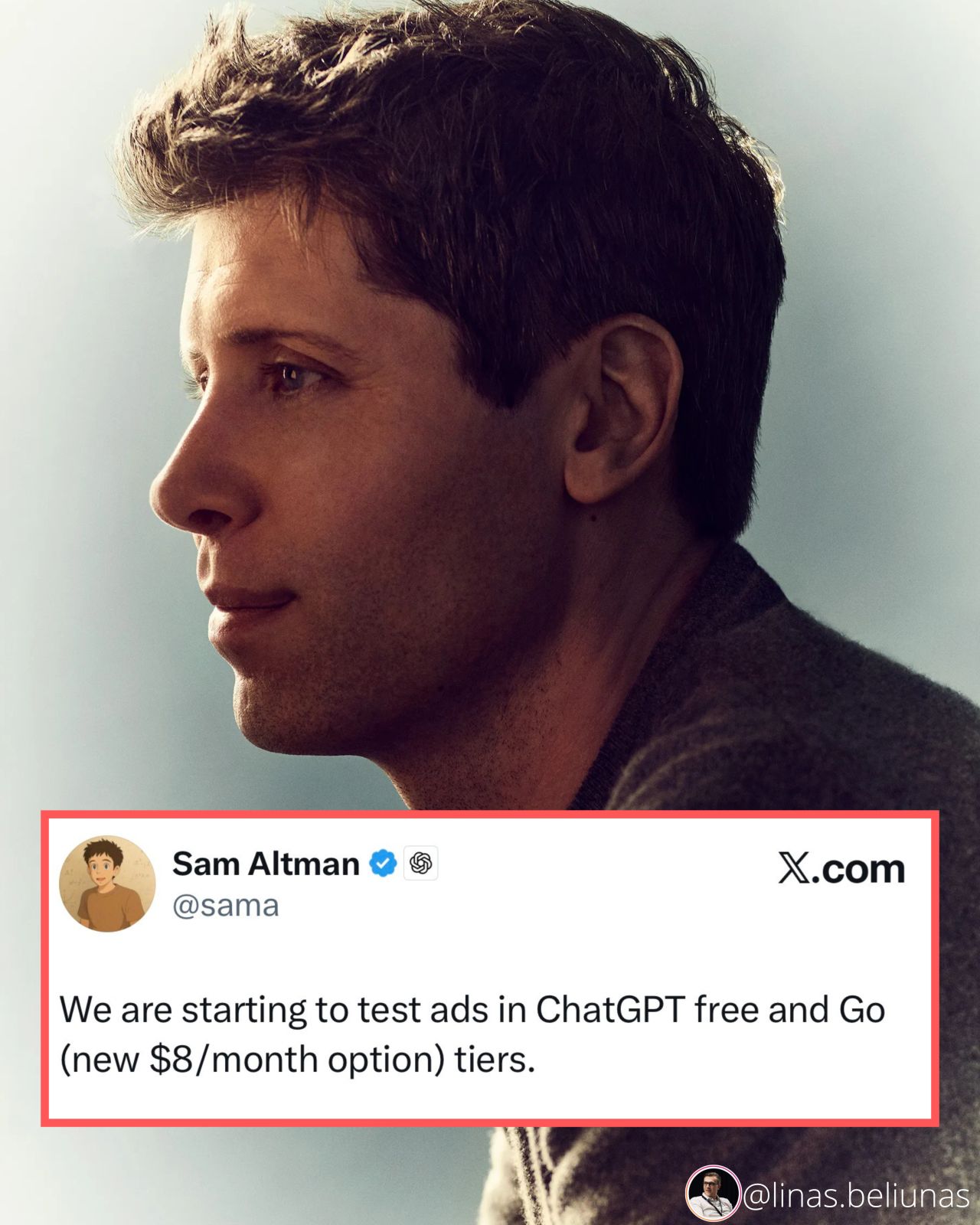
In a recent LinkedIn post, Linas Beliūnas discusses OpenAI’s controversial move to introduce advertising into ChatGPT, exploring the underlying financial pressures and strategic implications of this decision. Beliūnas frames the development not as a pursuit of Artificial General Intelligence (AGI), but rather ‘Ad-Generated Income’ (AGI), highlighting the stark reality of the company’s business model challenges.
Beliūnas points out the significant gap between OpenAI’s massive user base and its paying subscribers, a disparity that strains its considerable operational costs. He notes the sheer scale of the user base and the financial realities underpinning AI development.
“800M+ weekly users → Only 5% pay → AI Compute costs are exploding → Even $200/month Pro users lose money”
According to Beliūnas, the economics of scaling AI through subscriptions are unsustainable due to compounding inference costs. This financial reality, he argues, has pushed OpenAI towards a model that is proven to scale: advertising.
The Inevitable Pivot to Advertising
The introduction of ads, Beliūnas suggests, is a necessary step for OpenAI to navigate its escalating costs. He observes that this strategy mirrors the path taken by many successful tech platforms.
The post details the specifics of how these ads will be presented:
- At the bottom of responses
- Only for logged-in adults in the US
- On Free and the new $8 Go plan
- Clearly labeled and dismissible
Beliūnas contends that this move is a pragmatic response to a business model that struggles with profitability at scale.
“Subscriptions don’t scale when inference costs compound.”
He further elaborates on the broader industry trend, stating:
“The same escape hatch every tech, FinTech, and marketplace platform eventually takes.”
AGI vs. Ad-Generated Income
Beliūnas draws a parallel between the pursuit of Artificial General Intelligence (AGI) and the newly introduced ‘Ad-Generated Income’ (AGI). This clever wordplay underscores his assertion that the immediate financial needs are driving OpenAI’s decisions, potentially overshadowing the long-term vision of AGI.
He posits that companies face a fundamental choice when confronted with high operational costs and a low conversion rate for paid services:
“You either die chasing AGI or live long enough to start selling ads.”
This perspective suggests that the advertising model, while perhaps controversial, is a survival mechanism for companies like OpenAI that operate at a massive scale but struggle with direct monetization of their core, cost-intensive technology. Beliūnas’s analysis provides a critical look at the business decisions shaping the future of AI accessibility and monetization.
📝 About This Content
This article is based on insights shared by Linas Beliūnas on LinkedIn.
📅 Originally posted on January 17, 2026 | View original post on LinkedIn →