
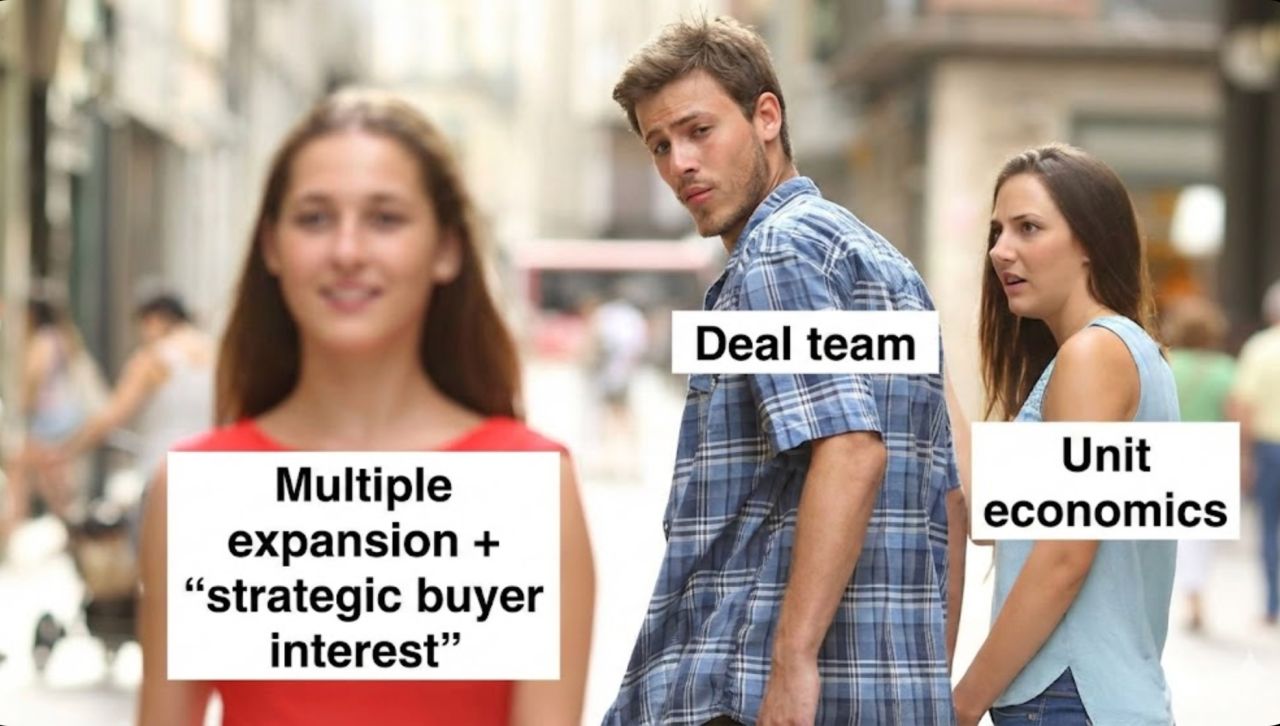
In a recent LinkedIn post, Lee McCabe offers a stark assessment of the private equity landscape, arguing that the era of easy returns driven by financial maneuvers is over. McCabe contends that a recent period of high returns masked underlying weaknesses, and the current economic climate is forcing a return to fundamentals.
McCabe begins by likening the recent past in private equity to a rising tide that lifted all boats, suggesting that many firms are now exposed as not having sustainable business models. He highlights a common reliance on what he terms a “comfort blanket” in deal team presentations.
“Every deal team has the same comfort blanket in the IC deck: multiple expansion plus strategic buyer interest, because nothing says ‘value creation’ like hoping the market gets horny again.”
The post references Apollo’s Market Insight, “Private Equity Returns to Its Roots,” to support the claim that a significant portion of value creation between 2010 and 2021 was attributable to factors largely outside of manager control, such as leverage and multiple expansion. As McCabe points out:
“from 2010 to 2021, roughly 66% of value creation came from leverage and multiple expansion, stuff largely outside the manager’s control.”
The End of Cheap Money and Easy Exits
McCabe argues that the conditions that allowed for such financial engineering – cheap money and a forgiving market – are no longer present. He criticizes the past reliance on “hoping the market gets horny again” and the casual use of financial concepts like WACC as mere trends rather than rigorous financial principles.
According to McCabe, the current environment presents significant challenges:
- Exits are becoming more difficult to achieve.
- Financing costs have become a substantial factor.
- Buyers are demanding concrete proof of value, not just optimistic projections.
“That party trick worked when money was cheap and everyone pretended a WACC was a vibe,” McCabe writes. “Now exits are tighter, financing costs are real, and buyers want proof not poetry.”
Focusing on Controllable Unit Economics
In contrast to the external factors that previously drove returns, McCabe champions the importance of unit economics – the fundamental, operational aspects of a business that are within a company’s direct control. He laments that these critical, albeit less glamorous, metrics have been neglected.
He elaborates on the core mechanics that truly determine business success across various sectors:
Key Unit Economic Indicators
- Acquisition cost versus payback period.
- Gross margin considering the true cost to serve.
- Customer churn and return rates.
- Asset utilization and operational throughput.
- Management of credit losses.
- Minimizing fulfillment leakage.
- Controlling support load.
- Preventing discounting creep.
McCabe asserts that the real value creation comes not from abstract strategic discussions, but from building a robust operational foundation. “You don’t earn a premium multiple by workshopping ‘strategic options’,” he states. “You earn it by building a business that doesn’t leak cash between demand and delivery, week after week, with owners, metrics, and consequences.”
Lee McCabe’s analysis suggests a fundamental shift is required in private equity, moving away from financial wizardry towards diligent operational management and a deep understanding of the unsexy but vital mathematics that underpin profitable growth.
📝 About This Content
This article is based on insights shared by Lee McCabe on LinkedIn.
📅 Originally posted on February 6, 2026 | View original post on LinkedIn →