
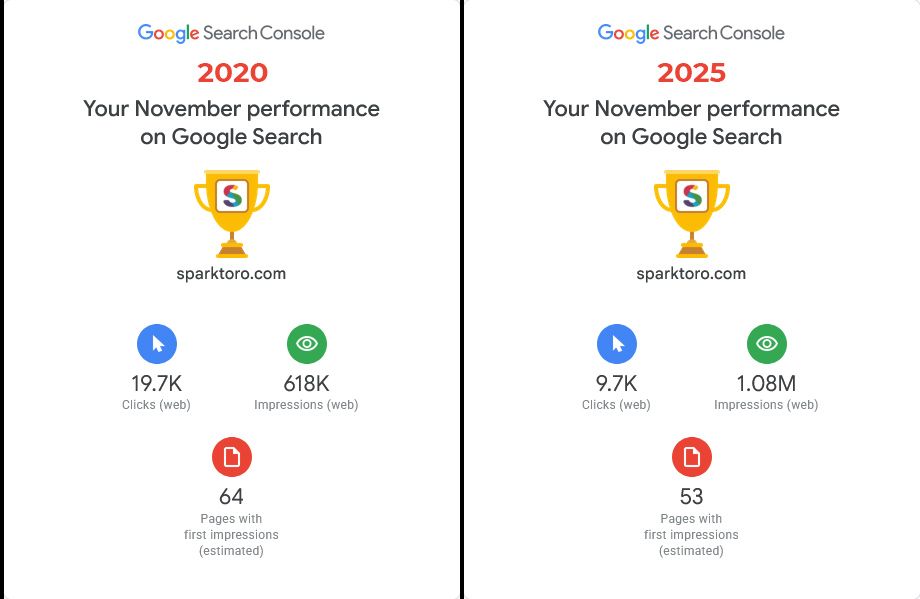
In a recent LinkedIn post, Rand Fishkin discusses a significant shift he’s observed in search engine performance, particularly concerning the “zero-click” trend and its implications for businesses. Fishkin, a prominent figure in the marketing and SEO community, shared his observations based on his own company’s data, prompting a broader conversation about the evolving nature of search engine results pages (SERPs) and their impact on website traffic and revenue.
The “Zero-Click” Phenomenon in Search
Fishkin’s core argument centers on the increasing tendency for search engines to provide direct answers or rich snippets that satisfy user queries without requiring a click-through to a website. He illustrates this point with a practical instruction to his audience:
“Open up your email. Search ‘your november search performance for'”
By encouraging readers to examine their own search data, Fishkin aims to demonstrate that this trend is not an isolated incident but a widespread phenomenon. He further elaborates on his company’s experience, stating:
“E.G. our impressions have doubled while clicks fell by more than half.”
This stark contrast between rising impressions and falling clicks is a key indicator of the “zero-click” trend. As Fishkin notes, while the number of times content is shown (impressions) has increased, the actual engagement through clicks has diminished significantly. This suggests that users are finding the information they need directly on the search results page itself, whether through featured snippets, knowledge panels, or other integrated features.
Rethinking Search Traffic as a Metric
Revenue Growth Despite Declining Clicks
Perhaps the most counterintuitive aspect of Fishkin’s observation is the simultaneous rise in revenue, even as clicks from search decline. He points out this apparent paradox:
“And yet, revenue is more 10X what it was 5 years ago.”
This suggests that while traditional metrics like search clicks might be declining in importance, they may no longer be the sole or even primary indicator of business success derived from search engines. Fishkin provocatively questions the long-held assumption that search traffic is a direct proxy for business value:
“Was search traffic always a vanity metric? ¯_(ツ)_/¯ 😏”
According to Fishkin, this observation challenges the conventional wisdom in SEO and digital marketing, where a high volume of search traffic has historically been equated with business growth and success. His post implies that businesses may need to re-evaluate their understanding of what constitutes effective search engine performance. The focus might need to shift from merely driving clicks to optimizing for visibility and brand presence directly on the SERP, or to understanding how search influences other, more direct revenue-generating channels.
Implications for Marketers and Businesses
Rand Fishkin’s insights serve as a critical reminder for marketers and business leaders to adapt their strategies. The data suggests that a sole reliance on driving organic search traffic to a website might be an outdated approach. Instead, optimizing for SERP visibility, understanding user intent that can be satisfied directly on Google, and exploring alternative attribution models for revenue become increasingly important.
As Fishkin’s post indicates, the landscape of search is continually evolving. Businesses that can recognize and adapt to these shifts, focusing on overall brand presence and value rather than just click-based metrics, are likely to be better positioned for sustained growth in the years to come.
📝 About This Content
This article is based on insights shared by Rand Fishkin on LinkedIn.
📅 Originally posted on December 4, 2025 | View original post on LinkedIn →